
World News
Why the rebel soldiers failed where others in the region succeeded

Paul MellyWest Africa analyst

 AFP via Getty Images
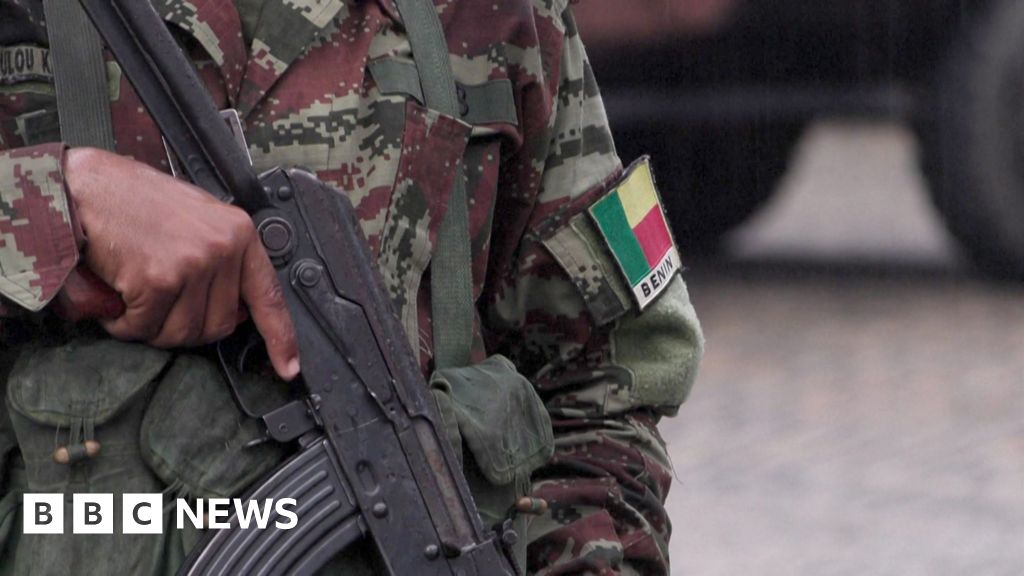
Had last week’s coup attempt in Benin been successful, it would have become the ninth to take hold in the region in the last five years alone.
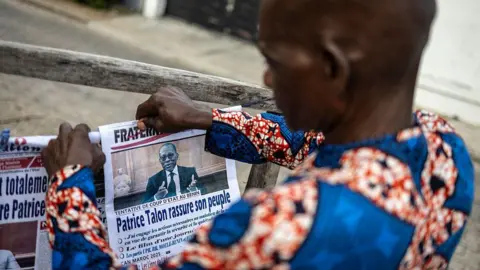
Just a few days after soldiers took power in Guinea-Bissau while a presidential election vote count was still under way, leaders of the West African grouping Ecowas rapidly concluded that Sunday’s attempted overthrow of Benin’s President Patrice Talon was one destabilising step too far.
In support of his government, Nigerian warplanes bombarded mutinous soldiers at the national TV and radio station and a military base near the airport in Cotonou, the largest city.
Ecowas also announced the deployment of ground troops from Ghana, Nigeria, Ivory Coast and Sierra Leone to reinforce the defence of constitutional order.
This is a region that has been shaken by repeated coups since 2020, and which little more than 10 months ago saw the putschist regimes in Mali, Burkina Faso and Niger completely withdraw their countries from Ecowas – the Economic Community of West African States – of which they had all been founding participants 50 years ago.
So, faced with the prospect that yet another civilian government might be overturned by discontented soldiers, the presidents of the remaining Ecowas member states rapidly reached the conclusion that the attempted coup in Cotonou could not be allowed to succeed.
Learning from past mistakes
Having fought off early morning putschist attacks on Talon’s home and the presidency offices, loyalist forces had already reaffirmed government control across the city, locking down the main central administrative district.
But it was proving hard to break down the last-ditch resistance of rebel troops who had shown they were ready to use lethal force without regard for civilians.
In response, Nigeria’s President Bola Tinubu, Benin’s eastern neighbour and much the largest military power in the region, authorised air strikes, while Ecowas leaders decided to despatch ground troops the same day.
Among those sending forces is Ghana’s President John Mahama, who leads a resilient democracy but has made friendly diplomatic overtures to the Sahelian military regimes.
In acting so quickly, Ecowas has perhaps learned a lesson from its misjudged response to the 2023 coup in Niger.
On that occasion it was not practically organised to intervene militarily in the hours after the elected head of state, Mohamed Bazoum, had been detained by coup leaders – the only moment, perhaps, when a rapid commando raid to rescue him and secure key buildings might have had any chance of success.
By the time the bloc had threatened intervention and begun to plan it, the chance had gone: the new junta had consolidated control over the Nigérien army and mobilised popular opinion in its support.
Faced with the prospect of intervention becoming full-scale war, and under strong domestic popular pressure to avoid any such bloodbath, Ecowas leaders backed off – opting to rely on sanctions. And when those also proved counter-productive, they settled for the diplomatic path alone.
This time around, in Benin, the situation was quite different: Talon was still in full control, even if some would-be putschists were still resisting. So he, as the internationally recognised president, could legitimately request support from fellow member countries in the regional bloc.
And this seems to have had popular support in Cotonou.
Many Béninois citizens do have grievances against the current government, notably over the exclusion of Les Démocrates, the main opposition party, from the forthcoming presidential election.
But there is a strong culture in Benin of trying to achieve change through political and civil society action, rather than force.
Béninois are rightly proud of their country’s role as the pioneering instigator of the wave of peaceful mass protest and democratisation that swept across francophone Africa in the early 1990s.
 BTV
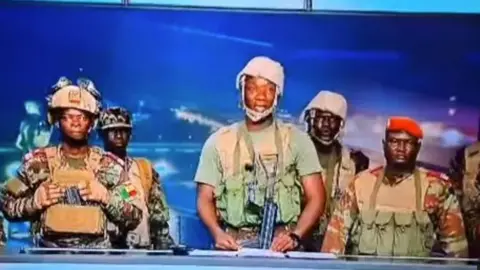
BTVWhile the complaints against Talon aired by the would-be putschists during their brief appearance on national television are widely shared, there has been absolutely no sign of any popular support for their attempt to get rid of the government by force.
So Benin represented a particularly favourable context for a forceful Ecowas intervention in defence of constitutional civilian rule.
Indeed, if anything, the coup-plotters are likely to become the target of growing public anger as news of casualties circulates. At least one civilian – the wife of Talon’s key military adviser – was killed.
In recent days two top military officials abducted during Sunday’s failed coup attempt in Benin have been rescued, but security forces are still searching for the coup leader Lt Col Pascal Tigri and other plotters.
Simmering grievances
This was just the latest in a string of coup attempts across the region, though most of the others have in fact succeeded.
They have all occurred in a context of fragility and pressure across West Africa at a time of Islamist violence across the Sahel, now spreading into the northern regions of many coastal countries.
There is disenchantment with traditional political elites. Even where economies are growing well, a desperate shortage of jobs and viable livelihoods, for the region’s rapidly growing young population.
However, while the regional context is widely shared, the driving factors for the coups are often local – specific to each country.
The lack of popular support for the Cotonou putschists stands in stark contrast to the mood on the streets of Conakry, the Guinean capital, in September 2021, when the commander of special forces, Col Mamady Doumbouya led the overthrow of then-President Alpha Condé.
Like Talon, Condé had first been democratically elected but later secured re-election in questionable conditions, and presided over a significant erosion of political freedoms. Yet in Guinea, Condé had presided over the violent abuse on a far greater scale than in Benin.
In addition, Condé had then strong-armed his way to a third term aged 83. Whereas the 67-year-old Talon has promised to step down next April, albeit having adjusted the electoral rules to almost guarantee an easy victory for his chosen successor, Finance Minister Romuald Wadagni.
Another key difference is Condé’s deeply disappointing economic track record, whereas Talon has presided over strong growth and improving services.
Further north, the wave of coups in the Sahelian countries in recent years were also driven by local conditions.
In Mali and Burkina Faso, military commanders had grown frustrated with the weak leadership elected presidents were providing in the campaign against Islamists. In both countries, troops had repeatedly suffered brutal losses while their civilian governments appeared incapable of mobilising the extra weapons or sometimes even food that the troops needed.
There was also deep resentment at France’s inability to bring the jihadists to heel, despite the high-tech weaponry at the disposal of its forces then deployed across the Sahel.
Also in Mali, some nationalist sections of political and military opinion were frustrated with the functioning of a 2015 peace agreement with former Tuareg separatists in the far north, overseen by UN troops. Hardliners even accused French forces of actively preventing Bamako from deploying national army units to the north.
In Niger, the circumstances surrounding the 2023 putsch were equally distinctive.
Bazoum’s political support had been eroded by his very publicly close partnership with France, and particularly his request that Paris provide troops to defend the north-western border from incursions by Mali-based jihadists.
However, his vocal support for judges probing a corruption scandal in defence procurement also risked alienating powerful elements of the military.
The coup that followed soon afterwards in Gabon, in August 2023, was similarly the product of local frustrations. In this case the opaque management of election results that saw an implausible victory awarded to President Ali Bongo, in frail health after a slow recovery from a stroke.
So, circumstances vary widely. And recent events confirm the trend.
The region certainly does face a real crisis of security and, in many countries, politics or development too.
But national conditions are often the major driver for each upheaval or coup attempt.
Many suspect the military takeover in Guinea-Bissau aimed to forestall a possible opposition election victory.
Whereas the Benin rebels seem to have been motivated by a mix of army grievances, and broader political and economic complaints.
But they strikingly misjudged the popular appetite in Cotonou for any violent or radical system change.
You may also be interested in:
 Getty Images/BBC
www.bbc.com

The US Coast Guard is in “active pursuit” of another vessel in international waters near Venezuela, an official has told the BBC’s US partner CBS News, as tensions in the region continue to escalate.
US authorities have already seized two oil tankers this month – one of them on Saturday.
Sunday’s pursuit related to a “sanctioned dark fleet vessel that is part of Venezuela’s illegal sanctions evasion”, a US official said. “It is flying a false flag and under a judicial seizure order.”
Washington has accused Venezuela of using oil money to fund drug-related crime, while Venezuela has described the tanker seizures as “theft and kidnapping”.
US President Donald Trump last week ordered a “blockade” of sanctioned oil tankers entering and leaving the country.
Venezuela – home to the world largest proven oil reserves – has accused the Trump administration of trying to steal its resources.
US authorities have not yet officially confirmed Sunday’s pursuit, and the exact location and name of the tanker involved is not yet known.
As of last week, more than 30 of the 80 ships in Venezuelan waters or approaching the country were under US sanctions, according to data compiled by TankerTrackers.com.
Saturday’s seizure saw a Panamanian-flagged tanker boarded by a specialised tactical team in international waters.
That ship is not on the US Treasury’s list of sanctioned vessels, but the US has said it was carrying “sanctioned PDVSA oil”. In the past five years the ship also sailed under the flags of Greece and Liberia, according to records seen by BBC Verify.
“These acts will not go unpunished,” the Venezuelan government said in response to Saturday’s incident. It added that it intended to file a complaint with the UN Security Council and “other multilateral agencies and the governments of the world”.
Venezuela is highly dependent on revenues from its oil exports to finance its government spending.
In recent weeks, the US has built up its military presence in the Caribbean Sea and has carried out deadly strikes on alleged Venezuelan drug-smuggling boats, killing around 100 people.
It has provided no public evidence that these vessels were carrying drugs, and the military has come under increasing scrutiny from Congress over the strikes.
The Trump administration has accused Venezuelan President Nicolás Maduro of leading a designated-terrorist organisation called Cartel de los Soles, which he denies.
www.bbc.com

Yogita LimayeSouth Asia and Afghanistan correspondent in Myanmar

 BBC
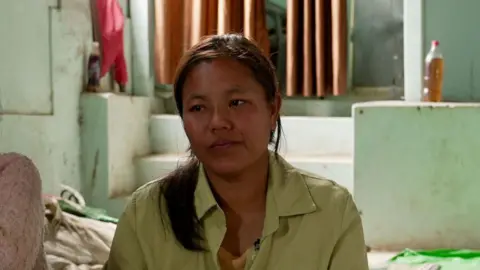
BBCLate one night last month Iang Za Kim heard explosions in a neighbouring village, then fighter jets flying overhead. She ran out of her home to see smoke rising from a distance.
“We were terrified. We thought the junta’s planes would bomb us too. So we grabbed what we could – some food and clothes and ran into the jungles surrounding our village.”
Iang’s face quivers as she recounts the story of what happened on 26 November in K-Haimual, her village in Myanmar’s western Chin State, and then she breaks down.
She’s among thousands of civilians who’ve fled their homes in recent weeks after the Burmese military launched a fierce campaign of air strikes, and a ground offensive in rebel-held areas across the country, to recapture territory ahead of elections starting on 28 December.
Four other women sitting around her on straw mats also start crying. The trauma of what they’ve gone through to make it to safety is clearly visible.
While the air strikes were the immediate cause for Iang to flee, she also doesn’t want to be forced to participate in the election.
“If we are caught and refuse to vote, they will put us in jail and torture us. We’ve run away so that we don’t have to vote,” she says.
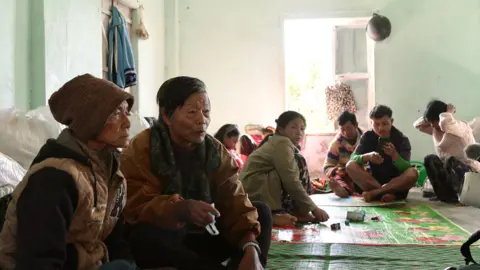
Some from Chin state have described the junta’s latest offensive as the fiercest it has launched in more than three years.
Many of the displaced have sought refuge in other parts of the state. Iang is among a group that crossed the border into India’s Mizoram state. Currently sheltered in a rundown badminton court in Vaphai village, the group’s few belongings they were able to carry are packed in plastic sacks.
Indian villagers have given them food and basic supplies.
Ral Uk Thang has had to flee his home at the age of 80, living in makeshift shelters in jungles for days, before finally making it to safety.
“We’re afraid of our own government. They are extremely cruel. Their military has come into our and other villages in the past, they’ve arrested people, tortured them, and burned down homes,” he says.
It isn’t easy to speak to Burmese civilians freely. Myanmar’s military government does not allow free access in the country for foreign journalists. It took over the country in a coup in February 2021, shortly after the last election, and has since been widely condemned for running a repressive regime that has indiscriminately targeted civilians as it looks to crush the armed uprising against it across Myanmar.
During its latest offensive, the junta last week targeted a hospital in Rakhine State, just south of Chin State. Rebel groups in Rakhine say at least 30 people were killed and more than 70 injured.
The Chin Human Rights Organisation says that since mid-September at least three schools and six churches in Chin State have been targeted by junta airstrikes, killing 12 people including six children.
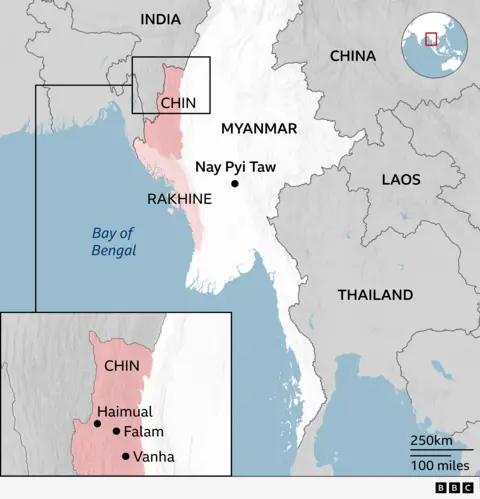
The BBC has independently verified the bombing of a school in Vanha village on 13 October. Two students –Johan Phun Lian Cung, who was seven, and Zing Cer Mawi, 12 – were killed as they were attending lessons. The bombs ripped through their classrooms injuring more than a dozen other students.
Myanmar’s military government did not respond to the BBC’s questions about the allegations.
This is the second time Bawi Nei Lian and his young family – a wife and two young children – have been displaced. Back in 2021, soon after the coup, their home in Falam town was burnt down in an air strike. They rebuilt their lives in K-Haimual village. Now they’re homeless again.
“I can’t find the words to explain how painful and hard it is and what a difficult decision it was to make to leave. But we had to do it to stay alive,” he says.
“I want the world to know that what the military is claiming – that this election is free and fair – this is absolutely false. When the main political party is not being allowed to contest the election, how can there be genuine democracy?”
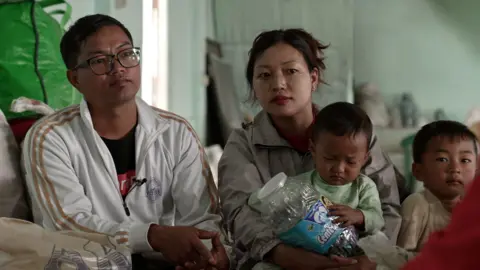
The National League for Democracy party, led by Aung San Suu Kyi, which won landslides in the two elections prior to the coup, will not be contesting as most of its senior leaders including Suu Kyi are in jail.
“We don’t want the election. Because the military does not know how to govern our country. They only work for the benefit of their high-ranking leaders. When Daw Aung San Suu Kyi’s party was in power, we experienced a bit of democracy. But now all we do is cry and shed tears,” says Ral Uk Thang.
Iang Za Kim believes the election will be rigged. “If we voted for a party not allied with the military, I believe they will steal our votes and claim we voted for them.”
The election will take place in phases, with a result expected around the end of January. Rebel groups have called it a sham.
At the base of the Chin National Front in Myanmar, the most prominent rebel group operating in the state, the group’s Vice Chairman Sui Khar says: “This election is only being held to prolong military dictatorship. It’s not about the people’s choice. And in Chin State, they hardly control much area, so how can they hold an election?”
He points out the areas where the most intense fighting is ongoing on a map and tells us nearly 50 rebel fighters have been injured in just the past month. There have been deaths too, but so far the groups have not released a number.
“There are columns of hundreds of soldiers trying to advance into the northern part of Chin state from four directions,” Sui Khar says. “The soldiers are being supported by air strikes, artillery fire and by drone units.”
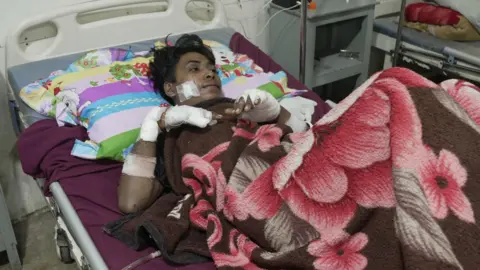
Access to the base is extremely rare. Set amid thickly forested mountains, it is the heart of the resistance against the junta in Chin state.
Sui Khar takes us to the hospital at the base. We see a group of injured fighters who were brought in overnight and had to undergo hours of surgery. Some of them have had to undergo amputations.
Many of them were just schoolboys when the coup occurred in 2021. Just about adults now, they’ve let go of their dreams to fight on the frontline against the junta.
Abel, 18, is in too much pain to speak. He was with a group of fighters trying to take back territory the junta captured a week ago. They won the battle, but Abel lost his right leg and has serious injuries to his hands as well.
In a bed next to him is Si Si Maung, 19, who’s also had a leg amputated.
“As the enemy was retreating we ran forward and I stepped on a landmine. We were injured in the explosion. Then we were attacked from the air. The airstrikes make things very difficult for us,” he says. “I’ve lost a leg, but even if I’ve to give up my life I’m happy to make the sacrifice so that future generations have a better life.”
The impact of the ferocity of the latest offensive is visible in room after room at the hospital.
Yet, it’s the support and grit of tens of thousands of youngsters like Si Si Maung, who picked up arms to fight against the junta, that have helped the rebels make rapid advances against a much more powerful rival in the past four-and-a-half years.
Some like 80-year-old Ral Uk Thang hope that after the election, the junta will retreat, and he will be able to go back home.
“But I don’t think I will live to see democracy restored in Myanmar,” he says. “I hope my children and grandchildren can witness it some day.”
Additional reporting by Aamir Peerzada, Sanjay Ganguly and Aakriti Thapar
www.bbc.com

Tiffanie TurnbullBondi Beach
 Getty Images
As helicopters circled overhead, sirens descended on her suburb, and people ran screaming down her street on 14 December, Mary felt a grim sense of deja vu.
“That was when I knew there was something seriously wrong – again,” she says, her eyes brimming with tears.
Mary – who did not want to give her real name – was at the Westfield Bondi Junction shopping centre last April when six people were stabbed to death by a man in psychosis, a tragedy still fresh in the minds of many.
Findings from a coronial inquest into the incident were due to be delivered this week, but were delayed after two gunmen unleashed a hail of bullets on an event marking the start of the Jewish festival of Hanukkah eight days ago.
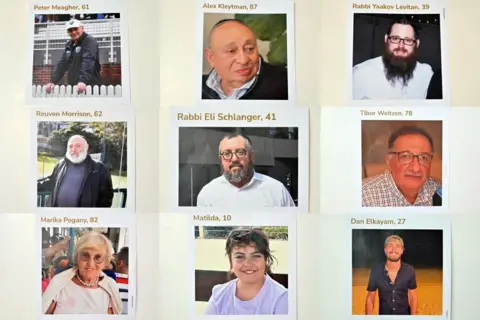
Declared a terror attack by police, 15 people were shot and killed, including a 10-year-old girl who still had face paint curling around her eyes.
The first paramedic to confront the bloody scenes at the Chanukah by the Sea event was also the first paramedic on the scene at the Westfield stabbings.
“You just wouldn’t even fathom that something like this would happen,” 31-year-old Mary, who is originally from the UK, tells the BBC. “I say constantly to my family at home how safe it is here.”
This was the overarching sentiment in the days following the shooting. This kind of thing, mass murder, just doesn’t happen in Australia.
But it can and it has – twice, in the same community, within 18 months.
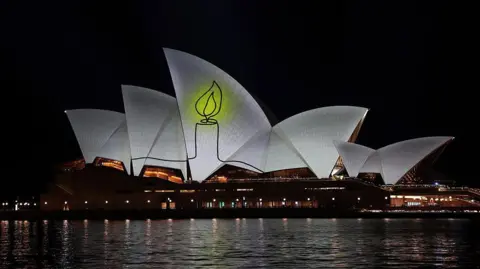
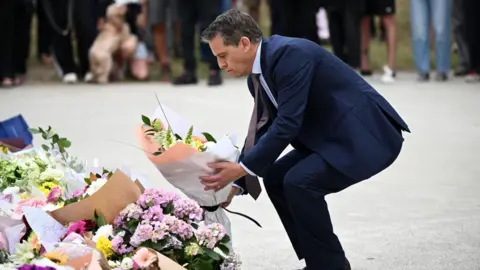
A sea of flowers left by shocked and grieving people at Bondi is being packed up. A national day of reflection is over. On Sunday night, Jewish Australians lit candles for the last time this Hannukah.
But the two tragedies have left scores physically scarred and traumatised, and the nation’s sense of safety shattered.
‘Everyone knows someone affected’
 EPA
EPABondi is Australia’s most famous beach – a globally recognised symbol of its way of life.
It’s also a quintessential slice of Australian community. There’s a bit of “everyone knows everyone” – and that means everyone knows someone affected by the 14 December tragedy, mayor Will Nemesh told the BBC.
“One of the first people I texted was [Rabbi] Eli Schlanger. And I said, ‘I hope you’re OK. Call me if you need anything’,” he said.
But the British-born father of five, also known as the “Bondi Rabbi”, was among the dead.
The first responders, police and paramedics would have been working on members of their own community. Others had the task of having to treat the shooters who had taken aim at their colleagues.
“[Westfield Bondi Junction] was horrendous, something we’re certainly not used to. And then this again was massive, catastrophic injuries,” Ryan Park, health minister for New South Wales, told the BBC.
“They’ve seen things that are like you would see in a war zone… You don’t get those images out of your head,” Park added.
Mayor Nemesh fears this will forever be a stain on Bondi, and Australia.
“If this can happen here at Bondi Beach, it really could happen anywhere… the impact has reverberated around Australia.”
 EPA
EPA‘Warnings ignored’
No one is feeling this more than the Jewish community, for whom Bondi has become a sanctuary.
“I swam here every day for years on end, rain or shine. And this week… I couldn’t get in the water. It didn’t feel right. It felt sacrilegious in some way,” Zac Seidler, a local clinical psychologist, told the BBC.
Many of the victims of the attack moved here over many decades for safety from persecution, including 89-year-old Holocaust survivor Alex Kleytman. Instead, his life was bookended by violent acts of antisemitic hate.
Mr Seidler has spent the past two years trying to convince his grandparents, who are also Holocaust survivors, to hold on to their belief in the good of humanity.
“[My grandmother] kept saying, ‘These are the signs. I’ve seen this before’. And I just kept saying, ‘Not in Australia, not here. You’re safe’, just trying to soothe her.
“But now I kind of feel like the fool.”
No community is a monolith, but one thing many Jewish Australians believe is that warnings about a rise of antisemitism in the months preceding this attack were ignored.
The year started with a spate of vandalism and arson incidents on Jewish marks in the suburbs surrounding Bondi. It has ended with mass murder targeting their community.
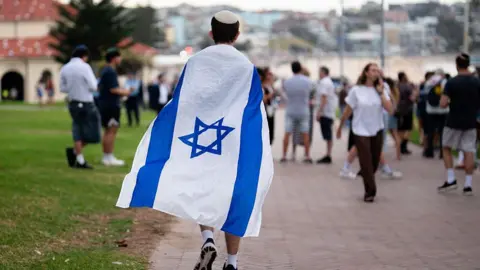
There has been resistance in the face of fear – some leaders urging Jewish Australians to double down, be more publicly Jewish and display their religious symbols with pride.
One woman perusing the flowers outside the Bondi Pavilion on Sunday admits she is too scared to do that. It took her all week to even work up the courage to visit this site, which is just metres from where many of the victims died.
“I’ve never felt my Jewishness before. I’ve never experienced antisemitism in my whole life until now,” MaryAnne says. “And now, I don’t want to wear my Star of David.”
Community, anger and sadness
The shooting triggered a massive outpouring of support from around the nation.
When the news broke, many in the community rallied to help.
Lifeguards – volunteer and paid – put their lives on the line. Restaurants opened their doors and hid people in their store rooms and freezers, and locals ushered lost children into their apartments.
Even the New South Wales opposition leader Kellie Sloane – also the local state member – was at the scene, helping pack bullet wounds.
In the days after the shooting, thousands of ordinary Australians lined up – many for hours on end – to donate blood desperately needed to treat those injured.
Each day, a carpet of petals, handwritten notes, commemorative stones and candles grew out from the gates of the Bondi Pavilion.
Bee motifs – stickers, balloons, even pavement art – are all over the suburb, in remembrance of Matilda, the terror attack’s youngest victim.
Surfers and swimmers on Friday paddled out beyond Bondi’s iconic breaks to honour those who died.
A day later, surf livesavers and lifeguards stood shoulder to shoulder on the beach in solidarity with the Jewish community.
But amid the platitudes, sadness and shock is calcifying into anger and tension.
Last year’s Bondi Junction stabbings were devastating for the community – but a shared resolution united it.
Experts say the attacker, who had schizophrenia, was in psychosis at the time of the stabbings, and his family have previously said he was frustrated at being unable to find a girlfriend. The question of whether he targeted women will likely forever go unanswered. But clear failures in the mental health system have been identified.
Last month, families of the victims asked the coroner to refer the doctor who weaned him off medication with limited supervision to regulators for investigation, and they have also argued for a massive boost to mental health service funding.
But last Sunday’s events raise more uncomfortable feelings and questions.
There is palpable fury at the government, over a perceived – and admitted – failure to do more to stop antisemitism. Prime Minister Anthony Albanese has been booed during public appearances this week, and talking to people visiting the site of the attack in Bondi, it isn’t uncommon to hear them demand his resignation.
Many people the BBC spoke to pointed to his government’s decision to recognise Palestinian statehood, alongside countries including the UK and Canada, and regular protests in Australia by members of the pro-Palestinian movement, which though largely peaceful but have been peppered with antisemitic chants and placards.
The state of New South Wales – which has in recent years tightened protest rules – has already announced it will introduce more legislation cracking down on “hateful” chants and give police more powers to investigate demonstrators. The federal government has promised similar.
The blame apportioned to these protests does not sit right with many, even some sections of the Jewish community.
“We need to hold multiple truths,” Mr Seidler says. “We can be afraid, we can feel that there is deep antisemitic rhetoric going on in certain circles within Australia… while also understanding that there is a right of people in this country – especially Muslim Australians – to be concerned about what is taking place in Gaza.
“We need to get better at finding that line and calling out when that line has been crossed.”
 Getty Images
For others, there is anger at what they feel is the politicisation of a tragedy.
“It’s a bloody photo op,” one woman tells me on Sunday, as a prominent Australian businesswoman arrives and begins posing with the floral tributes outside the Bondi Pavilion.
Some – including the local federal MP Allegra Spender – worry the attack is being used to fuel anti-immigration sentiment.
“We would not have had the man who saved so many Australians if we had cut off, for instance, Muslim immigration,” she said.
Mr Seidler says these arguments fail to recognise that antisemitic views – and other forms of bigotry – are formed here too.
“I heard someone say the other day that Australia thinks it’s on a holiday from history, that we’re somehow immune to this stuff, that it’s not bred here, it’s imported,” Mr Seidler says.
With the anger, there is also fear: for the Jewish community of other attacks, for the Muslim community of retaliation for an act of terror they have loudly condemned.
There are questions over how Australia’s security agency fumbled an alleged terrorist who at one point was on their watch list, prompting a review into federal police and intelligence agencies that was announced on Sunday.
There is frustration at NSW Police, who have for years been warned by the Muslim community of hate preachers poaching their young men.
There is animosity towards the media, driven by hurt among both Jewish and Arab Australians over a belief they and their communities have been misrepresented, and frustration at what some feel is incitement against them.
But there is also a queasiness at the treatment of traumatised victims throughout this week, some of whom were interviewed live on television while the blood of their friends still stained their hands.
Through it all, is an undercurrent of suspicion of institutions and each other.
There are varying opinions on how those rifts can heal – or even if they can. But there is a shared determination to try.
 EPA
EPAOne UK expat who was at the beach at the time of the shooting says everyone he speaks to is adamant this will not change Bondi, or Australia.
“It’s seriously unique what you have as a nation… there’s a magic about it,” Henry Jamieson tells the BBC.
“I’m traumatised… and I’m going to have to deal with that for the rest of my life, I know I am… even people who weren’t there were traumatised.
“But I’m not gonna let it shake me and we will not let it shake this community.
“You can’t let them win,” he says of the alleged terrorists.
At an emotional memorial on Sunday night, seven days since the attack, the same sense of defiance was on show. It ended with the lighting of the menorah, something the crowds gathered for Hannukah last week never got to do.
The shamash, the centre candle, was lit by the father of Ahmed al Ahmed, in honour of his bravery in wrestling a gun off one of the attackers. The children of the two rabbis who were killed lit another. Others were lit by a representative of surf lifesavers and a Jewish community medic who rushed to the scene and began treating the injured before the shots had even stopped. The final candle was lit by Michael, the father of Matilda, who has been described a fountain of joy to all who knew her.
After the parade of diverse Australians had sparked flames on each arm of the menorah, Rabbi Yehoram Ulman of Bondi Chabad made a plea for more love and more unity.
“Returning to normal is not enough,” he said.
“Sydney can and must become a beacon of goodness. A city where people look out for one another, where kindness is louder than hate, where decency is stronger than fear, and we can make it happen,” he said, stopping for a moment as the crowd applauded.
“But only if we take the feelings we have right now and turn them into action, into continuous action.”
www.bbc.com


‘Real Reason’ Why Sami Zayn Lost His Title to CM Punk

Kebbi ADC reps aspirant, Aminullahi Mustapha defects to APC

Folarin Balogun Reveals How He Feels About US Red Card Saga

Simi Sanya and Femi Dapson Are Now Legally Married and It Is Beautiful to See

Premier League Set-Piece Goals (2025/2026)

FCT Area Council Election: Live results from polling units
-
 Sports1 day ago
Neymar’s Comment to Norway Goalkeeper Orjan Nyland After Scoring Penalty
-
 Sports1 day ago
Mexican Media Cast Verdict on England After Chaotic World Cup Win
-
 Sports1 day ago
Wayne Rooney Blasts FIFA’s Decision to Suspend Folarin Balogun’s Red Card
-
 Sports1 day ago
England Fans Praise ‘Animal’ Anthony Gordon vs Mexico
-
 Sports2 days ago
Zlatan Ibrahimovic Causes Big Stir With Reaction to FIFA Suspending Folarin Balogun’s One-Game Ban
-
 Sports12 hours ago
Rodri Addresses Bernardo Silva Incident During Spain 1-0 Portugal
-
 Sports2 days ago
Mario Balotelli Names One Footballer Better Than Lionel Messi
-
 Sports13 hours ago
World Cup Fans Claim Bernardo Silva Player ‘Cost’ Portugal vs Spain