
Business
Tinubu signs Executive Order to end NNPC’s 30% oil revenue cuts

By Peter Egwuatu
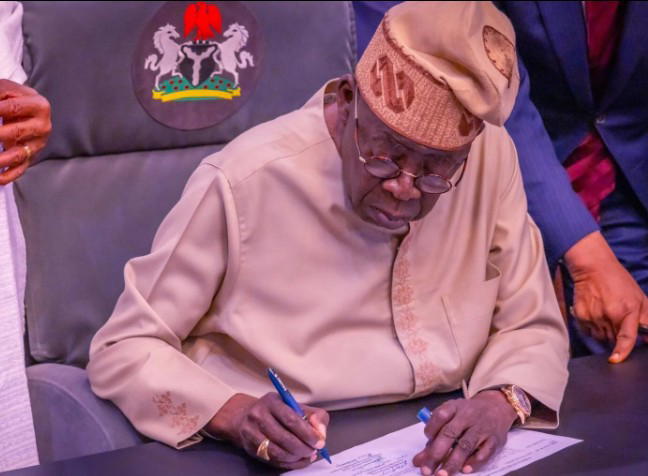
PRESIDENT Bola Tinubu, yesterday, signed an Executive Order (EO) to boost oil and gas revenues flowing into Nigeria’s Federation Account by eliminating wasteful deductions under the Petroleum Industry Act (PIA).
According to the statement issued by the Presidential spokesman, Bayo Onanuga, the Executive Order is anchored on Section 44(3) of the Constitution, which vests ownership, control, and derivative rights in all minerals, mineral oils, and natural gas in, under, and upon any land in Nigeria, including its territorial waters and Exclusive Economic Zone, in the Government of the Federation.
It explained that the directive seeks to restore the constitutional revenue entitlements of the federal, state, and local governments, which were removed in 2021 by the Petroleum Industry Act (PIA). The PIA created structural and legal channels through which substantial Federation revenues are lost through deductions, sundry charges, and fees.
It further stated: “Under the current PIA framework, NNPC Limited retains 30 per cent of the Federation’s oil revenues as a management fee on Profit Oil and Profit Gas derived from Production Sharing Contracts, Profit Sharing Contracts, and Risk Service Contracts.
“In addition, the company retains 20 per cent of its profits to cover working capital and future investments.
“Given the existing 20% retention, the additional 30% management fee is considered unjustified by the Federal Government, as the retained earnings are already sufficient to support the functions NNPCL performs under these contracts.
“NNPC Limited also retains another 30% of its profit oil and profit gas under the production sharing, profit sharing, and risk service contracts, as the Frontier Exploration Fund under sections 9(4) and (5) of the PIA. A fund of this size, being devoted to speculative exploration, risks accumulating large idle cash balances, which would encourage inefficient exploration spending, at a time when government resources are urgently needed for core national priorities, including security, education, healthcare, and energy transition investments.”
Continuing, it said: “There is also the Midstream and Downstream Gas Infrastructure Fund (MDGIF) under Section 52(7)(d) PIA, funded by the collection of gas flaring penalties provided under Section 104. The fund is to be used for supporting environmental remediation and relief for host communities impacted by gas flaring.
“However, section 103 of the PIA has already established a dedicated Environmental Remediation Fund, administered by NUPRC, specifically designed to fund the rehabilitation of communities negatively impacted by upstream petroleum operations, including gas flaring. Furthermore, Section 103 already imposes a fee on lessees to contribute to this fund for precisely this purpose.
“All these deductions far exceed global norms and effectively divert more than two-thirds of potential remittances to the Federation Account. The continuing decline in net oil revenue inflows is largely attributable to these deductions and fragmented oversight under the current PIA architecture.
“The Executive Order aims to resolve, among other things, the duplicative 30 per cent deduction for profit-sharing arrangements by addressing overlapping and redundant provisions across all relevant laws and regulatory instruments within the PIA framework and NNPC Limited’s governing structure.
“The objective is to eliminate unjustified multiple layers of deductions that erode revenues that ought to accrue to the Federation Account, enabling the three tiers of government to pursue critical national priorities.
“The President has identified structural concerns regarding the continued role of NNPC Limited as a concessionaire under Production Sharing Contract arrangements. The existing framework, which allows the company to influence operating costs while simultaneously functioning as a commercial entity, creates potential competitive distortions and undermines its transition into a fully commercial operator as envisioned under the PIA.
“The Executive Order, therefore, introduces immediate measures to curb leakages, enhance transparency, eliminate duplicative structures, and reposition NNPC Limited strictly as a commercial enterprise, while safeguarding the Federation’s interests.
”In rolling out the order, the President affirmed that the reforms are of urgent national importance, given their implications for national budgeting, debt sustainability, economic stability, and the overall well-being of Nigerians.”
The post Tinubu signs Executive Order to end NNPC’s 30% oil revenue cuts appeared first on Vanguard News.

The World Bank has said Nigeria’s biggest fiscal challenge is weak revenue mobilisation rather than excessive borrowing, urging the government to prioritise efforts to boost revenue generation to support sustainable economic growth.
Speaking during an interview on Channels Television on Friday, the World Bank Country Director for Nigeria, Mathew Verghis, said Nigeria’s debt profile remains moderate by international standards and is significantly different from countries experiencing debt distress.
“From our assessment, Nigeria doesn’t have a high indebtedness problem; it has a low revenue problem,” Verghis said.
He explained that Nigeria’s debt-to-GDP ratio is lower than that of many comparable countries, stressing that concerns should focus on improving government revenue rather than limiting borrowing.
“When we looked at the numbers, Nigeria is a moderately indebted country, meaning it has less debt relative to its economy than most of its neighbours and many other countries,” he said.
“Nigeria is in a very different situation than Ghana, for example, which is going through a debt restructuring.”
Verghis defended government borrowing as a necessary tool for financing long-term investments that stimulate economic growth and improve living standards.
“Nigeria borrows for the same reasons that all countries borrow. If you want to deliver results to people, the money available on an annual basis is not enough. So you borrow, deliver results, and that improves your ability to repay,” he said.
He cited the expansion of electricity access as an example, noting that providing power to about 32 million Nigerians requires substantial upfront investment.
“To be able to connect and provide energy to 32 million Nigerians, Nigeria needs to borrow money now. But with increased access to energy, the country will become wealthier and better positioned to repay the loans,” he added.
The World Bank official, however, warned that low government revenue poses a greater threat to Nigeria’s fiscal sustainability than its current debt level.
“Nigeria’s debt is not particularly high, and in fact, it’s quite moderate by international standards. Its revenues are very low by international standards, and unless those revenues are raised, it will not be able to pay back debt,” Verghis said.
According to him, strengthening revenue mobilisation would enable the government to increase investments in infrastructure, healthcare, education and other sectors that drive job creation, improve human capital and reduce poverty over the long term.
The remarks come as the World Bank recently unveiled a new six-year Country Partnership Framework for Nigeria, which places job creation at the centre of its support for the country through investments in infrastructure, healthcare, agriculture and digital connectivity.

By Elizabeth Adegbesan
As part of the Federal Government (FG) borrowing plan for the 2026 budget, the Central Bank of Nigeria, CBN, has issued Treasury Bills, TBs, to raise N5.8 trillion in the third quarter of 2026 (Q3’26).
This represents a 241 percent year-on-year (YoY) increase when compared to N1.76 trillion sold in Q3’25.
CBN disclosed this in its Nigeria Treasury Bills Issue programme for Q3’26.
Treasury Bills are short term (less than one year) debt instruments used by the apex bank to borrow money from the Nigerian public on behalf of the federal government. CBN also uses TBs to control money supply in the economy.
The TB issue programme commenced on July 1st, and ends on September 23rd, 2026. The settlement date began yesterday and ends on September 24th, 2026.
During the period, the apex bank will issue TBs worth N900 billion on 91 days tenor, N900 billion on 182 days and N4 trillion on 364 days.
A breakdown of the programme revealed that in July, the apex bank plans to issue N2 trillion worth of TBs, comprising N300 billion worth of 91 days bills, N300 billion worth of 182 days bills and N1.4 trillion worth of 364 bills.
In August, the apex bank issued N2.1 trillion worth of TBs, comprising N300 billion worth of 91 days bills, N300 billion worth of 182 days bills, and N1.5 trillion worth of 364 days bills.
In September, CBN plans to sell N1.7 trillion worth of TBs comprising N300 billion worth of 91 days bills, N300 billion worth of 182 days bills and N1.1 trillion worth of 384 days bills.

By Emma Ujah
President and Chairman of the Board of the African Export-Import Bank (Afreximbank), Dr. George Elombi, has tasked African nations to stop the export of Lithium, the main raw material used in the production of electric vehicle (EV) batteries. Nigeria is a major exporter of Lithium in Africa, though most of the quantity is illegally exported.
Speaking at the bank’s Mid-Year Media Roundtable in Abuja on Wednesday, he said that rather than exporting raw lithium, African countries should use it to manufacture EV batteries on the continent.
He also said Afreximbank has sufficient funds to finance the production of EV batteries and is ready to provide the necessary funding to any individual or organisation willing to venture into the industry.
In his words, “African mineral resources must work for Africa’s development. EVs are the future of transportation, and the use of lithium to produce EV batteries is taking centre stage in the EV industry.
“Africa must take its position in the EV industry. We have lithium. We should produce EV batteries at home. We simply have to produce them here. There is enough money in Africa to manufacture batteries in Africa.
“If you know anyone who is interested in EV battery production, bring them to me. But if you see someone looking for funding to export lithium, don’t bring them to me.”
Dr. Elombi also said African leaders and institutions must work together to ensure that African funds held outside the continent are repatriated to support the region’s development.
Some rating agencies biased against Africa
Speaking on the bank’s credit ratings, Dr. Elombi, who advocated for African rating agencies, said some global rating agencies initially dismissed Afreximbank as too small and insignificant to drive Africa’s development, while questioning the bank’s trade finance mandate.
According to him, one agency’s 2014 assessment suggested that trade finance could not serve as a foundation for development and implied that the bank’s core mandate lacked relevance.


Mbappe Labelled ‘Disrespectful’ For Full-Time Actions

Manchester United in Talks to Sign Chelsea’s Andrey Santos

Police foil suspected bandit attack in Sokoto, kill one attacker

Simi Sanya and Femi Dapson Are Now Legally Married and It Is Beautiful to See

Premier League Set-Piece Goals (2025/2026)

FCT Area Council Election: Live results from polling units
-
 Sports19 hours ago
Vozinha Reveals What Lionel Messi Told Him After Argentina 3-2 Cape Verde
-
 Sports15 hours ago
Joe Hart Slams ‘Disgrace’ France vs Paraguay Referee
-
 Sports2 days ago
FIFA Set to Change England vs Mexico World Cup Kick-Off Time
-
 Sports1 day ago
Footage Shows What Happened After Lionel Messi’s Post-Match Interview v Cape Verde
-
 Sports1 day ago
20 Players in England’s 2026 World Cup Squad Could’ve Represented Other Nations
-
 Sports2 days ago
8 Tunisia Players Fail Drug Tests As Mexican Food Contamination Suspected
-
 Sports6 hours ago
Mexico vs England Referee Already Made World Cup Blunder
-
 Sports2 days ago
Egypt Stars Watch Kylian Mbappe Footage as Penalty Tactic vs Australia