
Business
Dangote Refinery to supply 65m litres of petrol daily


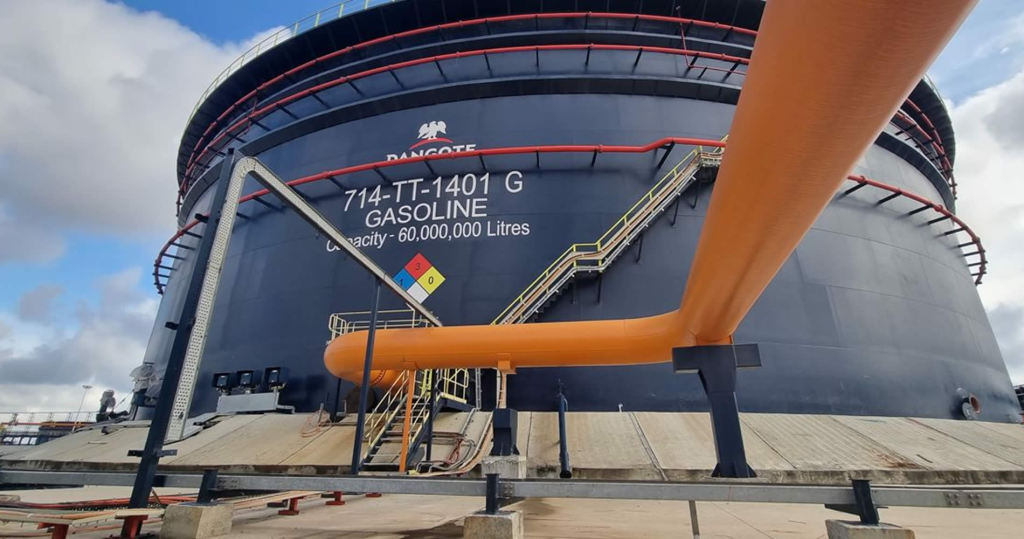
… Exports 20m litres surplus
By Udeme Akpan
In a landmark shift for Nigeria’s downstream petroleum sector, Dangote Petroleum Refinery & Petrochemicals will supply between 60 and 65 million litres of Premium Motor Spirit (PMS) daily to meet national demand, effectively positioning the country for sustained fuel self sufficiency while exporting up to 20 million litres in surplus.
President of Dangote Group, Aliko Dangote, disclosed the development in Lagos, confirming that a structured offtake agreement has been concluded with selected marketers to ensure nationwide distribution and eliminate supply instability.
“We have agreed an offtake framework to supply up to 65 million litres daily for the domestic market,” Dangote said. “Any surplus, estimated at between 15 and 20 million litres, will be exported.”
Nigeria’s average daily petrol consumption stands at between 50 and 60 million litres. The refinery’s output therefore exceeds current domestic requirements, marking a decisive break from decades of fuel import dependence and recurrent scarcity.
Under a revised distribution framework endorsed by the Nigerian Midstream and Downstream Petroleum Regulatory Authority, the refinery will channel nationwide supply through major marketing companies, including MRS Oil Nigeria Plc, Nigerian National Petroleum Company Limited Retail (NNPC), 11 plc (Mobil Producing Nigeria), TotalEnergies Marketing Nigeria Plc, Rainoil Limited, Northwest Petroleum & Gas Company Limited, Ardova Plc, Bovas & Company Limited, AA Rano Nigeria Limited, AYM Shafa Limited, Conoil and Masters Energy.
The structured model is designed to eliminate supply bottlenecks and curb speculative practices that have historically triggered disruptions.
The development signals what industry analysts describe as a significant structural reform in Nigeria’s fuel supply chain. For decades, Africa’s largest crude oil producer relied heavily on imported refined products, exposing the economy to foreign exchange volatility, logistics disruptions and periodic shortages.
With local refining now exceeding national demand, the country stands to conserve billions of dollars annually in foreign exchange previously spent on petrol imports. Analysts say this would ease pressure on the naira, strengthen external reserves, and improve trade balance stability.
The Group Chief Executive Officer of NNPC Limited, Engr. Bayo Bashir Ojulari, had during a recent visit to the facility described the refinery as a transformative national asset capable of redefining Nigeria’s energy security architecture and accelerating industrial growth.
He described the refinery as a source of national pride and an example of Nigeria’s ability to leapfrog legacy industrial constraints through the adoption of best-in-class global technology.
Commending its operational performance, Ojulari said the plant had exceeded expectations.
“This plant was designed for 650,000 barrels per day. None of us thought it would even touch 550,000. What we saw live today was 661,000. These are live parameters, not reports or photographs,” he stated.
The post Dangote Refinery to supply 65m litres of petrol daily appeared first on Vanguard News.

By Peter Egwuatu
The Chartered Institute of Stockbrokers (CIS) has described FTSE Russell’s decision to defer Nigeria’s planned reclassification to Frontier Market status as a temporary review process rather than a reversal of the country’s capital market reforms, stressing that Nigeria’s newly adopted T+1 settlement cycle remains a landmark achievement capable of strengthening investor confidence and market efficiency.
The Institute said the postponement announced by FTSE Russell on June 30, 2026, followed the global index provider’s decision to further assess the practical implications of Nigeria’s migration from a T+2 to a T+1 securities settlement cycle for international institutional investors.
According to CIS, Nigeria’s transition to the T+1 settlement framework on June 1, 2026, represents one of the most significant reforms in the country’s capital market history, making Nigeria the first capital market in Africa to implement the shortened settlement cycle.
The Institute noted that the reform aligns Nigeria with major global markets that have adopted faster settlement systems to improve operational efficiency, reduce settlement risk and enhance liquidity.
“The introduction of T+1 settlement demonstrates Nigeria’s commitment to international best practices and strengthens the country’s competitiveness within the global investment community,” the Institute stated.
CIS explained that FTSE Russell’s concerns centre on whether the shortened settlement period could, in practice, create a de facto prefunded market for foreign institutional investors operating across multiple jurisdictions and time zones.
However, the Institute maintained that Nigeria’s migration to T+1 has not altered the country’s Delivery versus Payment (DvP) settlement model, under which securities and cash are exchanged simultaneously at settlement.
“The implementation of T+1 does not require foreign portfolio investors to prefund their transactions. The market continues to operate under internationally recognised Delivery versus Payment principles, with the only change being the reduction of the settlement period from two business days to one.
“We recognise the operational challenges arising from the shortened settlement cycle. Accordingly, sustained engagement and constructive collaboration with all stakeholders will be crucial to refining the reforms, addressing emerging issues, and ensuring that no category of investor is disadvantaged or unintentionally excluded from participating in the Nigerian capital market,” CIS stated.

By Providence Ayanfeoluwa
The Minister of Marine and Blue Economy, Dr Adegboyega Oyetola, has called for synergy between the Federal and state governments, private sector and development partners to accelerate the implementation of Nigeria’s National Policy on Marine and Blue Economy, describing sub-national participation as critical to unlocking the sector’s vast economic potential.
Oyetola said this at the Second Quarter 2026 Citizens’ and Stakeholders’ Engagement of the Federal Ministry of Marine and Blue Economy held in Lagos last week with the theme: “From Policy to Action: Mobilising Sub-National Governments for Effective Implementation of Nigeria’s National Policy on Marine and Blue Economy”.
He said Nigeria had moved beyond policy formulation and must now focus on implementation capable of delivering measurable economic benefits, noting that the National Policy on Marine and Blue Economy had provided a strategic framework for harnessing Nigeria’s oceans, inland waterways, fisheries and coastal resources, but stressed that its success depended on coordinated action across all levels of government.
According to him, many of the country’s blue economy assets were located within states and communities, making sub-national governments indispensable partners in driving investment, creating jobs, improving food security and promoting environmental sustainability.
Oyetola said reforms under President Bola Ahmed Tinubu’s Renewed Hope Agenda had strengthened stakeholder engagement, attracted investment, improved maritime safety and enhanced the competitiveness of Nigeria’s ports.
He cited the 2025 Container Port Performance Index by the World Bank and S&P Global Market Intelligence, which ranked Tin Can Island Port as the tenth most improved port globally and Lagos Port Complex, Apapa, as the twelfth most improved between 2020 and 2025.
In his keynote address, Bayelsa State Governor, Senator Duoye Diri, commended President Tinubu for establishing the Federal Ministry of Marine and Blue Economy, describing it as a strategic step towards diversifying Nigeria’s economy.
He said Bayelsa followed suit by creating its own Ministry of Marine and Blue Economy in June 2024 to drive the blue economy component of the state’s A-S-S-U-R-E-D Prosperity Agenda.
In his presentation on private sector investment and industrialisation, President of Dangote Industries Limited, Aliko Dangote, said the successful implementation of the National Policy on Marine and Blue Economy would depend largely on sustained private sector participation. He noted that the policy targets the creation of three million jobs within its first four years, annual sectoral growth of seven per cent and the reservation of at least 50 per cent of new jobs for young people aged between 18 and 35.
Dangote, who was represented by the Managing Director of Dangote Port Operations, Simeon Akin Omole, said industrial transformation required policy consistency, quality infrastructure, access to finance and investor confidence.

In this picture obtained from Iran’s ISNA news agency on May 4, 2026, the Iran-flagged tugboat Basim sails near a ship anchored in the Strait of Hormuz off Bandar Abbas in southern Iran. Iran’s Revolutionary Guards on May 4 denied that any commercial ships had crossed the Strait of Hormuz, after the US military earlier said two US-flagged merchant vessels had transited through the vital waterway. (Photo by Amirhossein KHORGOOEI / ISNA / AFP) /
By Efe Onodjae
The Executive Secretary and Chief Executive Officer of the Nigerian Shippers’ Council (NSC), Dr. Akutah Pius, says the Council protects over N90.60 billion and $1.348 million in economic value for Nigerian shippers through regulatory interventions and dispute resolution.
Speaking through a representative at a media engagement with maritime editors and reporters in Lagos, he says: “Within the period under review, the Council protects over N90.60 billion and $1.348 million in economic value for Nigerian shippers and the national economy. This includes preventing N86.06 billion in unjustified demurrage payments and securing savings of N4.54 billion and $1.348 million through Alternative Dispute Resolution and regulatory interventions.”
According to him, “The Council receives 558 complaints and successfully resolves 295 commercial disputes involving container deposits, demurrage, detention charges, terminal charges, cargo claims and export fraud.”
He adds that the Council also records out-of-court settlements with APM Terminals Nigeria Limited, CMA CGM and Maersk Nigeria Limited over charges collected above approved tariffs.
On reforms, Dr. Akutah says: “The Council harmonises bonded terminal invoice charges by reducing billing categories from 18 to six. Terminal operators are directed to display approved tariffs publicly, while shipping companies are mandated to establish holding bays outside the ports to ease the return of empty containers and reduce congestion.”
He further says: “The Nigerian Port Economic Regulatory Agency Bill has been passed by both chambers of the National Assembly and is awaiting Presidential assent. The proposed law will strengthen tariff regulation, service standards, competition and commercial conduct across Nigerian ports.”
According to him, the Council also secures statutory funding through the 2025 Appropriation Act and continues to support the National Single Window, the International Cargo Tracking Note and the expansion of Inland Dry Ports to improve trade and reduce the cost of doing business.


Donald Trump’s Lawyers’ Role in Balogun’s Red Card Being Suspended

Wayne Rooney Blasts FIFA’s Decision to Suspend Folarin Balogun’s Red Card

OPEP troops arrest two suspects linked to NIPSS attack

Simi Sanya and Femi Dapson Are Now Legally Married and It Is Beautiful to See

Premier League Set-Piece Goals (2025/2026)

FCT Area Council Election: Live results from polling units
-
 Sports10 hours ago
Neymar’s Comment to Norway Goalkeeper Orjan Nyland After Scoring Penalty
-
 Sports24 hours ago
Mexico vs England Referee Already Made World Cup Blunder
-
 Sports1 day ago
Joe Hart Slams ‘Disgrace’ France vs Paraguay Referee
-
 Sports2 days ago
Vozinha Reveals What Lionel Messi Told Him After Argentina 3-2 Cape Verde
-
 Sports11 hours ago
Zlatan Ibrahimovic Causes Big Stir With Reaction to FIFA Suspending Folarin Balogun’s One-Game Ban
-
 Sports2 days ago
Explanation Emerges as Ref Accused of Breaking FIFA Rule to Favour Argentina v Cape Verde
-
 Sports2 days ago
Paraguay Legend Chilavert Sparks Uproar With ‘Disgraceful’ Comments About France
-
 Sports12 hours ago
Mario Balotelli Names One Footballer Better Than Lionel Messi