
Business
Bank Deductions: How hidden charges erode Nigerians’ trust in digital payments


By Juliet Umeh
“I recently came to the painful realisation of how much I am losing to bank charges after reviewing my transactions linked to a contribution scheme I manage”, Mrs. Elizabeth Akpan told Saturday Vanguard.
Read Also: State Police Bill: How NASS caged governors
“It has been horrible. You don’t even know what you are being charged for,” she said, her tone heavy with frustration.
What began as a routine review, she explained, soon turned unsettling as she started noticing repeated deductions across her accounts.
“I opened my one bank’s app and saw different kinds of charges – SMS charges and all sorts of deductions. I checked another account with another bank and it was almost the same thing. They charge for this and charge for that,” she said.
For her, what is most worrying is not just the size of the deductions but how frequently they occur.
“If I show you my account statement, you will see N50, N100, N250 and N300 popping up. Before you know it, the money is gone. Most people don’t even know exactly what they are paying for,” she said.
Frustration
Beyond personal frustration, Akpan said the experience has made her question the transparency of the system, warning that it is gradually eroding confidence in formal banking.
“They are talking about financial inclusion, but these charges are frustrating people. Sometimes it feels like keeping money under your pillow is better, except for the risk of theft,” she added softly.
Across Nigeria, citizens are increasingly being encouraged to adopt digital payments as the government, banks and fintech companies expand investments in the country’s Digital Public Infrastructure, DPI, the foundational systems that support digital identity, payments and data exchange.
Yet for many users, trust in that infrastructure is being tested by charges they often struggle to understand.
While Nigeria has invested heavily in digital payment infrastructure through initiatives led by the Central Bank of Nigeria, CBN, the Nigerian Inter-Bank Settlement System, NIBSS, banks and fintech operators, many users say their lived experience is defined more by deductions they struggle to understand than by convenience.
Digital payments surge, but confusion grows
The debate over bank charges is unfolding at a time Nigeria is recording unprecedented growth in electronic payments.
Data from NIBSS shows that the value of instant payment transactions surged to N1.07 quadrillion in 2024, representing a 78 percent increase from N600.36 trillion recorded in 2023. The highest monthly value was recorded in December 2024 at N115 trillion, reflecting the growing dependence of Nigerians on digital transactions.
Similarly, Nigerians carried out 1.38 billion Point-of-Sale, POS, transactions worth N18.32 trillion in 2024, while mobile money operators processed transactions valued at N79.5 trillion, according to NIBSS data.
Figures published by the CBN also show that internet-based transfers accounted for 51.91 percent of all electronic payment transactions by volume as of June 2024, while POS transactions represented 28.53 percent and mobile payments 15.58 percent.
This growth aligns with Nigeria’s financial inclusion agenda. The 2023 Access to Finance Survey by EFInA found that financial inclusion in Nigeria rose to 74 percent in 2023, up from 68 percent in 2020, reducing the financially excluded population to 26 percent.
Yet, experts warn that growth in transaction volumes does not automatically translate into trust.
The problem is opacity, not overcharging – Tech experts
Speaking at Open Access Data Centre, a technology expert, Obinna Adumike, said Nigerians are not necessarily being overcharged in strict terms, but are instead facing a deeper problem of poor understanding and transparency.
“I wouldn’t necessarily say Nigerians are being overcharged in a strict sense because most customers do not even clearly understand the full list of deductions being made from their accounts,” he said.
According to him, many Nigerians only become aware of charges when they review statements or transaction histories, where multiple deductions appear without context.
“In many cases, you only become aware of these charges when you print your statement and suddenly see deductions for transfers, maintenance, VAT and other items that often appear confusing to the average user,” he explained.
“Technically, these charges are published and available, but the problem is not availability; it is accessibility and comprehension. There is a wide gap in financial literacy and digital understanding,” he said.
Adumike argued that the system itself needs simplification.
“From a technology standpoint, the system needs to be far more streamlined. We should have a consolidated structure, one clear line for bank charges, another for government taxes. Everything else should be simplified into a predictable framework.”
He said technology should play a stronger role in improving transparency at the point of transaction.
“Banking apps should not just execute transactions; they should disclose costs upfront. Before confirmation, users should see a breakdown of amount, VAT, transfer fees and total cost. Most modern payment systems already do this,” he noted.
He cited fintech platforms as examples of better transparency.
“For example, platforms like Jumia checkout systems or payment processors like Paystack show full cost breakdowns before payment is completed. Traditional banking apps still need to improve in this area.”
Adumike also called for stronger public education.
“CBN has made efforts to publish guidelines, but putting information on a website is not enough. There needs to be stronger digital education, possibly in partnership with agencies like the National Orientation Agency,” he said.
On whether Nigerians are overcharged, he said perception is shaped more by opacity than excess, adding ”the issue is not necessarily excessive charging; it is lack of clarity. That is what creates distrust.”
He warned that confusion around charges could affect financial inclusion because ”when people feel unsure about deductions, some begin to lose confidence in the system. In extreme cases, they may prefer informal cash storage. But that decision is influenced by multiple factors, not charges alone.”
Ultimately, he said trust remains the central issue.
POS operators feel the pressure
The concerns extend beyond bank customers to POS operators, who sit at the frontline of Nigeria’s cashless push.
Mrs. Anna Bush, a small business owner, said recent transaction charges have triggered fresh complaints from customers.
“A lot of people complain about deductions from their accounts and debit alerts for one thing or another,” she said.
“Now there is another charge on POS transactions. We were told it is from the Central Bank of Nigeria and that transactions from N10,000 and above will attract charges. It was not like this before.”
According to her, customers increasingly feel they are paying charges at multiple points in a single transaction.
“If I transfer money from my bank account to a POS account above N10,000, a charge will be deducted. Customers complain that they are paying for POS transfers, and banks are also charging them. It feels like people are being charged at every stage.”
Another POS operator, Mrs. Manuwa Samuel, said she has come to accept the deductions, even if she does not fully understand them.
“The bank charges are not normal; we are just managing it,” she said.
She noted that what used to be minimal deductions have gradually increased.
“If you want to do a transfer of N5,000, they charge N50. Before, it used to be N20, but now, because of tax and all that, they are charging more than N20.”
While individual deductions appear small, she said the cumulative effect is significant for low- and middle-income earners who carry out frequent transactions.
A system built on charges
Nigeria’s banking sector has increasingly leaned on fee-based income.
Recent financial disclosures show that 11 listed banks generated N209.18 billion from account maintenance charges in the first quarter of 2026, up from N183.37 billion in the same period of 2025. Across the same period, banks also earned N984.47 billion from fees and commissions.
Although account maintenance charges officially apply mainly to current accounts under the CBN’s Guide to Charges by Banks and Other Financial Institutions, customers often encounter multiple deductions- SMS alerts, transfer fees, VAT, stamp duties, ATM fees and electronic transaction charges.
Industry analysts say many of these deductions are within regulatory approval. The challenge, however, is not legality but clarity.
Most customers struggle to distinguish between statutory charges, bank fees and charges collected on behalf of payment infrastructure providers.
What exactly are Nigerians paying for?
Under existing regulations, electronic transfers above certain thresholds attract prescribed fees. Stamp duty applies to qualifying transactions, while VAT is charged on selected banking services.
Recent ATM policy adjustments also introduced additional charges for withdrawals from other banks’ ATMs, particularly off-site machines in malls and airports.
Consumer advocates argue that while these charges may be legal, the communication around them is weak.
Many customers only see deductions after transactions are completed, while account statements often contain abbreviated or technical descriptions that are difficult to interpret.
Lessons from African country like Kenya
Kenya’s mobile money ecosystem is often cited as a model for pricing transparency. According to the Consultative Group to Assist the Poor, CGAP, 2018, the country’s regulatory framework requires mobile financial service providers to disclose transaction charges to users before payments are completed, enabling customers to see applicable fees upfront and make informed decisions.
Charges are regulated, not arbitrary – BCAN
President of the Bank Customers Association of Nigeria, BCAN, Dr. Uju Ogubunka told Vanguard that most deductions are regulated under the CBN’s Guide to Bank Charges.
He insisted that many complaints stem from lack of awareness rather than illegal deductions.
“There is a document called the Guide to Bank Charges. If you follow that document, you will see the kind of charges banks are allowed to charge and the extent they can go,” he said.
He added that customers have a responsibility to familiarise themselves with the guide.
“It is not new. It has been there for about three, four, five years or more,” he said.
Ogubunka maintained that charges such as stamp duty, SMS alerts and transfer fees are legitimate. “The charges are not too much. They are normal. Some of them are even statutory, like stamp duty,” he said.
He, however, advised customers to question deductions where necessary.
“If banks overcharge them, they will be able to know and complain for remedial action,” he said.
There’s room for improvement — Lotus Bank
In an interview, the Chief Digital Officer of Lotus Bank, Akin Adegoke, said most charges seen by customers are regulatory or transaction-based fees guided by the CBN.
He noted, however, that communication remains a key gap.
“The fees customers see are regulatory or transaction-related charges guided by CBN regulations, including transfer fees, SMS alert charges, and other statutory fees banks are required to disclose. Still, this is an area where clarity can be improved,” he said.
According to him, banks are working to improve transparency through clearer statements, digital alerts and better customer communication.
He added that the bank continues to engage regulators to strengthen trust and improve customer experience across banking channels.
Financial inclusion at a crossroads
As Nigeria’s digital payment ecosystem continues to expand, experts say the focus must shift from simply increasing financial inclusion to building trust through transparency and consumer education.
While millions now use digital financial services, unclear charges and poor understanding of deductions could undermine confidence and slow further adoption, particularly among vulnerable users.
•This report is supported by the DPI Africa Journalism Fellowship Programme of the Media Foundation for West Africa and Co-Develop.

By Babajide Komolafe
FirstBank has thrown its weight behind the Imo State Government’s One Kindred One Business Initiative (ÓKÓBÌ), a community-based entrepreneurship programme designed to stimulate job creation, expand financial inclusion and promote sustainable wealth creation through collective business ownership.
The bank said its support aligns with its commitment to empowering small and medium enterprises, deepening financial inclusion and driving long-term socio-economic development across Nigeria.
ÓKÓBÌ, conceived by Imo State Governor, Hope Uzodimma, is built on traditional African values of communalism, kinship and collective responsibility. The initiative formalises groups of like-minded individuals into registered businesses, making them more resilient, easier to finance and better equipped to tackle poverty in rural and urban communities.
Launched in 2023, the initiative has registered over 600 businesses with about 20,000 members and is targeting the creation or support of 100,000 jobs within three years.
Speaking on the partnership, Chief Executive Officer of FirstBank Group, Olusegun Alebiosu, said: “Peer accountability remains a powerful driver of sustainable enterprise growth. The ÓKÓBÌ initiative exemplifies this by transforming existing social capital into tangible economic value for communities.”
He added: “FirstBank is proud to support the Imo State Government in this forward-looking programme, which goes beyond traditional financing to embed financial inclusion directly within group-based enterprises.
“By supporting these collectively owned businesses, we are helping to stimulate economic empowerment at scale, creating a self-sustaining ecosystem where wealth creation is inclusive, participatory and widely shared. This initiative aligns with our broader commitment to enabling small and medium enterprises, deepening financial inclusion, and driving long-term socio-economic development across Nigeria.”
Also commenting, Chief Economic Adviser to the Imo State Government, Professor Kenneth Amaeshi, described ÓKÓBÌ as a viable solution to unemployment and informality, saying the programme had demonstrated remarkable success within a short period.
He urged more corporate organisations to adopt and support the model, stressing that it empowers people to become business owners, strengthens group enterprises and promotes sustainable economic development.

By Providence Ayanfeoluwa
The European Union, EU, has donated a 200kW solar PV power system to the Standards Organisation of Nigeria, SON.
Speaking at the commissioning ceremony in Lagos, Head of Cooperation, EU Delegation to Nigeria and ECOWAS, Massimo De Luca, said the EU and Germany have been working closely with SON to deliver the solar project.
According to him, the EU has been supporting SON to develop innovations that improve energy performance in Nigeria, adding that the donation reflects its continued partnership with the agency.
Luca said that SON is a critical partner in domestic trade and reaffirmed the EU’s commitment to supporting Nigeria’s energy transition plan. Also speaking at the event, Head of Development at the German Embassy, Dr. Karin Jansen, said the commissioning reflects efforts to create an enabling environment for businesses to become more resilient.
“We are building strong bridges between both countries, as this facility will help SON verify energy performance standards. It is also an opportunity to strengthen the next phase of Nigeria’s energy future,” she said.
Earlier, Director-General of SON, Mr. Ifeanyi Okeke, described the project as another milestone in the longstanding partnership between SON and the Nigerian Energy Support Programme (NESP).
He described the partnership as a collaboration that has continued to strengthen Nigeria’s quality infrastructure in support of sustainable energy.
He noted that the partnership began in 2018 with the signing of a Memorandum of Understanding between SON and GIZ for the development and implementation of renewable energy and energy-efficiency standards.
According to him, the collaboration has since expanded beyond standards development to include laboratory infrastructure, conformity assessment, capacity building, and support for emerging sectors such as electric mobility.
Okeke disclosed that, with NESP’s support, SON has developed Minimum Energy Performance Standards (MEPS) and energy labelling requirements for key electrical appliances, paving the way for a mandatory energy-labelling scheme.
“This initiative will empower consumers to make informed choices while ensuring that only energy-efficient products gain access to the Nigerian market,
“When fully operational, it will be the first facility of its kind in Nigeria and a reference testing centre for the West African sub-region.
“On average, we spend close to N80 million on diesel annually and about N6.7 million on electricity. This is money we can save by having an alternative energy source,” he said.
“As an agency that is not primarily revenue-generating, whatever money we can save will be very helpful.”
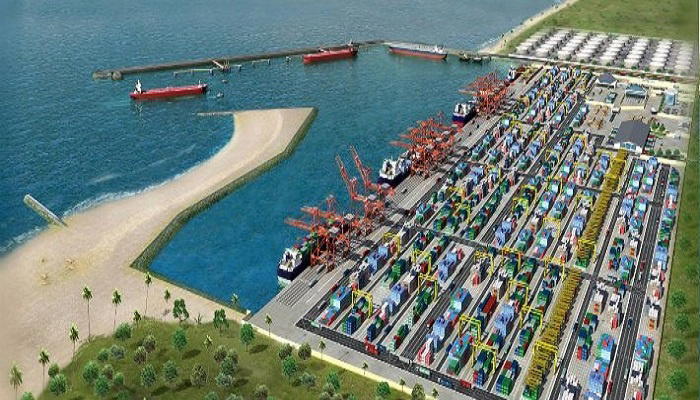
Lekki Deep Seaport.
By Providence Ayanfeoluwa
The Managing Director of Port and Terminal Multiservices Limited (PTML), Mr. Ascanio Russo, has unveiled plans to invest an additional $50 million in the terminal to strengthen port infrastructure, improve operational efficiency and support Nigeria’s ambition of becoming the leading maritime hub in West and Central Africa.
Russo disclosed the proposed investment during a visit to the Minister of Marine and Blue Economy, Dr. Adegboyega Oyetola, in Abuja.
According to a statement by the Minister’s Special Adviser, Dr. Bolaji Akinola, the investment by PTML, a member of the Grimaldi Group, will expand the terminal’s berthing capacity and provide additional state-of-the-art port equipment at the Tin Can Island Port Complex in Lagos.
Russo said: “The Grimaldi Group remains deeply committed to Nigeria and firmly believes in the country’s potential as the leading maritime and logistics gateway in West and Central Africa.
“This proposed investment of $50 million is designed to position PTML for the future by expanding our berthing capacity and deploying additional modern equipment that will significantly enhance operational efficiency, cargo handling capacity and service delivery.”
Responding, Oyetola welcomed the proposal, describing it as a strong vote of confidence in the Federal Government’s ongoing reforms in the maritime sector.
He reaffirmed the government’s commitment to creating an enabling environment for private investment and positioning Nigerian ports as the preferred hub for shipping, logistics and maritime services in West and Central Africa.


Iran Captain Mehdi Taremi Slams FIFA and USA After World Cup Draw v Egypt

Man Utd’s Chido Obi in Loan Talks with Bundesliga Club FC Koln

Troops neutralise suspected bandits, recover rustled livestock in Plateau

Simi Sanya and Femi Dapson Are Now Legally Married and It Is Beautiful to See

FCT Area Council Election: Live results from polling units

Premier League Set-Piece Goals (2025/2026)
-
 Sports1 day ago
FIFA Allow Rainbow Flags at World Cup ‘Pride Match’ Featuring Iran vs Egypt
-
 Sports2 days ago
Thomas Partey Could Be Blocked From Knockout Tie
-
 Sports18 hours ago
Raphinha’s Wife Debunks ‘Financial Problems’ Claim From World Cup Winner
-
 Sports2 days ago
Rory McIlroy Risks Breaking PGA Tour Rule That Led to One-Year Ban
-
 Sports1 day ago
Uruguay Players ‘Revolt Against Marcelo Bielsa’ Ahead of Spain Game
-
 Sports2 days ago
Supercomputer Predicts 2026-27 Championship Table
-
 Sports2 days ago
Trent Alexander-Arnold Could Have Played For the USMNT Instead of England
-
 Sports2 days ago
Cristiano Ronaldo’s Reaction to Lionel Messi’s Argentina Retirement in 2016