
Sports
Football’s No Racism ‘X’ Gesture


Players competing at the 2026 World Cup were provided with a new, intervening signal ahead of the tournament: the “X” gesture.
Developing easily understood symbols and in-match protocols has been a major part of FIFA’s global football strategy in the 2020s. It is the football governing body’s approach to stamping out abuse and discrimination, and whilst a step in the right direction, it arguably still has room for improvement.
These types of incidents have the ability to completely overshadow matches or entire tournaments, and reflect FIFA’s desire to respond to and condemn unacceptable behaviour.
But what does the “X” gesture stand for and how is it aiding FIFA’s global campaign?

The crossed arms symbol in football effectively means ‘no to racism’ and was first discussed at the 74th FIFA Congress in Bangkok, Thailand, in May 2024. The gesture itself was introduced at the 2024 Under-20 Women’s World Cup in Colombia and has now been used in other major tournaments.
The gesture is the latest advancement in FIFA’s Global Stand Against Racism initiative. When brought up for discussion in Thailand in 2024, the symbol was unanimously approved by FIFA’s 211 Member Associations.
The No Racism gesture is designed to empower players, referees, and team officials, as well as providing a simple and standardised way of reporting racist abuse during a football match that immediately triggers FIFA’s anti-racism protocols.
How It Works

The victim crosses their arms at the wrist, and this will signal to a referee, match official, or team captain, that they are being targeted by racist abuse. This will prompt the referee to activate the three-step procedure.
- Step 1 prompts the referee to decide whether to stop the match or not. If the gesture is made to a match official, they will communicate the report of abuse to the referee and the need to potentially stop the match.
- Step 2, if required, will lead to a suspension of the match by the referee. This step will be activated if the incident does not stop upon the restart of the match. This continued behaviour results in the suspension of the match and the two teams being instructed to return to their dressing rooms. An announcement is then made at the venue to inform all attendees of the reason for the match suspension, and that if the abusive behaviour does not cease, the match will be abandoned entirely.
- Step 3, if the conditions are met, results in the match being abandoned. This happens if the incident does not cease upon the restart of the match. The referee will only make this decision following consultation with the relevant authorities present and when it is safe to do so.
Notable Incidents

The “X” gesture was back in the headlines during Argentina and Egypt’s 2026 World Cup Last 16 fixture. Egypt head coach Hossam Hassan made the gesture multiple times toward referee François Letexier. It was alleged that racist insults from Argentina fans were hurled at the Egyptian bench during the celebrations for Enzo Fernández’s match-winning goal.
But instead of triggering the anti-racism three-step procedure, Letexier instead brandished a yellow card to Hassan for what was perceived as unacceptable touchline behaviour. It remains unclear whether Hassan was trying to report racist abuse.
⚽
World Cup History Quiz
You scored
out of 20
Following the gesture, an Egyptian substitute and Hassan’s brother, Ibrahim, intervened. They put Hassan’s arms back down by his sides. Ibrahim Hassan’s thumbs-up gesture to the referee suggests that the Egypt coach was possibly misusing the gesture, which could result in a punishment from FIFA.
Referee François Letexier was coincidentally involved in another high-profile incident involving the “X” gesture earlier this year. During the Champions League knockout fixture between Real Madrid and Benfica, Vinicius Jr was allegedly targeted by racist abuse.
The Brazilian celebrated his 50th-minute goal at the Estádio da Luz with a dance by the corner flag, drawing angry responses from both Benfica players and fans. After alleging discriminatory abuse, Letexier threw up the “X” symbol before momentarily pausing the game. The fixture was stopped for almost 10 minutes.
During the stoppage, replays showed Benfica winger Gianluca Prestianni covering his mouth whilst saying something to Vinicius after his celebrations. The Real Madrid players contested Prestianni’s continued involvement in the fixture during the match stoppage, even leaving the pitch in protest.
The match eventually resumed in the 61st minute, but the incident clearly had a negative effect on the match’s atmosphere. Prestianni was eventually given a six-match ban for homophobic conduct. The ban would have been 10 matches had the abuse been of a racist nature.

The UFC has been home to some of the most devastating and hard-hitting punchers in professional mixed martial arts, with many having displayed complete destruction under the promotional MMA fighting company.
The likes of Derrick Lewis, Tom Aspinall, Mark Hunt, Junior dos Santos, Thiago Santos, and Sergei Pavlovich are just some of the powerful stars that have shown off their strong punching abilities under the UFC banner in recent times.
However, UFC President and CEO, Dana White, who has seen all the top punchers perform in MMA over the years, knows who is the undisputed hardest puncher to ever represent the UFC.
Dana White’s Hardest Puncher in UFC History Revealed

According to past comments made by White at UFC 220 in January 2018, Francis Ngannou is the hardest puncher ever in UFC history.
When White was introducing the Cameroonian fighter to the crowd before his first clash with Stipe Miocic eight years ago, he laid out the facts to prove just how devastating the fighter’s punching abilities were.
“Francis is a guy who has the world record for the most powerful punch. His punches are equivalent to 96 horsepower. That’s equal to getting hit by a Ford Escort going as fast as it can,” the UFC boss explained ahead of the heavyweight world title showdown eight years ago.
“And it’s more powerful than a 12-pound sledgehammer from full force overhead. Holy s***,” White added back then.

However, White’s praise for Ngannou’s power did little for the MMA star during UFC 220, as Miocic was able to steer clear of the hard-hitting punches and was able to out-wrestle his opponent over five rounds.
Ngannou lost via unanimous decision, but he did get his revenge on the American three years later at UFC 260, knocking him out with a ferocious left hook inside two rounds to claim the UFC heavyweight championship.
Following the rematch win, Ngannou successfully defended his heavyweight crown against Ciryl Gane at UFC 270 a year later, before stepping away from fighting under the UFC banner and pursuing a career in professional boxing.
Francis Ngannou’s Departure From UFC

The former UFC heavyweight star went on to face former boxing heavyweight world champions, Tyson Fury and Anthony Joshua, in 2023 and 2024, respectively.
While Ngannou held his own against Fury, by knocking down the British star in the fifth round and losing controversially on points, he was taught a boxing lesson by Joshua, losing via a thumping knockout inside just two rounds.
Ngannou has since returned to the cage, albeit not with White and the UFC banner. Instead, he has fought in MMA events organised by both the Professional Fighters League (PFL) and Most Valuable Promotions (MVP).
The heavyweight knocked out Renan Ferreira in just a round in the headlining contest at PFL Super Fights: Battle of the Giants in 2024. He then secured another opening knockout win two months ago on the undercard of the MVP MMA: Rousey vs. Carano card, stopping Philipe Lins.

With a free-scoring Lionel Messi in your team, it’s hard not to be in a singing mood. And the Argentina fans have been in full voice, with “La Cuarta Estrella” reverberating around the 2026 World Cup stadia during the tournament.
The Argentina anthem has gone viral online, with its punchy tune finding an audience online. But with lyrics packed full of interesting cultural, political, and historical references, what else does “La Cuarta Estrella” tell its listeners about Argentina as a nation?
GIVEMESPORT brings you everything you need to know about the song ‘La Cuarta Estrella’.
Argentina Fans’ Song ‘La Cuarta Estrella’ (The Fourth Star)
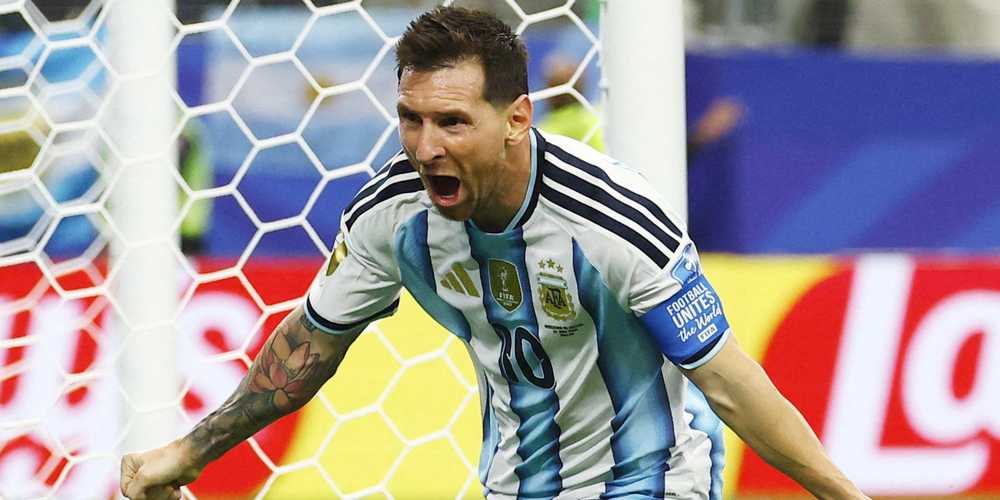
The song’s title is firstly a mark of ambition for the Albiceleste. The players and fans are aiming for their fourth World Cup triumph and a “fourth star” to emblazon their blue and white shirts.
Set to the rhythm of “No me arrepiento de este amor” by famed Argentine singer Gilda, and written by Argentinian musician Palmito Musica, the deeply patriotic anthem serves as a worthy successor to Argentina’s viral 2022 World Cup song “Muchachos”.
The song weaves a story that covers the recent and distant history of Argentina, both as a nation and a football team. Chief among them, the latest World Cup triumph in 2022, as symbolised by Lionel Messi‘s inclusion in the lyrics.
Interestingly, the song also refers to the controversy of the 1994 World Cup, where captain Diego Maradona tested positive for five stimulant substances and was banned from playing in the tournament. Thirty-two years later, and there is a great circularity to that lyric. Maradona’s heartbreak occurred at the 1994 World Cup in the United States, and now Argentina have a great chance of avenging that tournament with victory in the same location.
Beyond the country’s footballing idols, there is a strong sense of national pride. “I am Argentinian from the cradle to the grave,” read the lyrics, implying the eternal love that the fans share for their country.
The lyrics also briefly mention the Malvinas, also known as the Falkland Islands, a territory that was contested during the 1982 war of the same name. References to their political and cultural history, and a willingness to dig up past controversies, highlight a heart-on-your-sleeve sensibility that unites the Argentinians in their common goal of achieving that coveted “Fourth Star”.
La Cuarta Estrella Lyrics

Spanish Lyrics
“Soy hincha de la Selección
La aliento con el corazón
Ganamos la tercera con Lionel
Queremos ser campeones otra vez
La Copa que le robaron al diez
La que no nos dejaron levantar
Quiero ver la cuarta estrella
Soy argento de la cuna hasta el cajón
Por Malvinas, por el Diego
Argentina quiero verte bicampeón.”
English Translation
“I’m a fan of the national team,
I encourage her with all my heart,
We won the third one with Lionel,
We want to be champions again,
La Scaloneta will avenge,
The Cup that was stolen from the number ten,
The one they wouldn’t let us lift,
I want to see the fourth star,
I am Argentinian from cradle to grave,
Argentina, I want to see you become two-time champions.”
Argentina Fans Singing La Cuarta Estrella
You can watch a brilliant video of the Argentina fans singing the song in the video above. The video features English and Italian translated subtitles too.

In every era of WWE, there are a handful of figures who carry more than just star power. These are the veterans who influence culture backstage, guiding the next generation, solving problems, and commanding a level of respect that goes beyond what fans see on television. Nobody in WWE history embodied that role more fully than The Undertaker.
For decades, The Deadman ruled not just in the ring, but in the locker room. Behind the scenes, he was the standard-bearer, a quiet enforcer of discipline, professionalism, and unity. Countless wrestlers have spoken about what it meant to earn The Undertaker’s respect, and many more looked to him as the unofficial leader when tensions ran high or when guidance was needed.
Since his retirement, all manner of fans and wrestlers have wondered about who could step into that role, as it’s not something WWE can just assign at random. A true locker room leader gradually earns it, over years of consistency, respect, and authenticity.
Now, according to Cody Rhodes, there is one man who has stepped into that space.
The Current Leader of the WWE Locker Room

Speaking during a recent episode of his podcast, What Do You Wanna Talk About? with special guest Jelly Roll, Rhodes reflected on some of the names who carry real weight behind the scenes in a post-Undertaker WWE.
It was during this conversation that he revealed a new figurehead in the locker room, one who commands a level of influence reminiscent of The Phenom himself.
“I like the idea that you’re talking about Randy Orton, who is currently kind of, I don’t think Undertaker would dislike this, but he really has become The Undertaker of this locker room.
“If there was a real problem, probably gonna go to Randy or Seth. If there was somebody that I’d tell you, Little Brodie might come to TV with me sometimes, I’ll tell Little Brodie, ‘Hey, go say hi to Randy.’ That’s the number one. Same way, my brother, one time I came to a WWE show back in the day, said, ‘Hey, you wanna go meet Undertaker?’ Not just do you wanna meet him, it’s part of the experience. You’re in his locker room.”
This recognition adds another layer to Orton’s remarkable two-decade journey, a career defined not only by championship success and elite performances in the ring, but by the quiet authority he now carries behind the curtain.
Once known as a rebellious prodigy with limitless talent and limited patience, Orton has evolved into one of WWE’s most respected veterans, a presence others clearly look to for guidance and leadership.
Even though The Undertaker has retired from in-ring competition, his presence does linger in WWE through his work on NXT, offering wisdom and direction to the company’s freshest faces. But his exit from the main roster left a real leadership gap, a need for someone current Superstars could still look to on the road, in the locker room, and at the highest level of the business.

With stars like Seth Rollins also being trusted figures backstage, Orton’s longevity and experience make him uniquely positioned to fill the void left by The Undertaker. It’s not a lightly made comparison; Orton has clearly grown into one of the most respected leaders backstage.
The Apex Predator is now the apex figure when it comes to guiding WWE’s future stars, as well as the here and now.

Dana White Named Francis Ngannou as Hardest Puncher in UFC History
‘La Cuarta Estrella’ – Lyrics & Meaning of Argentina Fans’ World Cup Song

‘Only a third force can liberate Kwara’ – ADC chieftain, Akogun Oyedepo

Meaning Behind Egypt Manager’s ‘X’ Gesture vs Argentina

Simi Sanya and Femi Dapson Are Now Legally Married and It Is Beautiful to See

Premier League Set-Piece Goals (2025/2026)
-
Sports18 hours ago
Meaning Behind Egypt Manager’s ‘X’ Gesture vs Argentina
-
 Sports2 days ago
Rodri Addresses Bernardo Silva Incident During Spain 1-0 Portugal
-
 Sports1 day ago
‘Real Reason’ Why Sami Zayn Lost His Title to CM Punk
-
 Sports2 days ago
Ball Boy and Girls Salaries Revealed
-
 Sports18 hours ago
VAR Expert Claims Egypt Should Have Had Penalty vs Argentina
-
 Sports2 days ago
Martin Odegaard Speaks on Neymar Clash After Norway 2-1 Brazil
-
 Sports2 days ago
World Cup Fans Claim Bernardo Silva Player ‘Cost’ Portugal vs Spain
-
 Sports8 hours ago
Ian Wright Claims Argentina Winning Goal vs Egypt Should Have Been Disallowed