
Health
Cost of sperm donation in Nigeria + Requirements for sperm donation in Nigeria

Cost of sperm donation in Nigeria + Requirements for sperm donation in Nigeria, Where can i sell sperm in Nigeria?
Are you a male between the age of 18 and 39 years? Are you interested in helping couples finding it hard to achieve pregnancy bring a child to life. Are you interested in sperm donation… Are you interested in donating your sperm in fertility clinics in Lagos, Abuja, Benin, Port Harcourt, Ibadan, Enugu and other parts of Nigeria…. Do you want to know how much it cost to donate sperm in Nigeria. Do you want to know the income of a sperm donor in Nigeria? Then read this article…
What is sperm donation?
Sperm donation is a procedure in which a fertile man donates semen — the fluid containing sperm that is released during ejaculation — to help an individual or a couple conceive a baby. Sperm can also be donated for the purpose of research.
What happens to the donated sperm?
Your donated semen can be injected into a woman’s reproductive organs (intrauterine insemination) or used to fertilize mature eggs in a lab (in vitro fertilization). The use of donated sperm is known as third-party reproduction. You semen will help an infertile couple become parents. Sometimes, your sperm may be washed or filtered to give the aspiring couples their desired baby gender. This is known as sex selection.
Any Risks?
There are no risks attributed at all with sperm donation…… It is 100 percent safe.
MEDICAL SCREENING, requirements for sperm donation in Nigeria.
The Nigerian Medical Council requires basic screening for infectious diseases and certain risk factors before a man can become a sperm donor. Some IVF clinics or recipient of the donated sperm may require additional screening.
The World Health Organisation recommends that men who want to make sperm donations — including those who are known to recipients — complete these screenings:
1. Age. Most sperm banks require donors to be between the ages of 18 and 39. Some sperm banks set an upper age limit of 34.
2. Physical exam. The exam will include taking samples of your blood and urine to test for infectious diseases, such as HIV, hepatitis B and Hepatitis C. If you become a regular sperm donor, you’ll need to have physical exams every six months while you provide sperm donations. You’ll be asked to report any changes in your health.
3. Semen testing. You’ll need to provide several samples of your semen. Before providing each sample, you’ll likely be asked to abstain from ejaculation — either through sex or masturbation — for at least 48-72 hours. The samples will be analyzed for sperm quantity, quality and movement. In Nigeria, you will be asked to abstain from smoking at least a weak before donation.
4. Genetic testing. A blood sample will be analyzed to see if you’re a carrier of any genetic conditions like sickle cell anemia, some form of cancers, or diabetes. Ask individual sperm banks which tests they perform, as some banks conduct more-extensive testing than others.
5. Family medical history. You’ll need to provide details about the medical history of at least two previous generations of your family. A history that suggests the presence of a hereditary disease might disqualify you from donating sperm. A mental history may also be taken.
6. Psychological evaluation. You’ll likely be asked if you’re concerned about your personal information being shared with your biological children or about future contact with them. If you’re donating your sperm to someone you know, you’ll likely be asked to talk about your relationship with the recipient. If you have a partner, counseling might be helpful for him or her, too.
7. Personal and sexual history. You’ll need to provide a detailed history of your sexual activities, drug use and other personal information to show whether you have risk factors for developing an infectious disease, such as HIV. You’ll be asked to share detailed information about your personal habits, education, hobbies and interests.
After the tests what next?
If you test positive for any medical conditions during the screening process, you’ll be notified and referred to treatment or counseling.
If you pass the screening process, you’ll be asked to sign a consent form, which will likely state that you deny having any risk factors for sexually transmitted infections or genetic conditions. It’s important to discuss whether you’re open to contact from any child conceived with the help of your sperm.
How is the sperm collected?
Sperm donation is typically done at a sperm bank. You’ll provide a semen sample in a sterile cup through masturbation in a private room.
Cost of sperm donation in Nigeria
How much are sperm donors paid in Nigeria? If you donate semen to a sperm bank, you’ll likely be paid for each donation that passes the hospital’s (sperm bank) screening process. Payment is intended to compensate you for your time and any related expenses. The amount is typically low enough that money isn’t the main incentive for donating. Most fertility centres in Nigeria with sperm banks pay close to #50,000 – #80,000 Naira for sperm donation.
Where can i sell sperm in Nigeria?
Well, it is not in all hospitals.. There are some designated IVF centres and fertility clinics in Nigeria that have sperm banks and require sperm services to couple seeking for the fruit of the womb. These centres are in Lagos, Benin city, Ibadan, Ibadan, Kaduna, Abuja, Port Harcourt, and Enugu.
PS: For most sperm donated, the end users are strictly anonymous. If you’re providing a sperm to someone you know, consider hiring a lawyer to draft a contract that defines your financial and parental rights and obligations.
There are no negative effects of any kind associated with sperm donation.
A smoker is not eligible for sperm donation.
The sperm is gotten out through coitus interruptus or via masturbation.
SOURCE:
Mainly culled from Healthleech.

NSRS CONCLUDES 87TH SCIENTIFIC CONFERENCE IN BENIN, SETS STRATEGIC AGENDA FOR NIGERIA’S SURGICAL WORKFORCE
Benin City, Nigeria — July 2026: The Nigerian Surgical Research Society (NSRS) has successfully concluded its 87th Annual General Meeting and Scientific Conference in Benin City, Edo State, bringing together leading surgeons, researchers, educators, policymakers, and trainees from across the country and beyond.
The conference, hosted at the University of Benin Teaching Hospital (UBTH), focused on one of the most pressing issues in Nigeria’s healthcare sector: the future of the nation’s surgical workforce.
This year’s theme, “Surgical Workforce 2030: Training, Retaining and Task-Sharing in the Nigerian Context,”guided two days of intensive deliberations, scientific presentations, and policy-driven discussions. According to the Chairman of the Local Organizing Committee, Professor Stanley Ukadike Okugbo, the theme “strikes at the very heart of the structural headwinds confronting healthcare delivery in Nigeria today,” highlighting the challenges of brain drain, uneven workforce distribution, and evolving surgical needs.

In his presidential address, Prof. Afeyodion Akhator, President of NSRS, emphasized the urgency of strengthening surgical training programs, improving retention strategies, and adopting safe, evidence-based task-sharing models. He noted that the outcomes of the conference “will influence the direction of surgical education, workforce planning, healthcare policy, and patient care for years to come.”
A major highlight of the event was the keynote lecture delivered by Professor Peter Ndidi Ebeigbe, immediate past President of the National Postgraduate Medical College of Nigeria and Consultant to the World Health
Organization. His address provided a comprehensive roadmap for building a resilient and future-ready surgical workforce, drawing on global best practices and Nigeria’s unique healthcare realities.
The conference featured multiple scientific sessions, exhibitions, debates, and a pre-conference workshop. Delegates presented high-quality abstracts spanning trauma care, oncology, gastrointestinal surgery, surgical
education, and innovations in clinical practice. Participants were also encouraged to experience the cultural richness of Benin City, described in the brochure as “one of Africa’s most historic urban centres and the cradle of the ancient Benin Kingdom.”
The 87th AGM also marked a significant leadership transition for the Society. Members elected a new executive committee to steer NSRS into its next phase of growth, including preparations for the Society’s landmark 50th anniversary in December.

New Executive Committee of the Nigerian Surgical Research Society (NSRS)
• Dr. George C. Obonna — President
• Dr. Clement Odion — Secretary
• Dr. Lucky Ehiagwina — Assistant Secretary
• Dr. Raymond Eghonghon — Treasurer
• Dr. Omorodion Irowa — Auditor
• Prof. Emmanuel Akpo — Editor
• Dr. Francis Campbell — Assistant Editor
• Prof. Aifeyodion Akhator — Ex Officio I
• Prof. Stanley Okugbo — Ex Officio II

Why you feel dizzy when you stand up?
A young, healthy patient asked me: “Doc, sometimes when I stand up from the bed too fast, my vision goes completely black for two seconds and I get dizzy. Am I having a mini-stroke?”
No, it is actually proof that your nervous system is working perfectly.
The exact neurovascular cascade behind why your vision blacks out when you stand up too fast and why you don’t actually pass out. 👇
• The Gravity Drop: When you are lying down, your heart pumps blood easily on a flat plane. The moment you stand up abruptly, gravity instantly pulls about 500 to 800 mL of your blood straight down into your legs.
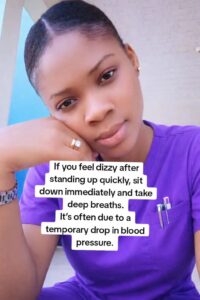
• The Transient Drain: This sudden pooling means less blood returns to your heart, which temporarily means less blood is pumped up to your head. For a split second, your brain experiences a drop in pressure.
• The Visual Blackout: The retina (the back of your eye) is incredibly sensitive to oxygen and pressure changes. When the blood pressure dips, the retina temporarily shuts down to conserve energy which is exactly why your vision goes black or static.
• The Baroreceptor Rescue: Luckily, you have pressure sensors (baroreceptors) in your neck. Within milliseconds, they detect the blood pressure drop and fire a panic signal to your brainstem.
• The Sympathetic Snap: Your autonomic nervous system instantly kicks in. It violently constricts the blood vessels in your legs and spikes your heart rate, physically squeezing the blood right back up to your brain. Vision restored.
Summary:
First time this happened to me I genuinely thought I was dying.
Turns out my body was just buffering.
Knowing the science changes everything
Here’s what’s actually happening:
When you stand up quickly, gravity pulls blood downward. Your body briefly has less blood reaching the brain. Your nervous system — specifically the baroreceptors –detects this drop and rapidly triggers your heart to beat faster and your blood vessels to constrict, restoring blood flow within seconds.
The momentary blackout and dizziness is just that brief gap before the correction kicks in.
👉Hi, I am Dr. Priyam. I break down complex medical science and advocate for Evidence-Based Medicine. FOLLOW ME for more clinical facts.

can a+ and a+ give birth to o+ or O negative?
Itâs a panic that lands in clinics and WhatsApp groups far too often: âBoth of us are A positive⦠how is our child O negative? Did the lab mess up? Or is something else going on?â
The short, reassuring answer is no lab error, no mystery, and no betrayal. This outcome is completely possible under normal genetics. Hereâs why the âmathâ actually maths perfectly once we look at what blood-type tests really reveal.
Your blood type is decided by two separate systems that most people only see the final phenotype of, not the hidden genes.
ABO system ð©¸ð©¸ð©¸ð©¸ð©¸ð©¸ð©¸ð©¸ð©¸
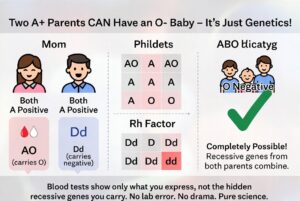
Type A means you carry at least one A allele. You could be AA or AO. The O allele is recessive and invisible in your test result. If both you and your partner are AO (very common), each of you has a 50 % chance of passing the O allele. When both pass O, the child is blood group O. Roughly 45â50 % of people with type A are actually AO carriers, so this pairing happens every day.
Rh (positive/negative) system ð©¸ð©¸ð©¸
âPositiveâ means you have the dominant D antigen. You can still be heterozygous Dd and carry the recessive d allele. If both parents are Dd, there is a 25 % chance the child inherits d from both and is Rh negative. About 15 % of people are Rh negative, which means a large portion of âpositiveâ people quietly carry the d gene.
When both parents are A positive but heterozygous for both traits (AO and Dd), an O-negative child is not only possible â it is mathematically expected in a predictable percentage of pregnancies. The child simply received the two recessive alleles that were hiding in plain sight in both parents.
Blood-group reports show only what antigens are expressed on red cells. They do not sequence your DNA or tell you whether you are homozygous or heterozygous. That hidden information is what allows âimpossibleâ combinations to appear regularly in perfectly ordinary families.
This is basic Mendelian inheritance, not infidelity or laboratory failure. The same recessive-gene logic explains blue-eyed children born to brown-eyed parents or curly-haired kids from straight-haired couples. It is science doing exactly what it is supposed to do.
If the result still feels unsettling, a simple conversation with your doctor or a genetics counsellor can walk you through your specific probabilities. In the overwhelming majority of cases, however, the only thing that needs updating is the outdated assumption that blood types behave like simple labels instead of the elegant, recessive-carrying system they actually are.
Your O-negative child is not evidence of a mistake. They are proof that genetics loves surprises â and that love (and science) are doing just fine.ââââââââââââââââââââââââââââââââââââââââââââââââââ
Dr Parveen Yograj


Assembly complex collapse kills one, injures seven in Gombe

We have reconciled over 400 aggrieved party members after disputed primaries – Jigawa APC

2027: Inside ADC’s battle for control – Vanguard News

Meaning Behind Egypt Manager’s ‘X’ Gesture vs Argentina

Simi Sanya and Femi Dapson Are Now Legally Married and It Is Beautiful to See

Premier League Set-Piece Goals (2025/2026)
-
 Sports20 hours ago
Mbappe’s Brutal Comments About Hakimi After Morocco 0-2 France Go Viral
-
 Sports1 day ago
Erling Haaland Fumes at World Cup Decision During France vs Morocco
-
 Sports19 hours ago
Spain’s Luis de la Fuente Issues Strong Verdict on Argentina vs Egypt Referee
-
 Sports2 days ago
Where Morocco Players Were Born
-
 Sports2 days ago
New Footage Showing Mo Salah’s Actions After Argentina 3-2 Egypt Emerges
-
 Sports2 days ago
Fabrizio Romano Issues Ederson to Man Utd Transfer Update
-
 Sports23 hours ago
Michael Olise Stopped From Celebrating France Goal Due to Little-Known Rule
-
 Sports12 hours ago
Lineker Brings Up Falklands Ahead of Potential England vs Argentina Tie