
Politics
Fresh tensions envelop PDP as crisis spills over to A/Ibom, Plateau, C/River, Kebbi


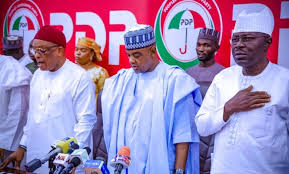
•Damagun, Anyanwu flex muscles
By Luminous Jannamike
On the corridors of Wadata Plaza, the national headquarters of the Peoples Democratic Party (PDP), perception is shifting fast. What once seemed a stable command structure is now exposed as fragile, with authority split between defining figures.
In the past week, congresses in Akwa Ibom, Plateau, Kebbi, and Cross River have become chessboard squares on which major factions advance their pieces.
National Chairman, Umar Damagum; National Secretary, Samuel Anyanwu; and National Publicity Secretary, Debo Ologunagba, emerge not merely as officers but as captains maneuvering for influence.
The outcome may determine who controls PDP’s direction ahead of 2027, not by election, but by internal legitimacy.
Two Centers, One Siege
The PDP has long maintained that its constitution guides every major decision, but interpretation is contentious.
Damagum, as National Chairman, presides over the formal NWC meetings.
Anyanwu, reinstated as National Secretary, insists that his co-validation is essential for any decision to be binding.
Ologunagba, National Publicity Secretary, often communicates Damagum’s side, emphasizing executive action and adherence to declared NWC resolutions.
This dual center of power becomes visible when state congresses are involved.
Those congresses are not trivial technicalities; they are the machinery through which party organs are refreshed, loyalties are signaled, and structures are prepared for future electoral claims.
Moves in Four States
The first decisive move came from the top: a public statement declared that the Akwa Ibom State Working Committee (SWC) was dissolved and replaced by a caretaker committee. Igwat Umoren was named the leader. The justification included alleged compromise of party principles and dual loyalty concerns.
Hours later, Anyanwu issued a counter-letter addressed to Aniekan Akpan, the state chairman, stating: “For purposes of clarity, that press release should be discountenanced, because there was no formal sitting of the National Working Committee (NWC) in which such decision was taken.”
He declared the earlier announcement “null and void and of no effect.” The state executive was to continue in place, Anyanwu asserted.
Plateau & Kebbi
In Plateau and Kebbi, conflict over scheduling heightened tension. Penultimate Thursday, Damagum reportedly wrote to INEC, postponing congresses in Plateau, Kebbi, and Cross River due to operational logistic challenges.
The next day, Anyanwu was said to have also written a counter-letter insisting that those scheduled congresses still stand and must proceed.
The two purported letters, nearly identical in audience but opposing in content, sowed confusion in state chapters. Delegates, local executives, and INEC were faced with contradictory instructions.
Cross River
In Cross River, the divergence turned public. The State Working Committee held a congress in Calabar on the scheduled date, declaring its re-election valid.
Yet in Abuja, the national leadership insisted the congress was unauthorised: Ologunagba said it was “hallucination” and “a carnival,” maintaining the NWC had earlier postponed the exercise.
“There was no congress in Cross River by the PDP as the leadership of the party had earlier announced the postponement of congress in Cross River, Plateau and Kebbi States,” he insisted.
The Cross River chapter responded. The state publicity secretary, Mike Ojisi, said: “A purported social media chat between five members of the National Working Committee cannot constitute a National Working Committee of the Party, talk more of taking such a fundamental decision.”
The Moment of Fracture
At this point, the PDP’s internal coherence is under severe strain. Two centres of authority now issue directives on the same matters: dissolutions of state organs, scheduling or postponement of congresses, and the appointment of caretaker committees, and both insist their actions are constitutional.
State chapters are confronted with conflicting orders from Abuja, unsure which to obey. The legitimacy of every decision taken in the PDP’s name now depends on whose interpretation of the party’s own constitution holds sway.
Much of the confusion stems from competing readings of the PDP Constitution (2017, as amended), which, while comprehensive, leaves room for strategic interpretation.
For instance, Article 47(1) states that “the term of office of every organ of the Party shall be clearly defined, and any attempt to dissolve or truncate the term of any organ before the expiration of its tenure shall be subject to constitutional procedure.”
Those opposed to recent dissolutions argue that this provision means no State Working Committee (SWC) can be removed or replaced by a caretaker body unless the prescribed constitutional steps, including formal NWC resolution and NEC approval, are strictly followed.
The question of who has the authority to initiate or certify such steps is itself contested.
Section 35(a)(1) vests the National Working Committee (NWC) with the power “to organise the activities of the Party and ensure the implementation of decisions of the National Executive Committee (NEC).”
Supporters of Damagum rely on this clause to argue that the NWC’s decisions, such as the postponement of congresses or the appointment of interim committees, are binding once adopted by a majority.
But critics counter that the constitution also sets procedural requirements for such decisions to be valid.
Central to this argument is Section 36(2), which states that “the Deputy National Secretary shall act as National Secretary whenever so directed.”
This wording is often cited by Anyanwu’s camp to suggest that unless the National Secretary, or someone formally designated through proper procedure, authenticates a directive, actions like caretaker appointments or congress postponements lack constitutional standing.
This is why Anyanwu continues to argue that decisions announced without his co-signature or without a ‘properly’ convened NWC meeting are null and void.
The constitution also imposes strict limits on the authority of state organs.
Section 57(7) explicitly provides that “no executive committee at any level, except the National Executive Committee, shall entertain any question of discipline as may relate or concern a member of the National Executive Committee, Deputy Governors, or members of the National Assembly.”
This clause is now central to arguments against unilateral actions by state chapters; for instance, attempts to suspend or challenge national officers, which opponents argue are constitutionally prohibited. It also reinforces the idea that state congresses, however well attended, cannot override a decision taken at the national level.
On the other hand, proponents of the current NWC-led decisions often invoke Section 31(3), which provides that “resolutions of the National Executive Committee are binding on all organs, officers, chapters, and members of the Party, except where they are in conflict with the Constitution or a higher judicial order.”
In their view, this language confirms that once the NEC or its delegated NWC issues a resolution, whether postponing a congress or reconstituting a state executive, all other party structures are constitutionally bound to comply.
It is in the tension between these clauses; one emphasising procedure and co-signatures, another prioritising the supremacy of collective resolutions, that the PDP’s fracture has deepened.
Actions that once passed without question are now dissected line by line against constitutional language, and procedural disagreements have become existential battles over legitimacy.
Even a simple letter announcing a new congress date now triggers debates over whether a quorum was achieved, minutes were properly recorded, and whether the correct officers signed off.
This is no longer a mere administrative tug-of-war; it is a confrontation fought with constitutional provisions as weapons.
Each side frames its authority not just as a political reality but as a constitutional imperative. For state leaders, delegates, and even INEC officials, the question is not only whom they support, but whose reading of the party’s foundational text they trust enough to risk defying the other.
The implications stretch far beyond the four states at the centre of the dispute. Every contested congress, disputed dissolution, or parallel executive structure sets a precedent that could shape how the PDP organises itself ahead of 2027.
The stakes are therefore not simply about today’s contests for state control; they are about defining the constitutional centre of gravity for the party’s future.
Stakes Beyond State Lines
As these conflicts ripple outward, damage appears in unexpected places. Grassroots organizers express fatigue; party activists begin to question the point of allegiance when headquarters issues conflicting commands.
In state chapters, unsubtle signals suggest that money, recognition, and future appointments may be awarded not on merit but on factional alignment.
Public trust, crucial for any opposition party, is eroding. A party that cannot agree with itself becomes vulnerable in electoral contests, especially in states where it should have confidence. The paralysis over congresses delays mobilisation, training, and strategy sessions for upcoming elections.
At the same time, efforts toward reconciliation begin. Elders and respected figures within PDP have been quietly advising retreat from open confrontation, suggesting symbolic steps, retreats, and shared committees.
Paths That Might Define the Next Turn
Two possible trajectories now lie ahead. One path leads to limited resolution: concessions, compromises, and negotiated settlements.
Perhaps Damagum and Anyanwu agree on a revised schedule of congresses, jointly signed letters, or shared oversight of caretaker committees.
Perhaps legitimacy is re-anchored to transparent, rule-based processes. For instance, panels constituted properly, notices issued, and INEC notified correctly. This scenario could preserve PDP as a coherent force.
Another path risks further unraveling. If conflicting directives become the norm rather than an exception, factional allegiance may override formal party structure. If state executives accept directives only from one faction, the PDP could soon operate as though two parties occupy its shell. Legal challenges, public perceptions of arbitrariness, and defections could follow.
The House Still Stands, But Who Decides Its Silence
For now, much remains unsettled. Wadata Plaza is awash with internal counsels, emissaries, and legal opinions being drafted. State chapters await definitive communication. Observers outside the party watch closely, noting that the signals PDP sends now may matter more than the outcomes.
What is certain: this is not a moment of collapse, at least not yet. PDP as an institution remains, with history, resources, and visible membership. But its capacity to act as a unified opposition hinges on whether a consensus is built or a split is cemented.
If reconciliation prevails, the factional shadows might recede, allowing the PDP to present itself as disciplined and prepared for what comes next.
Yet if the fissures widen, the party may find its internal legitimacy questioned every time it goes to court, to the media, or to the ballot box. Either way, the moves made now are defining, not just for 2025 but for the political terrain of 2027 and beyond.
The post Fresh tensions envelop PDP as crisis spills over to A/Ibom, Plateau, C/River, Kebbi appeared first on Vanguard News.
www.vanguardngr.com
Scores of members of the All Progressives Congress, APC, on Tuesday staged a protest at the party’s Lagos State Secretariat in Ikeja, demanding the cancellation of primary election results in several constituencies over alleged irregularities.
The demonstrators, drawn from various constituencies including Amuwo-Odofin Federal Constituency, Amuwo-Odofin Constituency II, Ajeromi-Ifelodun Federal Constituency, Oshodi-Isolo Constituency I and Somolu Constituency II, urged the party leadership to investigate complaints arising from the recently concluded House of Representatives and Lagos State House of Assembly primaries.
The APC conducted its legislative primaries in May and subsequently announced the names of successful candidates. However, some aspirants and party members have continued to challenge the outcomes, insisting that the published results did not reflect the decisions made by party members during the direct primary elections.
The protesters called on the party’s leadership and relevant appeal panels to review the conduct of the elections and address what they described as widespread procedural breaches.
One of the petitions was submitted by House of Representatives aspirant for Amuwo-Odofin Federal Constituency, Mr Ayodele Adewale, who challenged the outcome of the primary election in the constituency.
Adewale alleged that the exercise across the constituency’s 11 wards was marred by significant procedural violations, including the absence of an official membership register during accreditation.
He further claimed that accreditation was conducted using APC slips that were neither properly verified nor officially recognised.
The aspirant urged the appeal committee to thoroughly investigate the accreditation and voting processes and nullify the election outcome.
Similarly, House of Assembly aspirant for Amuwo-Odofin Constituency II, Mr David Doherty, faulted the transparency of the exercise, alleging that aspirants were excluded from critical decisions leading up to the election.
He also claimed that armed individuals disrupted voting in some riverine communities by firing gunshots, forcing party members to flee from polling locations.
Doherty called for the cancellation of the constituency’s results and demanded sanctions against anyone found culpable of electoral misconduct or violence.
In Ajeromi-Ifelodun Federal Constituency, petitioners alleged widespread irregularities, including result manipulation, improper collation procedures and breaches of electoral guidelines.
According to them, some electoral officials failed to appear at designated collation centres, while certain results were allegedly altered.
They further claimed that votes were inflated in some wards and that proper accreditation procedures were not followed.
The petitioners requested a verification of ward-level results and a forensic review of disputed result sheets and signatures.
Speaking on behalf of protesters from Amuwo-Odofin Constituency II, Prince Hakeem Ola described the alleged treatment of Doherty as unfair and unacceptable.
He maintained that party members should be allowed to choose their representatives freely through a transparent and credible democratic process.
Ola alleged that Doherty emerged victorious in the primary election but that attempts were being made by some party leaders to overturn the outcome.
Another protester from Agege Local Government Area, Mr Oluwasola Olugbemi, warned against what he described as efforts to impose candidates on party members.
He argued that ignoring the preferences of party members undermines democratic values and weakens confidence in the electoral process.
Protesters from Oshodi-Isolo Constituency I and Somolu Constituency II also submitted petitions alleging attempts to alter the outcomes of their respective primaries.
They appealed to the party leadership to uphold the results already forwarded to the APC National Secretariat.
The demonstrators insisted that the credibility of the APC’s internal democratic process was at stake and called for a transparent resolution of all disputes ahead of the 2027 general elections.
Despite the morning rainfall, the protesters gathered outside the party secretariat, chanting solidarity songs and demanding action on their grievances.
Meanwhile, the Lagos State chapter of the APC dismissed reports circulating on social media claiming that the state chairman, Pastor Cornelius Ojelabi, was harassed during the protest.
In a statement issued by his Senior Special Assistant on Media and Publicity, Mrs Omobola Akingbehin, the party clarified that Ojelabi was not present at the secretariat when the protest took place.
Akingbehin stated that while the party respected the constitutional right of members to express grievances through lawful means, such actions should be carried out responsibly.
She noted that the primary election process had been concluded and that established internal mechanisms were already available for resolving disputes arising from the exercise.
The party encouraged aggrieved aspirants and members to utilise the appropriate channels in the interest of unity, fairness and the continued growth of the APC.
Akingbehin also urged party members, stakeholders and the general public to disregard what she described as misleading reports and rely solely on information released through official party communication platforms.
dailypost.ng
Scores of members of the All Progressives Congress, APC, on Tuesday staged a protest at the party’s Lagos State Secretariat in Ikeja, demanding the cancellation of primary election results in several constituencies over alleged irregularities.
The demonstrators, drawn from various constituencies including Amuwo-Odofin Federal Constituency, Amuwo-Odofin Constituency II, Ajeromi-Ifelodun Federal Constituency, Oshodi-Isolo Constituency I and Somolu Constituency II, urged the party leadership to investigate complaints arising from the recently concluded House of Representatives and Lagos State House of Assembly primaries.
The APC conducted its legislative primaries in May and subsequently announced the names of successful candidates. However, some aspirants and party members have continued to challenge the outcomes, insisting that the published results did not reflect the decisions made by party members during the direct primary elections.
The protesters called on the party’s leadership and relevant appeal panels to review the conduct of the elections and address what they described as widespread procedural breaches.
One of the petitions was submitted by House of Representatives aspirant for Amuwo-Odofin Federal Constituency, Mr Ayodele Adewale, who challenged the outcome of the primary election in the constituency.
Adewale alleged that the exercise across the constituency’s 11 wards was marred by significant procedural violations, including the absence of an official membership register during accreditation.
He further claimed that accreditation was conducted using APC slips that were neither properly verified nor officially recognised.
The aspirant urged the appeal committee to thoroughly investigate the accreditation and voting processes and nullify the election outcome.
Similarly, House of Assembly aspirant for Amuwo-Odofin Constituency II, Mr David Doherty, faulted the transparency of the exercise, alleging that aspirants were excluded from critical decisions leading up to the election.
He also claimed that armed individuals disrupted voting in some riverine communities by firing gunshots, forcing party members to flee from polling locations.
Doherty called for the cancellation of the constituency’s results and demanded sanctions against anyone found culpable of electoral misconduct or violence.
In Ajeromi-Ifelodun Federal Constituency, petitioners alleged widespread irregularities, including result manipulation, improper collation procedures and breaches of electoral guidelines.
According to them, some electoral officials failed to appear at designated collation centres, while certain results were allegedly altered.
They further claimed that votes were inflated in some wards and that proper accreditation procedures were not followed.
The petitioners requested a verification of ward-level results and a forensic review of disputed result sheets and signatures.
Speaking on behalf of protesters from Amuwo-Odofin Constituency II, Prince Hakeem Ola described the alleged treatment of Doherty as unfair and unacceptable.
He maintained that party members should be allowed to choose their representatives freely through a transparent and credible democratic process.
Ola alleged that Doherty emerged victorious in the primary election but that attempts were being made by some party leaders to overturn the outcome.
Another protester from Agege Local Government Area, Mr Oluwasola Olugbemi, warned against what he described as efforts to impose candidates on party members.
He argued that ignoring the preferences of party members undermines democratic values and weakens confidence in the electoral process.
Protesters from Oshodi-Isolo Constituency I and Somolu Constituency II also submitted petitions alleging attempts to alter the outcomes of their respective primaries.
They appealed to the party leadership to uphold the results already forwarded to the APC National Secretariat.
The demonstrators insisted that the credibility of the APC’s internal democratic process was at stake and called for a transparent resolution of all disputes ahead of the 2027 general elections.
Despite the morning rainfall, the protesters gathered outside the party secretariat, chanting solidarity songs and demanding action on their grievances.
Meanwhile, the Lagos State chapter of the APC dismissed reports circulating on social media claiming that the state chairman, Pastor Cornelius Ojelabi, was harassed during the protest.
In a statement issued by his Senior Special Assistant on Media and Publicity, Mrs Omobola Akingbehin, the party clarified that Ojelabi was not present at the secretariat when the protest took place.
Akingbehin stated that while the party respected the constitutional right of members to express grievances through lawful means, such actions should be carried out responsibly.
She noted that the primary election process had been concluded and that established internal mechanisms were already available for resolving disputes arising from the exercise.
The party encouraged aggrieved aspirants and members to utilise the appropriate channels in the interest of unity, fairness and the continued growth of the APC.
Akingbehin also urged party members, stakeholders and the general public to disregard what she described as misleading reports and rely solely on information released through official party communication platforms.
dailypost.ng
A Federal High Court in Gusau has begun hearing a pre-election suit filed by the All Progressives Congress, APC, Zamfara North Senatorial aspirant, Dr. Sani Abdullahi Shinkafi, challenging his exclusion from the party’s primary election.
The suit, before Justice Hassan Dikko, has the APC, the Independent National Electoral Commission, INEC, and Senator Sahabi Ya’u Kaura as first to third defendants.
Shinkafi is asking the court to nullify the senatorial primary election over what he described as his unlawful exclusion from the process.
When the matter came up for mention on Tuesday, proceedings could not progress due to unresolved issues relating to INEC’s participation in the case.
The court adjourned the matter to June 25 and directed that INEC appear and that all parties exchange pleadings before the next hearing date.
Counsel to the plaintiff, Bello Galadi, said he was confident in his client’s case, noting that the court would ensure justice is served.
Counsel to Senator Kaura, Jaysey Sharka, confirmed that the matter is still at the hearing stage.
dailypost.ng


APC members protest at Lagos Secretariat, demand cancellation of primary results
APC members protest at Lagos Secretariat, demand cancellation of primary results

Important Phrases You Need to Know for the 2026 FIFA World Cup

Simi Sanya and Femi Dapson Are Now Legally Married and It Is Beautiful to See

FCT Area Council Election: Live results from polling units

Premier League Set-Piece Goals (2025/2026)
-
 Sports2 days ago
Denmark FA Announce Special Measures For Players After Christian Eriksen Collapses
-
 Sports2 days ago
FIFA Referee ‘Denied Entry’ into the US Ahead of 2026 World Cup
-
 Sports22 hours ago
Ian Wright’s Reaction to Ref Being Denied Entry to the US Goes Viral
-
 Sports15 hours ago
Simon Jordan Defends the US Decision to Ban World Cup Referee
-
 Sports2 days ago
George Russell’s Mercedes Contract Could Soon Be ‘Void’
-
 Sports2 days ago
Iran World Cup Stars Arrive in the US With ‘168’ Pinned to Shirts
-

 Sports2 days ago
Tyson Fury’s Final Opponent Before Facing Anthony Joshua ‘Leaked’
-
 Sports2 days ago
Lewis Hamilton Seriously Slammed For ‘Hypocritical’ Billionaire Comments