
Health
How much is Pelvic scan in Nigeria?


How much is pelvic scan in Nigeria, how much does pelvic ultrasound cost in Nigeria, pelvic scan cost in Nigeria, pelvic ultrasound price in Nigeria, pelvic ultrasound cost in Nigeria, transvaginal ultrasound cost in Nigeria.
What is a pelvic ultrasound scan?
A pelvic scan is a noninvasive diagnostic exam that produces images that are used to assess organs and structures within the female pelvis. A pelvic ultrasound allows quick visualization of the female pelvic organs and structures including the uterus, cervix, vagina, fallopian tubes and ovaries.
What are the other names?
Ultrasound-Pelvis, Pelvic Ultrasonography, Pelvic Sonography, Pelvic Scan, Lower Abdomen Ultrasound, Gynecologic Ultrasound, Transabdominal Ultrasound, Transvaginal Ultrasound, Endovaginal Ultrasound, transrectal scan (for men).
Is it safe?
Yes. It is 100 percent safe and you have no need to worry. You may experience slight discomfort during the procedure but no need to worry. No side effects.
Why should your doctor request for a scan?
You doctor will require you to do a scan of she/he in the following situations
1. Ectopic pregnancy
2. Uterine fibroids
3. Other pelvic tumours
4. Pelvic inflammatory disease and other cases of vaginal discharge
5. Review the anatomy of pelvic organs like the womb, Fallopian tubes, ovaries, bladder etc in order to check for abnormalities.
6. Uterine bleeding especially postmenopausal
7. Monitor the release of egg during ovulation especially in women having difficulty in conceiving.
8. Check the position of intra-uterine contraceptive device (IUCD)
9. Very important for ultrasound guided aspiration of egg during IVF
10. Monitor fetal growth and development during pregnancy.
11. Chronic pelvic pain/frozen pelvic organs.
12. To check the kidney, ureter and bladder.
13. Ultrasound guided percutaneous drainage of abscess (pus)
In men, a pelvic ultrasound is used to evaluate the:
- bladder
- seminal vesicles
- prostate
- Kidneys
Transrectal ultrasound, a special study usually done to provide detailed evaluation of the prostate gland, involves inserting a specialized ultrasound transducer into a man’s rectum.
In men and women, a pelvic ultrasound exam can help identify:
- kidney stones
- bladder tumors
- other disorders of the urinary bladder
In children, pelvic ultrasound can help evaluate:
- pelvic masses
- pelvic pain
- ambiguous genitalia and anomalies of pelvic organs
- early or delayed puberty in girls
How will my organs be accessed for examination?
The test can be done by placing a probe on the lower abdomen (transabdominal) or inside the vagina (transvaginal). The route will depends on what your doctor is trying to view on your pelvic cavity and consideration for accuracy.
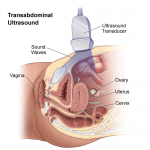
Credit:dwhcs.com
Preparing for pelvic scan?
It is simple. It is mandatory to you drink plenty of water and not urinate until after the test. A full bladder improves the visibility of your organs and the the accuracy of the test. You will be told to empty your bladder right before the test if the procedure is transvaginal.
In addition, it is important you put on simple wears such as gowns to make adjusting your dress during the procedure easy.
Where can you do pelvic ultrasound in Nigeria?
I will advise you to do the test in established radiodiagnostic centres near you or the one you are referred to by your doctor. There is at least one centre in every state across Nigeria but more in Lagos, Benin city, Ibadan, Port Harcourt, Abuja, Kano, Kaduna and Warri.
How much is Pelvic scan in Nigeria?
It is largely affordable. A pelvic scan in Nigeria cost between #5,000 – #10,000 Naira. It may be up to #12,000 – #25,000 Naira in city-centres like Abuja, Ibadan and Lagos. Pelvic scans in very big private labs may go as high as #35,000.
Some scans are special so the prices may vary.
Source:


Why you feel dizzy when you stand up?
A young, healthy patient asked me: “Doc, sometimes when I stand up from the bed too fast, my vision goes completely black for two seconds and I get dizzy. Am I having a mini-stroke?”
No, it is actually proof that your nervous system is working perfectly.
The exact neurovascular cascade behind why your vision blacks out when you stand up too fast and why you don’t actually pass out. 👇
• The Gravity Drop: When you are lying down, your heart pumps blood easily on a flat plane. The moment you stand up abruptly, gravity instantly pulls about 500 to 800 mL of your blood straight down into your legs.

• The Transient Drain: This sudden pooling means less blood returns to your heart, which temporarily means less blood is pumped up to your head. For a split second, your brain experiences a drop in pressure.
• The Visual Blackout: The retina (the back of your eye) is incredibly sensitive to oxygen and pressure changes. When the blood pressure dips, the retina temporarily shuts down to conserve energy which is exactly why your vision goes black or static.
• The Baroreceptor Rescue: Luckily, you have pressure sensors (baroreceptors) in your neck. Within milliseconds, they detect the blood pressure drop and fire a panic signal to your brainstem.
• The Sympathetic Snap: Your autonomic nervous system instantly kicks in. It violently constricts the blood vessels in your legs and spikes your heart rate, physically squeezing the blood right back up to your brain. Vision restored.
Summary:
First time this happened to me I genuinely thought I was dying.
Turns out my body was just buffering.
Knowing the science changes everything
Here’s what’s actually happening:
When you stand up quickly, gravity pulls blood downward. Your body briefly has less blood reaching the brain. Your nervous system — specifically the baroreceptors –detects this drop and rapidly triggers your heart to beat faster and your blood vessels to constrict, restoring blood flow within seconds.
The momentary blackout and dizziness is just that brief gap before the correction kicks in.
👉Hi, I am Dr. Priyam. I break down complex medical science and advocate for Evidence-Based Medicine. FOLLOW ME for more clinical facts.

can a+ and a+ give birth to o+ or O negative?
Itâs a panic that lands in clinics and WhatsApp groups far too often: âBoth of us are A positive⦠how is our child O negative? Did the lab mess up? Or is something else going on?â
The short, reassuring answer is no lab error, no mystery, and no betrayal. This outcome is completely possible under normal genetics. Hereâs why the âmathâ actually maths perfectly once we look at what blood-type tests really reveal.
Your blood type is decided by two separate systems that most people only see the final phenotype of, not the hidden genes.
ABO system ð©¸ð©¸ð©¸ð©¸ð©¸ð©¸ð©¸ð©¸ð©¸

Type A means you carry at least one A allele. You could be AA or AO. The O allele is recessive and invisible in your test result. If both you and your partner are AO (very common), each of you has a 50 % chance of passing the O allele. When both pass O, the child is blood group O. Roughly 45â50 % of people with type A are actually AO carriers, so this pairing happens every day.
Rh (positive/negative) system ð©¸ð©¸ð©¸
âPositiveâ means you have the dominant D antigen. You can still be heterozygous Dd and carry the recessive d allele. If both parents are Dd, there is a 25 % chance the child inherits d from both and is Rh negative. About 15 % of people are Rh negative, which means a large portion of âpositiveâ people quietly carry the d gene.
When both parents are A positive but heterozygous for both traits (AO and Dd), an O-negative child is not only possible â it is mathematically expected in a predictable percentage of pregnancies. The child simply received the two recessive alleles that were hiding in plain sight in both parents.
Blood-group reports show only what antigens are expressed on red cells. They do not sequence your DNA or tell you whether you are homozygous or heterozygous. That hidden information is what allows âimpossibleâ combinations to appear regularly in perfectly ordinary families.
This is basic Mendelian inheritance, not infidelity or laboratory failure. The same recessive-gene logic explains blue-eyed children born to brown-eyed parents or curly-haired kids from straight-haired couples. It is science doing exactly what it is supposed to do.
If the result still feels unsettling, a simple conversation with your doctor or a genetics counsellor can walk you through your specific probabilities. In the overwhelming majority of cases, however, the only thing that needs updating is the outdated assumption that blood types behave like simple labels instead of the elegant, recessive-carrying system they actually are.
Your O-negative child is not evidence of a mistake. They are proof that genetics loves surprises â and that love (and science) are doing just fine.ââââââââââââââââââââââââââââââââââââââââââââââââââ
Dr Parveen Yograj

Why does BCG vaccine leave a scar?
That scar on your arm is a battlefield, and the chemistry of how it forms is completely different from any other vaccine you’ve ever received.
Most vaccines inject dead or weakened pathogens into your muscle. Your immune system sees the threat, builds antibodies, done. No lasting damage to the tissue. The BCG tuberculosis vaccine does something radically different. It injects live Mycobacterium bovis bacteria directly into the top layer of your skin, the dermis, and then lets them multiply.

For the first six weeks, those bacteria are actively replicating at the injection site. Your immune system detects them and sends macrophages to engulf the invaders. T-cells get recruited to the area. Then something happens that no other routine vaccine triggers: your body builds granulomas. Those are organized clusters of immune cells that physically wall off the bacteria like a biological quarantine zone. The immune system can’t fully kill every bacterium, so it builds a containment structure around them instead.
That containment war destroys tissue. The granulomas break down the dermis. A blister forms, then an open ulcer that weeps for weeks. The entire process from injection to final scar takes about three months. What you’re left with is the structural aftermath of your immune system demolishing a section of its own skin to contain a live bacterial colony.
The wild part: 4 billion doses administered since 1921. 100 million newborns receive it every year. And the size of your scar correlates with how strong your immune response was. Studies in West Africa found that infants who developed a visible scar had half the mortality rate of infants who didn’t. Not just from TB. From everything. The scar tissue itself became a marker that your immune system trained correctly.
That circular mark is the one vaccine scar that actually means something went right. Your body fought a live infection in a controlled space, won, and left the evidence on your skin for life.
Aakash Gupta


Pep Guardiola Claimed Nathan Redmond ‘Destroyed’ Prime Man City

Egypt Forced Into Last-Minute Kit Design Change

Tottenham Must Move Immediately To Sign 6ft 3ins Striker

Simi Sanya and Femi Dapson Are Now Legally Married and It Is Beautiful to See

FCT Area Council Election: Live results from polling units

Premier League Set-Piece Goals (2025/2026)
-
 Sports1 day ago
Lewis Hamilton’s Awkward Response to Kimi Antonelli Trolling Kim Kardashian
-
 Sports1 day ago
Fox Break FIFA Broadcasting Rule During Mexico v South Africa
-
 Sports22 hours ago
12 Hardest Football Competitions to Win [Ranked]
-
 Sports21 hours ago
Referee Michael Oliver Out of 2026 World Cup Match Due to Injury
-
 Sports1 day ago
England Fan Denied World Cup Access After Breaking Trump Rule
-
 Sports2 days ago
Gary Neville and Roy Keane Slam the US For Banning World Cup Referee
-
 Sports12 hours ago
‘Mistaken Identity’ VAR Check Seen For First Time at 2026 World Cup
-
 Sports11 hours ago
Clint Dempsey Slams Canada Boss Jesse Marsch on Live TV