
Tech
The spectacle of Bryan Johnson and his livestreamed shrooms trip

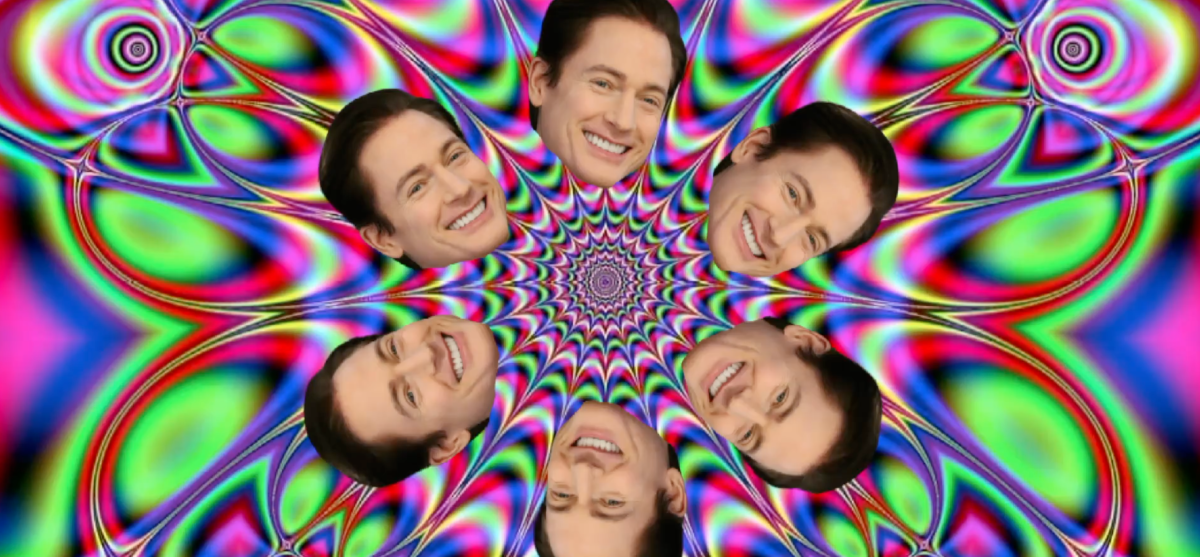
When I was eighteen, I bought a cheap ticket from my college class Facebook group to see Grimes perform at a nearby music festival. Amid the crowd on that sunny afternoon, a drug-addled man continuously tried to climb a young, flimsy tree for a better view. He failed again and again – it was simply impossible for such a dainty plant to hold his weight – yet I watched in fascination and horror as this stranger fixated on a task that would only succeed if he could defy the very laws of physics.
Over a decade later, I found myself in a disturbingly similar situation. I watched Grimes perform on Sunday before yet another drug-addled man. But this time, her DJ set was part of a public livestream for Bryan Johnson, an investor and entrepreneur who had taken a hefty 5.24 gram dose of psilocybin mushrooms to see if psychedelics could aid him in his quest for immortality.
Bryan Johnson – who made his millions selling his finance startup Braintree – wants to live forever. He publicly documents each step of his process on social media, including getting plasma transfusions from his son, taking over 100 pills per day, or injecting Botox into his genitals. All the while, Johnson’s outlandish campaign to cheat death also functions as an advertisement for Kernel, his neurotechnology company, and Blueprint, his business that sells supplements, nut butters, and olive oil.

Johnson promoted his shrooms trip as a livestream extravaganza, complete with hokey graphics resembling a Windows XP desktop. Before his trip, Johnson and his Blueprint co-founder, Kate Tolo, joked they could make this stream like the Super Bowl and sell commercials. What was once a rite of passage for a certain ilk of college kids — listening to music and getting too high — was being turned into a very public, yet remarkably uncool, experiment on stretching the bounds of humanity.
Over a million people viewed the livestream on X, either in real time or as a replay. As Johnson ingested the shrooms and used his own technology from Kernel – a giant black helmet – to monitor his body’s reaction, a cadre of commentators with a collective net worth upwards of $10 billion joined the video feed to heap praise upon Johnson for bravely tripping balls.
While some people see Johnson’s methods as elaborate, vampiric performance art, his Silicon Valley contemporaries think he’s a visionary.
Marc Benioff, founder and CEO of Salesforce, spoke about the parallels he sees between Johnson and the Biblical Jacob.
Techcrunch event
San Francisco
|
October 13-15, 2026
“My Bible study this morning was on Jacob’s Ladder… Jacob ends up with this incredible experience where he’s able to talk to God, and he’s climbing the ladder and coming back down, and finding the land he was in as holy,” Benioff said on the stream. “We’re still trying to find those bridges, and I think that’s what Bryan’s trying to do… he’s not doing this for recreational purposes, I would say.”

Naval Ravikant, the renowned investor and founder of AngelList, described Johnson as a “one-man FDA,” complaining that scientific advancement does not move forward as quickly as he would like due to regulators and bioethicists. It’s reminiscent of the manifesto Marc Andreessen published two years ago, in which he decries “social responsibility” and “tech ethics” as enemies to innovation.
“[Bryan’s] just like screw it, I’ll do it myself, and I’ll legitimize it, I’ll popularize it, I’ll experiment with it, and I’m gonna blaze the trail,” Ravikant said. “I hope he survives for a long time and then gives us the cheat codes. That’s really what we want. There should be a thousand Bryans, ten thousand Bryans out there doing this.”
But Johnson was not privy to this lavish praise – he had put on an eye mask and swaddled himself in a weighted blanket, oblivious to the proceedings of the five-hour livestream he had planned.
“I think it was a bit of a burden to have a microphone and have to be concentrating on what he wanted to say on a livestream,” explained Ashlee Vance, a journalist who has been chronicling Johnson’s pursuit to conquer death.
The purpose of Johnson’s public, meticulously measured shrooms trips is to research the potential for the use of psychedelics in life extension – research that academics are already working on in peer-reviewed studies. He’s far from the first to approach hallucinogens as a therapeutic intervention.
In the 1960s, Harvard psychologist Timothy Leary helped accelerate the movement to adopt psychedelics as mind-expanding tools, even sharing an interest in the same themes that captivate today’s tech elite: space migration, intelligence increase, and life extension, which Leary abbreviated as “SMI²LE.”
In Leary’s era, psychedelics were the focal point of a broader cultural movement that emphasized expanding the mind for the sake of music and art – he had a personal relationship with artists and writers like Allen Ginsberg, Ken Kesey, and the Grateful Dead (then called the Warlocks). Kesey, who has said he volunteered to participate in experiments involving LSD and other psychedelic drugs, was a key influencer of the psychedelic era, whose exploits were documented in Tom Wolfe’s “The Electric Kool-Aid Acid Test.” Even John Lennon first wrote “Come Together” as a campaign song for Leary’s political aspirations, but Leary never did run for office – instead, the song served as the opener for Abbey Road, one of the most iconic albums of the decade.
Two generations later, Johnson is gearing up to take shrooms on a livestream as he tries to explain a concept he calls “longevity escape velocity,” the point at which humans would no longer have to age.
“Time passes, but you stay the same age biologically,” Johnson said. “So that would be probably the most significant accomplishment for humans.”
“AKA, we’re going to try to make Bryan Johnson immortal, effectively, by 2039,” explained Tolo, who sat with Johnson through the duration of the stream.
“So we’re basically doing this protocol and sharing it with all of you, for free, of how can we all do this together?” Johnson said. “So psilocybin is part of that journey where we’re trying to say, what therapies in the world could actually help us slow down our speed of aging, and reverse aging damage?”
Johnson and Tolo portray this shrooms trip as a groundbreaking moment in the quest for immortality. The backdrop isn’t a dimly lit and smoke-filled room festooned with psychedelic colors and music, nor is it a university research lab. Instead, it could be another corporate Zoom meeting with the addition of Johnson wrapped in a weighted blanket and eye mask, happily divorced from responsibility. Looking fondly at Johnson in his cozy cocoon, Benioff remarked, “I think we’re missing a really great opportunity for a sponsorship with a sleep mask company.”

Eventually, Johnson is roused from his swaddle, and Tolo struggles to collect his requisite saliva samples, then places a large black helmet on his head, which records his brain activity while he stares at a wall.
Welcome to Johnson’s longevity revolution, which plays out in a beige room with beige furniture, equipped with laptops and tools for monitoring his biometrics, while some of the richest and most powerful in tech watch along.

Waymo is adding another four cities to its growing list of robotaxi rollouts. The company announced Wednesday it has begun testing its autonomous vehicles (with a safety monitor) in Philadelphia, and that it will start manual driving to collect data in Baltimore, St. Louis, and Pittsburgh.
Waymo did not offer a timeline for when it plans to launch commercial services in those locations, nor do we know whether the Alphabet-owned company will partner with other companies to operate robotaxis in each one. That has been the move in cities like Atlanta and Austin, for example, where Waymo has partnered with Uber to advance its robotaxi rollout.
But the new locations join a list of over 20 cities where the company is either offering rides, prepping a commercial launch, or testing. Waymo is also now offering rides on freeways in Los Angeles, Phoenix, and the San Francisco Bay Area. The company plans to be doing one million rides per week by the end of 2026.
Waymo has done all this while claiming to be operating at a level five times safer than humans, according to data the company recently released.
But the expansion has not come without its issues. The National Highway Traffic Safety Administration is investigating how the company’s vehicles operate near school buses, after a Waymo was filmed driving around a stopped bus in Atlanta in September.
This week, Austin news outlet KXAN published a report showing Waymo’s vehicles have driven past school buses that were in the process of unloading or loading children multiple times — including after Waymo claims to have shipped software updates to address the problem.
Techcrunch event
San Francisco
|
October 13-15, 2026

Spotify Wrapped is back. After last year’s widely criticized flop that included an AI podcast as its highlight, the streamer’s highly anticipated annual review feature has returned to its roots. This year, Spotify is doubling down on what it knows works best: deep dives into your streaming data, creative experiences, messages from favorite artists, and other social features.
The company claims that Wrapped 2025 is its biggest, as it’s introducing nearly a dozen new features in addition to its old standbys, like top songs and artists. Plus, it’s offering more visibility into users’ data than in years past. For the first time, Spotify Wrapped is adding a live multiplayer feature to compare your listening data with friends.
Wrapped Party, Wrapped’s first live interactive experience, allows you to invite up to nine friends to compare listening stats.

Also new this year, your Top Songs Playlist will include the play counts for each of the top songs, so you can actually see how much time you spent with your favorite tracks.
Other standout features this year include an interactive Top Song Quiz, a Listening Age feature, and Wrapped Clubs, which match you to one of six unique listening styles.
The company believes these additions will not only bring back the personalized, engaging experience that users have long expected from Wrapped, but will take it a step further by making it more interactive than before.
In the Top Song Quiz, for instance, you can try to guess which top song soundtracked your year before seeing the results.
Techcrunch event
San Francisco
|
October 13-15, 2026

The new interactive Wrapped Party feature isn’t just about comparing the personal streaming data you’ve already received to your friends’ data, as that’s something people already do on social media. Instead, the feature presents unique data stories for your group, like who’s the “most obsessed fan,” the “early bird,” the most “picky listener,” or even something as nice as the “dinner table explainer,” meaning the person who listens to the most news podcasts.

Spotify says these awards update dynamically every time you join a Wrapped Party, so no two sessions are ever the same — even if you run through them again with the same group of friends.
The new Wrapped Clubs, meanwhile, will group you into one of half a dozen listening styles, like the “Soft Hearts Club,” the “Club Serotonin,” the “Full Charge Crew,” the “Cosmic Stereo Club,” and others. You’ll also receive a role in the club based on your listening data. You might be a club leader if your listening choices strongly matches the club’s values, a scout if you’re always seeking out new releases, or an archivist if you listen to music from past eras.

Another feature, Listening Age, compares your 2025 music listening to others in your age group. To calculate your age, the feature considers the release years of the tracks you listen to most. From there, it identifies the five-year span of music that you engaged with more than other listeners your age.

As in prior years, you’ll see your top songs, top artists, top genres, and, for the first time, top albums. If you engaged with audiobooks and podcasts, you’ll see metrics for those as well. Artists, writers, and podcasters will have their own version of Wrapped as before. And top fans will again receive video messages from their favorite artists, podcasters, and, now, authors.
You’ll also receive a playlist of your top songs of the year, as before.

What you won’t find in this year’s Wrapped is any feature that advertises it was made with AI.
In a press briefing on Tuesday, Spotify’s Senior Director of Global Marketing, Matt Luhks, admitted the company received a “lot of feedback” about its 2024 AI-focused Wrapped experience, saying it was a “mix of positive and ‘more constructive feedback,’” despite the feature driving more engagement than prior years.
“We take all of that in. We use that as information, insights, [and] inspiration for how we approached Wrapped this year,” he said in a press event ahead of today’s launch.
“What our users tell us about Wrapped means a lot to us, so it was really informative in how we approached Wrapped this year. And what we tried to build was the most creative, most innovative, most engaging Wrapped ever,” he added, setting a high bar for the 2025 edition of the now 11-year-old annual year-in-review feature.
“We’re the original and, we believe, still the best,” Luhks said.

Still, AI was a part of the Wrapped experience. Though the company claims the overall experience was not made with AI, it does leverage a LLM (large language model) to add a storytelling layer to Wrapped’s facts and figures, and natural language summaries in other parts of its experience, looking back on your data.
Spotify’s attempt to fix Wrapped after a notable stumble comes as the streamer faces increased competition from Apple, Amazon, YouTube, and others, which have all launched their own annual review features, inspired by Wrapped.
“Everyone seems to have their own version of Wrapped. Now, there’s a lot of reviews and replays and rewinds out there, but we believe that Wrapped still sets the bar for these year-end recaps,” Luhks said.
Along with the consumer experience, Spotify shared its top artists, songs, albums, podcasts, and audiobooks for the year, with top winners that included, respectively, Bad Bunny (top song and album), Joe Rogan (“The Joe Rogan Experience” podcast), and Rebeca Yarros (author of “Fourth Wing”).

Hardware maker Nothing is letting its user base buy its stock as part of a new community investment round of $5 million. The new round, which opens on December 10, will enable consumers to buy the company’s shares at its Series C valuation of $1.3 billion.
The company said it has so far raised $8 million in total from over 8,000 people across two previous community investment rounds. It held its first community funding event in 2021, aiming to raise $1.5 million.
“This isn’t about raising capital, it’s about giving our community/fans a chance to invest while we’re private and join us on the journey,” a spokesperson for Nothing told TechCrunch.
Community investors have a rotating seat on the company’s board, but it is unclear what else they get for investing in the company through such rounds.
Nothing raised $200 million in its Series C back in September from investors including Tiger Global, GV, Highland Europe, EQT, Latitude, I2BF and Tapestry. The company has raised $450 million to date.
The community round comes as Nothing makes changes to its corporate structure as it tries to increase its share of a smartphone market dominated by giants like Samsung and Apple. The company is spinning off its budget CMF brand, and plans to explore AI-centric devices while it keeps building smartphones and audio products. And Nothing claims it crossed $1 billion in cumulative revenue this year, up 150% from 2024.
The startup is working to be “IPO-ready” in three years, CEO Carl Pei told TechCrunch in an email. “The timing will depend on market conditions and what makes sense for the business at that point in time,” he said.
Techcrunch event
San Francisco
|
October 13-15, 2026
“What’s important is that we’re already operating with that discipline now. We’re building the systems, the governance, the financial discipline that a public company needs. It forces us to think longer-term and make smarter decisions that prioritise sustainable growth,” Pei added.
It’s not clear if Nothing aims to raise another round before an IPO. When asked about its fundraising plans, a Nothing spokesperson said the company is not thinking about raising capital immediately, but it wouldn’t be averse to those conversations.
Those interested in investing in the community round can use platforms like Wefunder and Crowdcube to participate.


France Boss Didier Deschamps Praises Argentina vs Egypt Referee

Liverpool Eyeing Move to Sign Wolves Star Mateus Mane

Osun AAC guber candidate calls for sweeping reforms in Nigeria’s political system

Meaning Behind Egypt Manager’s ‘X’ Gesture vs Argentina

Simi Sanya and Femi Dapson Are Now Legally Married and It Is Beautiful to See

Premier League Set-Piece Goals (2025/2026)
-
Sports1 day ago
Meaning Behind Egypt Manager’s ‘X’ Gesture vs Argentina
-
 Sports20 hours ago
Ian Wright Claims Argentina Winning Goal vs Egypt Should Have Been Disallowed
-
 Sports2 days ago
‘Real Reason’ Why Sami Zayn Lost His Title to CM Punk
-
 Sports1 day ago
VAR Expert Claims Egypt Should Have Had Penalty vs Argentina
-
 Sports16 hours ago
Arsene Wenger Says Only Spain Can Stop France Winning the 2026 World Cup
-
Sports5 hours ago
France Boss Didier Deschamps Praises Argentina vs Egypt Referee
-
 Sports1 day ago
The ‘Real Reason’ Roger Federer Was Sitting Alone at Wimbledon
-
 Sports2 days ago
Cristiano Ronaldo’s ‘Arrogant’ Interview After Portugal World Cup Exit