
Business
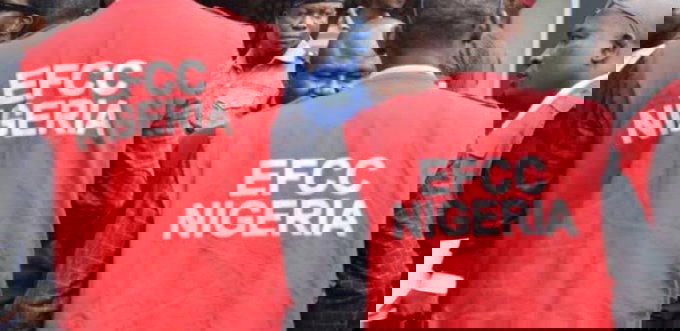
Banks, fintechs facilitate N162bn crypto, N18.7bn scam — EFCC


By Luminous Jannamike
The Economic and Financial Crimes Commission (EFCC) has uncovered widespread compromise within Nigeria’s financial system, revealing that commercial banks, fintech companies and microfinance banks facilitated the movement of N162 billion in cryptocurrency transactions and N18.7 billion in fraud proceeds without due diligence, facilitating scams that affected more than 900,000 Nigerians.
The Commission said the funds were laundered through financial institutions that failed to observe Know Your Customer (KYC) and Customer Due Diligence (CDD) requirements, allowing fraudsters, many of them foreign nationals, to convert illicit proceeds into digital assets and move them to offshore destinations.
The disclosures were made in Abuja yesterday during a media briefing by the Director of Public Affairs of the EFCC and Commander of the EFCC, Wilson Uwujaren, who outlined major investigative breakthroughs recorded by the Commission as it began the 2026 operational year.
Uwujaren said the first scheme involved a syndicate that deployed a fake airline ticket discount system to defraud unsuspecting foreign travellers, using deceptive payment platforms designed to appear as legitimate airline accounts.
“The payment module is designed in such a way that their victims would be convinced that the payment is actually made into the account of the airline. No sooner the payment is made than the passenger’s entire funds in his bank account are emptied,” Uwujaren said.
He explained that while only seven victims initially reported the fraud, deeper investigations revealed that more than 700 victims had been affected, with total losses amounting to N651.1 million.
According to him, the Commission has so far recovered and released N33.6 million to victims.
Uwujaren said investigations showed that the scheme was masterminded by a foreign national who recruited young Nigerians, provided them with laptops and specialised software, and used compromised accounts to execute the fraud, with proceeds converted into cryptocurrency and transferred through Bybit.
The EFCC also uncovered a second, far larger investment fraud linked to an investment firm which lured Nigerians into bogus investment packages.
He said more than 900,000 victims were defrauded in the scheme, with a total of N18.1 billion generated through nine companies offering various investment opportunities.
Uwujaren said investigations again pointed to foreign nationals as the masterminds, noting that three Nigerian accomplices had been arrested and charged to court, while efforts were ongoing to apprehend the fleeing suspects.
A major concern raised by the Commission was the role played by financial institutions, with Uwujaren disclosing that a new-generation bank, alongside six fintech and microfinance banks, compromised standard banking procedures to enable the laundering of fraud proceeds.
“A total sum of N18.7 billion had been moved through our financial system without due diligence of customers by the banks,” he said.
He further described as troubling the discovery that cryptocurrency transactions worth N162 billion passed through a new-generation bank without due diligence, adding that another bank allowed a single customer to operate 960 accounts used solely for fraudulent activities.
“It is worrisome that investigations by the Commission showed that cryptocurrency transactions to the tune of N162 billion passed through a new generation bank without any due diligence,” Uwujaren said.
The EFCC called on regulatory authorities to compel full compliance within the financial sector, warning that institutions found to be aiding or abetting fraud would face sanctions, investigation and possible prosecution.
“Deposit Money Banks, Fintechs, Micro Finance Banks found to be aiding and abetting fraudsters should be suspended and referred to the EFCC for thorough investigation and possible prosecution,” Uwujaren said.
He added that negligence and failure to monitor suspicious and structured transactions would no longer be tolerated, stressing that financial institutions must strengthen their internal systems to stop leakages that continue to bleed the nation’s economy.
The post Banks, fintechs facilitate N162bn crypto, N18.7bn scam — EFCC appeared first on Vanguard News.

By Godwin Oritse
Managing Director
of the Nigerian Ports Authority (NPA), Dr. Abubakar Dantsoho, has expressed support for the Abuja Memorandum of Understanding (Abuja MoU) Capacity Building Programme as a major step towards strengthening maritime governance and enhancing Port State Control across West and Central Africa.
Speaking at the programme’s launch in Abuja, Dantsoho reaffirmed the NPA’s commitment to initiatives that promote maritime safety, security and regulatory compliance in the region.
He said: “The Capacity Building Programme is designed to equip maritime administrations with the knowledge, skills and technical capacity required to implement Port State Control measures effectively, ensure greater compliance with international maritime conventions and improve the overall performance of member states within the Abuja MoU region.”
Dantsoho commended the Chairman of the Abuja MoU, Hon. Ebrima Sillah, Minister of Transport, Works and Infrastructure of The Gambia, for his leadership in advancing regional maritime cooperation.
He also praised the Vice-Chairman of the Abuja MoU and Nigeria’s Minister of Marine and Blue Economy, Adegboyega Oyetola, as well as the Secretariat led by Captain Sunday Umoren.
According to him, “Their dedication and exemplary leadership have continued to drive the objectives of the Memorandum of Understanding on Port State Control for the West and Central African Region.”
Expressing confidence in the initiative, Dantsoho said: “The strengthened collaboration among member states will enhance the effectiveness of Port State Control inspections, improve maritime safety standards and contribute significantly to the sustainable development of the maritime sector across the Abuja MoU region.”
The programme is expected to strengthen institutional capacity, improve compliance with international maritime standards and deepen regional cooperation among member states responsible for Port State Control.

•FTSE Russell delays Nigeria’s Frontier Market status over T+1 concerns
By Peter Egwuatu
The Nigerian stock market ended June on a bearish note, with investors losing a whopping N13.3 trillion in the value of their investments listed on the Nigerian Exchange Limited (NGX) on a month-on-month (MoM) basis, the highest monthly loss recorded in the first six months of 2026.
Despite the sharp decline in June, equity investors recorded a gain of N44.8 trillion in the first half of 2026 (H1’26), reflecting improved capital gains.
Market analysts attributed the bearish performance in June to sustained profit-taking in blue-chip and fundamentally sound stocks, which overshadowed bargain hunting and extended the market’s recent corrective trend.
They noted that investors remained cautious after the impressive rally recorded in May, opting to lock in gains across key sectors amid continued portfolio rebalancing ahead of the half-year earnings season.
Analysis of month-on-month trading showed that the NGX market capitalisation, which represents the total value of equities listed on the Exchange, closed the last trading day of June at N147.217 trillion, down from N160.508 trillion in May 2026, indicating massive sell-offs by investors.
Similarly, the NGX All-Share Index (ASI), another major market performance indicator that measures the cumulative price movement of listed equities, declined by 8.4 per cent to close at 229,419.18 points, compared with 250,385.47 points recorded in May 2026.
The renewed wave of profit-taking came despite the country’s improving macroeconomic indicators and expectations that listed companies with strong fundamentals would deliver resilient half-year results. Investors appeared to adopt a more selective approach, rotating funds into defensive stocks while taking profits in equities that had posted significant capital appreciation since the beginning of the year.
However, in H1’26, the NGX market capitalisation rose by N47.841 trillion to close at N147.217 trillion, from N99.376 trillion recorded at the end of trading in December 2025. Similarly, the NGX ASI surged by 47.4 per cent to close at 229,419.18 points, from 155,613.03 points recorded at the end of December 2025.
Meanwhile, FTSE Russell, a global provider of stock market indices and data analytics, yesterday stated that it had placed Nigeria’s planned reclassification to Frontier Market status under further review.
The global index provider disclosed the development in a statement, citing concerns over the country’s transition to a T+1 settlement cycle, which allows trades to settle one business day after execution. According to the statement, the pause in Nigeria’s planned status upgrade would allow FTSE Russell to examine the implications of the transition for foreign investors.
“Further to the FTSE Equity Country Classification March 2026 Interim Announcement, which confirmed the reclassification of Nigeria from Unclassified to Frontier Market status from September 2026, FTSE Russell announces that the reclassification of Nigeria is under further review.
“A requirement to prefund equity trades is deemed a negative for the ‘Settlement Cycle (DvP)’ criterion, which is one of the five core FTSE Quality of Markets criteria required for attaining Frontier Market status within the FTSE Equity Country Classification scheme.
“Consequently, the reclassification of Nigeria is under further review to assess the implications of the transition to a T+1 settlement cycle for international institutional investors.”
FTSE Russell said it would provide an update on Nigeria’s potential reclassification to Frontier Market status by the end of August 2026.

The Federal Competition and Consumer Protection Commission (FCCPC) has warned oil marketers against exploiting consumers, saying the current retail prices of petrol do not reflect the sharp decline in global crude oil prices.
In a statement issued on Sunday, the Commission said its ongoing surveillance of the downstream petroleum sector had uncovered indications of consumer exploitation, as recent reductions in petrol prices by refiners, depot operators and marketers remain insignificant despite the sustained fall in crude oil prices.
According to the FCCPC, global crude oil prices have dropped to about 73 dollars per barrel following the ceasefire between the United States and Iran and the reopening of the Strait of Hormuz. The agency noted that crude prices had climbed to about 120 dollars per barrel at the height of tensions in the Middle East between April and May, prompting a swift increase in petrol pump prices across Nigeria.
The Commission observed that while crude oil prices have now returned to levels recorded in February, retail fuel prices have remained relatively high.
It recalled that petrol sold for between ₦800 and ₦900 per litre in February, but rose sharply to between ₦1,350 and ₦1,500 per litre during the period of heightened geopolitical tensions. Despite the subsequent drop in crude oil prices, petrol is still being sold at an average of about ₦1,200 per litre, while some local refiners have fixed ex-depot prices between ₦1,025 and ₦1,075 per litre.
The Commission acknowledged that domestic fuel prices are influenced by several factors, including refining costs, foreign exchange fluctuations, logistics, financing and distribution expenses. However, it maintained that consumers should benefit from lower crude oil prices through competitive market pricing.
Executive Vice Chairman and Chief Executive Officer of the FCCPC, Tunji Bello, said although the Commission does not regulate petrol prices in Nigeria’s deregulated downstream petroleum sector, it has a statutory responsibility to ensure consumers are protected from unfair and exploitative practices.
“To be clear, the Commission does not regulate or approve petroleum prices in a deregulated downstream market. Our responsibility under the Federal Competition and Consumer Protection Act, 2018, is to promote competitive markets, prevent anti-competitive conduct and protect consumers from unfair, deceptive and exploitative business practices,” Bello said.
He questioned why marketers often respond immediately by increasing pump prices whenever crude oil prices rise, yet delay passing on the benefits to consumers when prices fall.
“We are concerned that while dealers often respond swiftly by hiking pump prices whenever crude prices rise, it is curious that it is taking forever for consumers to benefit significantly when crude prices fall. Competitive markets must work fairly in both directions,” he added.
Bello warned that deregulation does not absolve businesses of the responsibility to compete fairly or respect consumer rights.
According to him, the Commission will investigate and sanction any company found engaging in anti-competitive conduct, consumer exploitation or any practice that violates the Federal Competition and Consumer Protection Act.
“Where credible evidence indicates conduct that undermines competition, exploits consumers or otherwise contravenes the Federal Competition and Consumer Protection Act, the Commission will investigate and take appropriate enforcement action,” he said.
He also urged Nigerians to continue reporting suspected price manipulation, anti-competitive practices and other unfair market behaviour through the Commission’s official complaint channels.
The FCCPC’s warning comes days after the Dangote Refinery reduced its ex-depot petrol price from ₦1,175 to ₦1,125 per litre, following the continued decline in international crude oil prices. Brent crude, the global oil benchmark, recently fell to about 72.97 dollars per barrel, its lowest level since February.


FIFA Issue Statement After Controversial Germany vs Paraguay VAR Call

Notorious bandit, Auta Yankuzo posts cash obtained from kidnap ransom on TikTok

Everton Exploring Deal To Sign Gabriel Jesus From Arsenal

Simi Sanya and Femi Dapson Are Now Legally Married and It Is Beautiful to See

FCT Area Council Election: Live results from polling units

Premier League Set-Piece Goals (2025/2026)
-
 Sports23 hours ago
Kevin Pietersen Causes Stir With Tweet About His International Cricket Retirement
-
 Sports23 hours ago
Virgil van Dijk Slammed For Comments After Netherlands’ World Cup Exit v Morocco
-
 Sports22 hours ago
Carlo Ancelotti Explains Why He Didn’t Celebrate Brazil’s Winner v Japan
-
 Sports1 day ago
Zlatan Ibrahimovic Blames Netherlands’ Shock World Cup Exit on Ronald Koeman
-
 Sports18 hours ago
Leon Goretzka Slammed For Not Taking Penalty in Germany vs Paraguay
-
 Sports21 hours ago
Virgil van Dijk Blasted For Not Taking a Penalty in Netherlands’ World Cup Exit v Morocco
-
 Sports2 days ago
Roger Federer Names His Top 5 Tennis Players of All Time
-
 Sports2 days ago
How Much Emma Raducanu Will Earn Despite Withdrawing Through Injury