
Business
Trump threatens Canada with 100% tariff over China trade deal

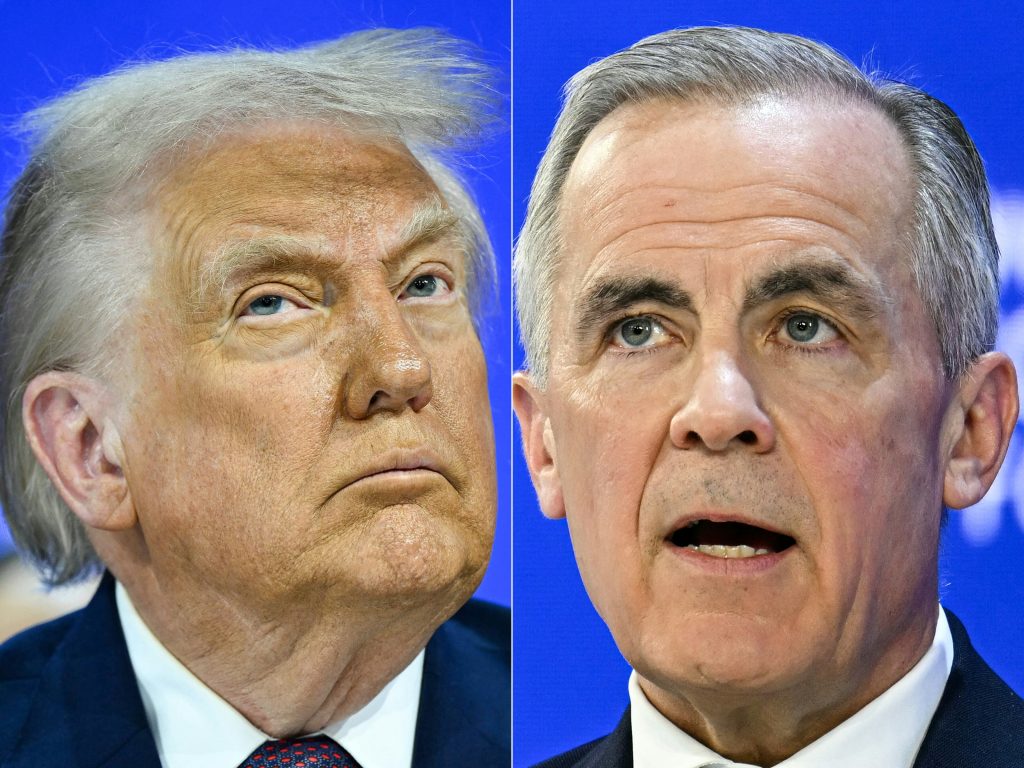
US President Donald Trump on Saturday warned Canada that if it concludes a trade deal with China, he will impose a 100 percent tariff on all goods coming over the border.
Relations between the United States and its northern neighbor have been rocky since Trump returned to the White House a year ago, with spats over trade and Canadian Prime Minister Mark Carney decrying a “rupture” in the US-led global order.
During a visit to Beijing last week, Carney hailed a “new strategic partnership” with China that resulted in a “preliminary but landmark trade agreement” to reduce tariffs — but Trump warned of serious consequences should that deal be realized.
If Carney “thinks he is going to make Canada a ‘Drop Off Port’ for China to send goods and products into the United States, he is sorely mistaken,” Trump wrote on his Truth Social platform.
“China will eat Canada alive, completely devour it, including the destruction of their businesses, social fabric, and general way of life,” he said.
“If Canada makes a deal with China, it will immediately be hit with a 100% Tariff against all Canadian goods and products coming into the USA.”
Trump insulted Carney by calling him “Governor” – a swipe referring to the US president’s repeated insistence that Canada should be the 51st US state.
Trump this week posted an image on social media of a map with Canada — as well as Greenland and Venezuela — covered by the American flag.
‘Canada thrives because we are Canadian’
The two leaders have sharpened their rhetorical knives in recent days, beginning with Carney’s speech on Tuesday at the World Economic Forum in Davos, where he earned a standing ovation for his frank assessment of a “rupture” in the US-led global order.
His comment was widely viewed as a reference to Trump’s disruptive influence on international affairs, although the US leader was not mentioned by name.
Trump fired back at Carney a day later in his own speech, and then withdrew an invitation for the Canadian prime minister to join his “Board of Peace” — his self-styled body for resolving global conflict.
Initially designed to oversee the situation in postwar Gaza, the body appears now to have a far wider scope, sparking concerns that Trump wants to create a rival to the United Nations.
“Canada lives because of the United States. Remember that, Mark, the next time you make your statements,” Trump said.
Carney fired back on Thursday: “Canada doesn’t live because of the United States. Canada thrives because we are Canadian.” He nevertheless acknowledged the “remarkable partnership” between the two nations.
Trade spats
Canada is heavily reliant on trade with the United States, the destination for more than three quarters of Canadian exports.
Key Canadian sectors like auto, aluminum and steel have been hit hard by Trump’s global sectoral tariffs, but the impacts of the levies have been muted by the president’s broad adherence to an existing North American free trade agreement.
Negotiations on revising that deal are set for early this year, and Trump has repeatedly insisted the United States doesn’t need access to any Canadian products — which would have sweeping consequences for its northern neighbor.
The two nations, along with Mexico, are set to host the World Cup later this year.
The post Trump threatens Canada with 100% tariff over China trade deal appeared first on Vanguard News.

The Federal Competition and Consumer Protection Commission (FCCPC) has warned oil marketers against exploiting consumers, saying the current retail prices of petrol do not reflect the sharp decline in global crude oil prices.
In a statement issued on Sunday, the Commission said its ongoing surveillance of the downstream petroleum sector had uncovered indications of consumer exploitation, as recent reductions in petrol prices by refiners, depot operators and marketers remain insignificant despite the sustained fall in crude oil prices.
According to the FCCPC, global crude oil prices have dropped to about 73 dollars per barrel following the ceasefire between the United States and Iran and the reopening of the Strait of Hormuz. The agency noted that crude prices had climbed to about 120 dollars per barrel at the height of tensions in the Middle East between April and May, prompting a swift increase in petrol pump prices across Nigeria.
The Commission observed that while crude oil prices have now returned to levels recorded in February, retail fuel prices have remained relatively high.
It recalled that petrol sold for between ₦800 and ₦900 per litre in February, but rose sharply to between ₦1,350 and ₦1,500 per litre during the period of heightened geopolitical tensions. Despite the subsequent drop in crude oil prices, petrol is still being sold at an average of about ₦1,200 per litre, while some local refiners have fixed ex-depot prices between ₦1,025 and ₦1,075 per litre.
The Commission acknowledged that domestic fuel prices are influenced by several factors, including refining costs, foreign exchange fluctuations, logistics, financing and distribution expenses. However, it maintained that consumers should benefit from lower crude oil prices through competitive market pricing.
Executive Vice Chairman and Chief Executive Officer of the FCCPC, Tunji Bello, said although the Commission does not regulate petrol prices in Nigeria’s deregulated downstream petroleum sector, it has a statutory responsibility to ensure consumers are protected from unfair and exploitative practices.
“To be clear, the Commission does not regulate or approve petroleum prices in a deregulated downstream market. Our responsibility under the Federal Competition and Consumer Protection Act, 2018, is to promote competitive markets, prevent anti-competitive conduct and protect consumers from unfair, deceptive and exploitative business practices,” Bello said.
He questioned why marketers often respond immediately by increasing pump prices whenever crude oil prices rise, yet delay passing on the benefits to consumers when prices fall.
“We are concerned that while dealers often respond swiftly by hiking pump prices whenever crude prices rise, it is curious that it is taking forever for consumers to benefit significantly when crude prices fall. Competitive markets must work fairly in both directions,” he added.
Bello warned that deregulation does not absolve businesses of the responsibility to compete fairly or respect consumer rights.
According to him, the Commission will investigate and sanction any company found engaging in anti-competitive conduct, consumer exploitation or any practice that violates the Federal Competition and Consumer Protection Act.
“Where credible evidence indicates conduct that undermines competition, exploits consumers or otherwise contravenes the Federal Competition and Consumer Protection Act, the Commission will investigate and take appropriate enforcement action,” he said.
He also urged Nigerians to continue reporting suspected price manipulation, anti-competitive practices and other unfair market behaviour through the Commission’s official complaint channels.
The FCCPC’s warning comes days after the Dangote Refinery reduced its ex-depot petrol price from ₦1,175 to ₦1,125 per litre, following the continued decline in international crude oil prices. Brent crude, the global oil benchmark, recently fell to about 72.97 dollars per barrel, its lowest level since February.

By Godwin Oritse
The Association of Nigerian Licensed Customs Agents (ANLCA) has called on the Federal Government (FG) to suspend the implementation of the Green Tax Policy, scheduled to take off from July 1st, 2026, citing inadequate stakeholder engagement by the implementing agency, the Nigeria Customs Service (NCS).
The association argued that key stakeholders, particularly licensed customs agents and importers, who will be directly affected by the policy were not sufficiently sensitised or consulted before its rollout.
In a statement signed by ANLCA President, Emenike Nwokeoji, yesterday, the association expressed concern that a fiscal policy with such far-reaching implications for import duty, cargo valuation, contractual obligations, shipping arrangements and business planning was communicated to only a section of the critical trading community in Lagos barely 72 hours before its proposed implementation.
“Even more astonishing was the extremely late invitation extended to stakeholders for the consultation meeting. Such an approach is insensitive, procedurally defective and inconsistent with the principles of fairness, inclusiveness, stakeholder engagement and due consultation that should ordinarily guide the implementation of major public policies.
“Fiscal policies of this magnitude ought to be preceded by adequate notice, extensive consultations with all relevant stakeholders across the country, comprehensive sensitisation and sufficient transitional periods to ensure seamless compliance.
Anything short of this undermines confidence in government policies, exposes legitimate businesses to avoidable financial losses and ultimately erodes the confidence of both local and foreign investors in Nigeria’s trade environment.”
The group also raised concern about the decision to subject shipments already in transit to Nigeria to the new levy.
“This amounts to a retrospective fiscal burden on importers and licensed customs agents who had already entered into binding commercial contracts based on the existing tariff regime. Such a development will inevitably result in severe financial losses and unnecessary disputes within the international trading community.
“Furthermore, the stakeholders’ meeting failed to adequately address critical implementation issues. For instance, there was no clear methodology provided for determining engine capacities for the purpose of Green Tax assessment.
“This ambiguity is capable of creating confusion, inconsistent assessments, avoidable disputes and ultimately leaving the trading public at the discretion of individual assessment officers.
“ANLCA remains committed to constructive engagement with the Federal Government and the Nigeria Customs Service in pursuit of policies that promote legitimate trade while achieving national objectives,” he said.
The association also made it clear that it is not challenging the authority of the Federal Government to formulate or implement fiscal policies. It, however, demanded the immediate suspension or postponement of the implementation of the Green Tax Policy until adequate stakeholder consultations have been conducted nationwide.

By Elizabeth Adegbesan
The national average Cost of a Healthy Diet (CoHD) rose by 3.12 percent month-on-month (MoM) to N1,589 per adult per day in April from N1,541 per adult per day in March 2026.
The National Bureau of Statistics (NBS) disclosed this yesterday in its CoHD Report for April 2026, noting that the increase was driven by rising prices across all food groups except starchy staples.
it stated: “The national average Cost of a Healthy Diet was N1,589 in April 2026. This shows an increase of 3.12% when compared to the amount recorded in the previous month (March 2026 was N1,541).”
The Bureau noted that the CoHD rose faster than both general inflation and food inflation during the period.
On the cost of food share groups, the Bureau said animal source foods were the most expensive food group recommendations to meet in April, accounting for 40 percent of the total CoHD while providing 13 percent of the total calories.
“Fruits and vegetables were the most expensive food groups in terms of price per calorie; they accounted for 16 percent and 14 percent, respectively, of the total CoHD while providing only 7 percent and 5 percent, respectively, of the total calories in the Healthy Diet Basket.
“Legumes, Nuts, and Seeds were the least expensive food group on average, accounting for 7 percent of the total cost.”
On national, state and zonal trends, the NBS said: “The national average Cost of a Healthy Diet was N1,589 per adult per day in April 2026.
“At the state level, Ekiti, Imo and Bayelsa states recorded the highest costs at N2,036, N2,018 and N1,909, respectively. Adamawa, the Federal Capital Territory and Akwa Ibom State recorded the lowest costs at N1,143, N1,278 and N1,314, respectively.
“At the zonal level, the average CoHD was highest in the South-East Zone at N1,830 per day, followed by the South-West Zone at N1,753 per day.
“The lowest average Cost of a Healthy Diet was recorded in the North-East Zone at N1,415 per day.”


16 Favourites to Land NBA Icon

World Cup Player Ratings and Match Highlights

Donald Trump Reacts to US Court’s Ruling Over Transgender Athlete Bans

Simi Sanya and Femi Dapson Are Now Legally Married and It Is Beautiful to See

FCT Area Council Election: Live results from polling units

Premier League Set-Piece Goals (2025/2026)
-
 Sports15 hours ago
Virgil van Dijk Slammed For Comments After Netherlands’ World Cup Exit v Morocco
-
 Sports15 hours ago
Kevin Pietersen Causes Stir With Tweet About His International Cricket Retirement
-
 Sports14 hours ago
Carlo Ancelotti Explains Why He Didn’t Celebrate Brazil’s Winner v Japan
-
 Sports18 hours ago
Zlatan Ibrahimovic Blames Netherlands’ Shock World Cup Exit on Ronald Koeman
-
 Sports10 hours ago
Leon Goretzka Slammed For Not Taking Penalty in Germany vs Paraguay
-
 Sports1 day ago
Roger Federer Names His Top 5 Tennis Players of All Time
-
 Sports2 days ago
How Much Emma Raducanu Will Earn Despite Withdrawing Through Injury
-
 Sports13 hours ago
Virgil van Dijk Blasted For Not Taking a Penalty in Netherlands’ World Cup Exit v Morocco