
Business
‘Elumelu effect’ drives Seplat to historic N10,000 – First NGX stock to cross barrier


By Udeme Akpan
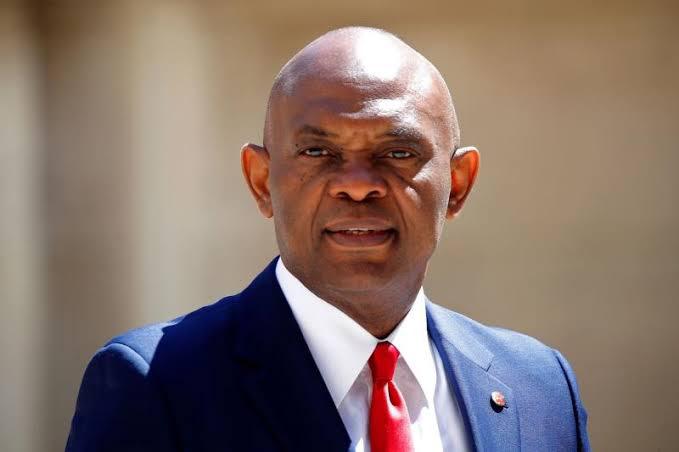
Seplat Energy Plc has become the first company in the 65-year history of the Nigerian Exchange (NGX) to close above N10,000 per share, a milestone directly linked to the strategic investment by Tony Elumelu’s Heirs Energies.
Seplat closed trading on April 14, 2026, at N10,450 per share, representing a staggering 80 per cent gain since January and adding approximately N2.9 trillion in market capitalisation in just four months.
The historic rally traces directly to a single transaction: In December 2025, Tony Elumelu’s Heirs Energies acquired a 20.07 per cent stake in Seplat Energy for approximately $500 million, becoming the company’s single largest shareholder. Elumelu subsequently joined Seplat’s Board as a Non-Executive Director in January 2026.
That $500 million investment is now valued at over $800 million – a $300 million paper gain in under 120 days.
‘Elumelu Effect’ Triggers Market Re-rating
Market analysts have dubbed the surge the “Elumelu effect,” pointing to the billionaire investor’s track record of transforming companies such as United Bank for Africa (UBA) and Transcorp.
Since Tony Elumelu’s Heirs Energies became the largest shareholder, Seplat’s share price has gained over N4,600, making it the most valuable indigenous energy stock on the continent.
The rally has been further supported by Nigeria’s recent reclassification by FTSE Russell from “Unclassified” to Frontier Market status, effective September 2026. Analysts project the upgrade could drive between $840 million and over $1 billion in foreign portfolio inflows into Nigerian equities, with Seplat positioned as a prime beneficiary.
Record Financial Performance Underpins Rally
The share price surge is anchored in Seplat’s strong 2025 financial results. Revenue grew 144 per cent to $2.73 billion, while profit before tax jumped 86.7 per cent to $497.8 million. Adjusted EBITDA rose 137 per cent to $1.28 billion, and total dividend increased 52 per cent to 25.0 cents per share.
Seplat’s production averaged 131,506 barrels of oil equivalent per day (boepd) in 2025, up 148 per cent, reflecting the first full-year consolidation of offshore assets following its acquisition of Mobil Producing Nigeria Unlimited.
The company has issued 2026 production guidance of 135–155 kboepd and plans to drill 17 new wells.
Market Reaction
Following the record close, the NGX All-Share Index reached an all-time high of 205,831.38 points, while the Oil & Gas Index gained 4.36 per cent, led by Seplat.
CardinalStone Research described Seplat as “the undisputed heavyweight driver of the session,” while Meristem Securities reinstated a Buy rating on the stock.
The record-breaking rally marks a defining moment for Nigeria’s energy sector, demonstrating that indigenous capital — when deployed strategically — can drive transformative value creation. Elumelu’s Heirs Energies has signalled that this is a long-term commitment to building an African energy champion, and the market has responded decisively.
The post ‘Elumelu effect’ drives Seplat to historic N10,000 – First NGX stock to cross barrier appeared first on Vanguard News.


By Etop Ekanem
Chief Executive Officer of Jumia Group, Francis Dufay, has offered a perspective that placed Nigeria not at the margins of risk, but at the centre of reform, growth and stability.
Speaking during a panel on emerging markets, at the Sohn Conference in New York, Dufay described the period between 2021 and 2024 as one of the most difficult economic cycles in recent memory for African markets, with Nigeria among the hardest hit.
Sharp currency swings, weakened consumer purchasing power, and inflation created a challenging operating environment, particularly for sectors tied to imports, logistics, payments, and retail demand. For businesses like Jumia, where pricing stability, inventory planning, and payment predictability are critical, the volatility tested resilience.
But according to Dufay, the pressure forced structural responses, arguing that Nigeria’s reform trajectory, particularly under President Bola Tinubu, has marked the beginning of a new macro-cycle. Measures around exchange rate unification, fiscal adjustments, and broader economic restructuring, he suggested, are gradually creating a more transparent and stable operating environment for compliant businesses.
He pointed to Nigeria as a clear case study of reform under strain. “Nigeria was in a tough situation three or four years back,” he noted.
adding that recent policy shifts are laying the foundations for greater stability. For e-commerce and digital platforms, that stability translates directly into improved pricing models, better supplier relationships, stronger payment flows, and renewed investor confidence.
The post Nigeria’s economic recalibration good for business — Jumia CEO appeared first on Vanguard News.


By Emma Ujah, Abuja Bureau Chief
The Central Bank of Nigeria (CBN) has issued fresh Foreign Exchange Guidelines which provides that an individual can move cash of up to $50,000, but must be declared at the point of exit.
The bank also retained the earlier provision for the movement or import of cash of up to $10,000 without having to declare it.
A document cited by Vanguard stated, “The following may be exported from Nigeria: Without declaration, foreign currency, either in cash or any other credit instruments not exceeding $10,000.00 or its equivalent in other foreign currencies.
“Any amount in excess of $10,000.00 but not more than $50,000.00 or its equivalent in other foreign currencies, provided the whole amount is declared at the point of exit.
“Any amount above $50,000.00 or its equivalent in other foreign currency, subject to evidence of transaction/procurement through an Authorised Dealer.
“Foreign currency, drafts, etc, brought into the country less expenses incurred, except foreign currency held as a ship or aircraft fund.
“Foreign currency, either in cash or any other credit instrument, not exceeding $10,000.00 or its equivalent in other foreign currencies, may be imported into Nigeria by a person without declaration.
“However, any amount above US$10,000.00 or its equivalent in other foreign currencies shall be declared at the point of entry.”
It provides that Authorised Dealer Banks can import foreign currency to meet their local cash needs, subject to prior approval of the CBN.
The guidelines says all inbound FX transfers to Nigeria shall be disbursed to beneficiaries’ bank accounts in Naira or any currency as may be determined by the CBN from time to time.
The document further stated: “Maximum allowable cash withdrawal for inbound mon-ey transfer shall not be more than the Naira equivalent of USD200.00, and any amount in excess of USD200 shall be paid through an account.
“All IMTOs shall open Naira settlement accounts and ensure that all transactions are routed strictly through their designated settlement accounts, maintained with Authorised Dealer Banks in Nigeria.
“Authorised Dealers and Buyers may purchase foreign currency from individuals visiting Nigeria. At the time of their departure, such visitors may exchange the unutilized balance of Nigerian currency for foreign currency, provided there is evidence of initial conversion.
“Such an exchange is limited to the amount converted at entry if done through an Authorised Dealer, while an Authorised Buyer can exchange the unutilised balance of the converted amount.”
The post CBN unveils new FX guidelines, approves cash movement of $50,000 appeared first on Vanguard News.

By Elizabeth Adegbesan
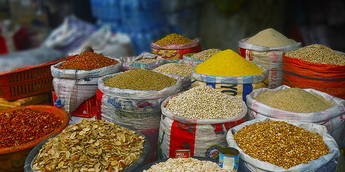
Despite the moderation in inflation rate reported by the National Bureau of Statistics, NBS, the financial burden of feeding on Nigerian households may have intensified as the national average Cost of a Healthy Diet (CoHD) climbed to N1,541 per adult per in March 2026, about 4.4 per cent up from N1,477 in March 2025.
The Bureau had reported a steady downward trend in inflation rate up till February 2026 but the trend reversed marginally in March and April.
On a month-on-month basis, nutritious food prices rose by 1.89 percent from February 2026.
However, NBS noted that the upward movement in CoHD was driven by price hikes across almost all essential food groups.
It stated: “The national average Cost of a Healthy Diet was N1,541 per adult per day in March 2026.
“On a month-on-month basis, the cost increased by 1.89 percent compared to February 2026 (N1,513).
“The increase was driven by the rise in prices across all food groups.”
Data from the report revealed sharp geographical divides in food affordability.
Southern states bear the heaviest financial burden, while northern regions enjoy lower costs.
NBS said: “At the State level Ekiti, Imo and Abia States recorded the highest cost at N2,091, N2,052, and N1,970 respectively.
“Adamawa, Federal Capital Territory and Taraba State accounted for the lowest costs at N1,004, N1,113 and N1,149 respectively.”
Zonally, the South-East emerged as the most expensive region at N1,899 per day, followed closely by the South-West at N1,801.
The North-East remained the most affordable zone at N1,233 daily.
The report further showed that meeting dietary guidelines for animal-source foods proved to be the most expensive component.
This category accounted for 39 percent of total daily costs while delivering just 13 percent of total calorie intake.
Fruits and vegetables also strained budgets due to their low calorie-to-price ratio.
Fruits consumed 16 percent of the daily budget for a mere 7 percent of calories.
Vegetables consumed 14 percent of the budget while providing only 5 percent of calories. Legumes, nuts, and seeds remained the most economical choice, representing just 7.0 percent of total costs.
The post Food Crisis: Cost of healthy diet rises further — NBS Report appeared first on Vanguard News.


England Fans Worried by Ivan Toney vs New Zealand Display

Predicting England’s Starting 11 For 2026 World Cup Opener

ADC constitutes Ekiti governorship campaign committee [PHOTO]

Simi Sanya and Femi Dapson Are Now Legally Married and It Is Beautiful to See

FCT Area Council Election: Live results from polling units

Premier League Set-Piece Goals (2025/2026)
-
 Sports7 hours ago
Yaya Toure to Take Charge of Slovan Bratislava in First Manager Job
-
 Sports2 days ago
Ibrahima Konate to Earn Crazy Amount at Real Madrid as Liverpool Wage Compared
-
 Politics1 day ago
Anger as Anambra govt arraigns Abia NDC Senatorial aspirant for alleged fake miracles
-
 Sports1 day ago
Sheikh Jassim’s Stance on New Man Utd Takeover Bid
-
 Sports2 days ago
Newcastle Agree £25m Deal to Sign Ewen Jaouen
-
 Sports1 day ago
Arsenal Set Record-Breaking Transfer Price Tag For Gabriel Martinelli
-
 Sports13 hours ago
More Than a Dozen Iran Staff Members Denied Entry Into the United States
-
 Sports1 day ago
Ravel Morrison Was Better Than Lamine Yamal