
Health
Cholera, measles, and mpox persist across Africa despite shifting response patterns – healthnews.ng


Post Views: 27
Cholera, measles, and mpox continue to drive public health activity across Africa in 2026, with new data showing a mix of declining transmission in some areas and renewed increases in others.
According to the latest Africa CDC weekly briefing, 95 moderate- to high-risk public health events have been recorded so far this year, reflecting sustained pressure on surveillance and response systems across the continent.
Cholera: uneven trends, persistent risk
Cholera remains one of the most widespread outbreaks. As of epidemiological week 15, 15 countries had reported 35,048 cases and 750 deaths. Recent trends show a split pattern. Cases have increased in Burundi, Nigeria, and Angola over the past three weeks, indicating ongoing transmission. Nigeria alone recorded a rise of more than 300 cases in that period.
At the same time, several countries—including the Democratic Republic of the Congo (DRC), Mozambique, and Somalia—have reported declining case numbers.
Despite these reductions, the overall burden remains high. The DRC and Mozambique together account for about 80% of reported cases, with the DRC responsible for the majority of deaths. Transmission continues to be linked to displacement, flooding, and limited access to safe water and sanitation, particularly in conflict-affected areas.
Measles: concentrated burden, ongoing transmission
Measles remains a major contributor to morbidity and mortality, with 72,544 cases and 549 deaths reported across 21 countries this year. The outbreak is highly concentrated. The DRC accounts for around 70% of cases and 95% of deaths, reflecting a combination of low vaccination coverage, population displacement, and gaps in access to healthcare.
Across the continent, case numbers have remained broadly stable compared with previous years, suggesting continued transmission rather than large-scale expansion.
Mpox: declining from peak but still active
Mpox activity has declined significantly compared with 2025, but transmission continues across multiple countries. In epidemiological week 15, 1,016 suspected cases and 157 confirmed cases were reported, with 15 countries still classified as active.
Recent data show that Madagascar, Kenya, and Guinea accounted for around 80% of confirmed cases over the previous six weeks. The broader trend suggests a transition from emergency response to more routine management, although surveillance and targeted vaccination campaigns are ongoing.
New and emerging signals
Alongside these established outbreaks, health authorities are tracking new developments. In Cameroon, a pertussis outbreak has been confirmed, with 120 suspected cases and low testing coverage. Vaccination coverage for the third dose of the pentavalent vaccine stood at just over 54% in early 2026.
In Burundi, an undiagnosed illness cluster has raised concern. Thirty-eight cases and five deaths have been reported, with a case fatality rate of about 13%. Laboratory testing has ruled out major viral haemorrhagic fevers, and investigations are ongoing.

Why you feel dizzy when you stand up?
A young, healthy patient asked me: “Doc, sometimes when I stand up from the bed too fast, my vision goes completely black for two seconds and I get dizzy. Am I having a mini-stroke?”
No, it is actually proof that your nervous system is working perfectly.
The exact neurovascular cascade behind why your vision blacks out when you stand up too fast and why you don’t actually pass out. 👇
• The Gravity Drop: When you are lying down, your heart pumps blood easily on a flat plane. The moment you stand up abruptly, gravity instantly pulls about 500 to 800 mL of your blood straight down into your legs.
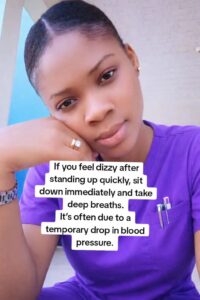
• The Transient Drain: This sudden pooling means less blood returns to your heart, which temporarily means less blood is pumped up to your head. For a split second, your brain experiences a drop in pressure.
• The Visual Blackout: The retina (the back of your eye) is incredibly sensitive to oxygen and pressure changes. When the blood pressure dips, the retina temporarily shuts down to conserve energy which is exactly why your vision goes black or static.
• The Baroreceptor Rescue: Luckily, you have pressure sensors (baroreceptors) in your neck. Within milliseconds, they detect the blood pressure drop and fire a panic signal to your brainstem.
• The Sympathetic Snap: Your autonomic nervous system instantly kicks in. It violently constricts the blood vessels in your legs and spikes your heart rate, physically squeezing the blood right back up to your brain. Vision restored.
Summary:
First time this happened to me I genuinely thought I was dying.
Turns out my body was just buffering.
Knowing the science changes everything
Here’s what’s actually happening:
When you stand up quickly, gravity pulls blood downward. Your body briefly has less blood reaching the brain. Your nervous system — specifically the baroreceptors –detects this drop and rapidly triggers your heart to beat faster and your blood vessels to constrict, restoring blood flow within seconds.
The momentary blackout and dizziness is just that brief gap before the correction kicks in.
👉Hi, I am Dr. Priyam. I break down complex medical science and advocate for Evidence-Based Medicine. FOLLOW ME for more clinical facts.


can a+ and a+ give birth to o+ or O negative?
Itâs a panic that lands in clinics and WhatsApp groups far too often: âBoth of us are A positive⦠how is our child O negative? Did the lab mess up? Or is something else going on?â
The short, reassuring answer is no lab error, no mystery, and no betrayal. This outcome is completely possible under normal genetics. Hereâs why the âmathâ actually maths perfectly once we look at what blood-type tests really reveal.
Your blood type is decided by two separate systems that most people only see the final phenotype of, not the hidden genes.
ABO system ð©¸ð©¸ð©¸ð©¸ð©¸ð©¸ð©¸ð©¸ð©¸
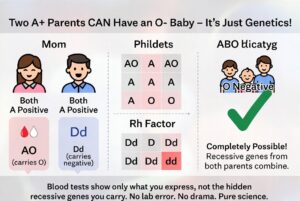
Type A means you carry at least one A allele. You could be AA or AO. The O allele is recessive and invisible in your test result. If both you and your partner are AO (very common), each of you has a 50 % chance of passing the O allele. When both pass O, the child is blood group O. Roughly 45â50 % of people with type A are actually AO carriers, so this pairing happens every day.
Rh (positive/negative) system ð©¸ð©¸ð©¸
âPositiveâ means you have the dominant D antigen. You can still be heterozygous Dd and carry the recessive d allele. If both parents are Dd, there is a 25 % chance the child inherits d from both and is Rh negative. About 15 % of people are Rh negative, which means a large portion of âpositiveâ people quietly carry the d gene.
When both parents are A positive but heterozygous for both traits (AO and Dd), an O-negative child is not only possible â it is mathematically expected in a predictable percentage of pregnancies. The child simply received the two recessive alleles that were hiding in plain sight in both parents.
Blood-group reports show only what antigens are expressed on red cells. They do not sequence your DNA or tell you whether you are homozygous or heterozygous. That hidden information is what allows âimpossibleâ combinations to appear regularly in perfectly ordinary families.
This is basic Mendelian inheritance, not infidelity or laboratory failure. The same recessive-gene logic explains blue-eyed children born to brown-eyed parents or curly-haired kids from straight-haired couples. It is science doing exactly what it is supposed to do.
If the result still feels unsettling, a simple conversation with your doctor or a genetics counsellor can walk you through your specific probabilities. In the overwhelming majority of cases, however, the only thing that needs updating is the outdated assumption that blood types behave like simple labels instead of the elegant, recessive-carrying system they actually are.
Your O-negative child is not evidence of a mistake. They are proof that genetics loves surprises â and that love (and science) are doing just fine.ââââââââââââââââââââââââââââââââââââââââââââââââââ
Dr Parveen Yograj

Why does BCG vaccine leave a scar?
That scar on your arm is a battlefield, and the chemistry of how it forms is completely different from any other vaccine you’ve ever received.
Most vaccines inject dead or weakened pathogens into your muscle. Your immune system sees the threat, builds antibodies, done. No lasting damage to the tissue. The BCG tuberculosis vaccine does something radically different. It injects live Mycobacterium bovis bacteria directly into the top layer of your skin, the dermis, and then lets them multiply.
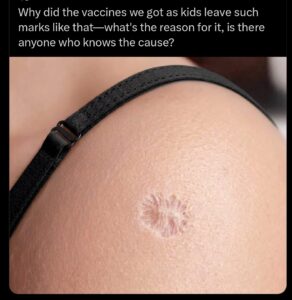
For the first six weeks, those bacteria are actively replicating at the injection site. Your immune system detects them and sends macrophages to engulf the invaders. T-cells get recruited to the area. Then something happens that no other routine vaccine triggers: your body builds granulomas. Those are organized clusters of immune cells that physically wall off the bacteria like a biological quarantine zone. The immune system can’t fully kill every bacterium, so it builds a containment structure around them instead.
That containment war destroys tissue. The granulomas break down the dermis. A blister forms, then an open ulcer that weeps for weeks. The entire process from injection to final scar takes about three months. What you’re left with is the structural aftermath of your immune system demolishing a section of its own skin to contain a live bacterial colony.
The wild part: 4 billion doses administered since 1921. 100 million newborns receive it every year. And the size of your scar correlates with how strong your immune response was. Studies in West Africa found that infants who developed a visible scar had half the mortality rate of infants who didn’t. Not just from TB. From everything. The scar tissue itself became a marker that your immune system trained correctly.
That circular mark is the one vaccine scar that actually means something went right. Your body fought a live infection in a controlled space, won, and left the evidence on your skin for life.
Aakash Gupta


Tottenham Willing To Pay £85m to Sign Sandro Tonali

Two suspected cultists wounded in gunfight with Police, 25 others arrested

Police arrest seven suspected cultists in Delta, recover gun, illicit drugs

Simi Sanya and Femi Dapson Are Now Legally Married and It Is Beautiful to See

FCT Area Council Election: Live results from polling units

Premier League Set-Piece Goals (2025/2026)
-
 Sports2 days ago
US Denied World Cup Visa For Mum of Cape Verde Goalkeeper Vozinha
-
 Sports11 hours ago
Ilia Topuria Said Just 9 Words to His Agent After Justin Gaethje Defeat
-
 Sports1 day ago
Saudi Arabia the Only 2026 World Cup Flag That Cannot Touch Ground
-
 Sports14 hours ago
Clip of Zinedine Zidane in the Stands During Argentina 3-0 Algeria Goes Viral
-
 Sports2 days ago
Emma Hayes Praised For Using Drinks Break For Tactical Analysis
-
 Sports2 days ago
Rodri Labelled ‘Salty’ For Cape Verde Comments After Spain Draw
-
 Sports1 day ago
Federico Chiesa U-Turns on Liverpool Exit After Andoni Iraola’s Appointment
-
 Sports1 day ago
Petition Demands FIFA Probe into Scotland 1-0 Haiti World Cup Match