
Politics
Was ADC presidential primary ever a contest? – Amaechi’s fury, Atiku’s peace mission expose cracks in opposition coalition


By Luminous Jannamike, ABUJA
By the time fisherman soup, Arsenal banter and reconciliation smiles entered the conversation, the damage had already been done.
Read Also: Fruits of Poisonous Tree: Outrage as fraudulent party primaries throw up candidates
Inside the African Democratic Congress, ADC, victory had already started giving way to suspicion. The party had just concluded its nationwide direct presidential primary conducted across more than 8,000 wards.
Former Vice President Atiku Abubakar emerged with a commanding 1,846,370 votes, defeating former Rivers State governor and ex-Minister of Transportation, Rotimi Amaechi, who secured 504,117 votes, while businessman and banker Mohammed Hayatu-Deen polled 177,120 votes.
On paper, the result looked decisive. But before the final announcement ended late Wednesday, tension had already started building around parts of the collation process.
In Abuja, rival camps huddled around phones deep into the night. Supporters traded accusations quietly across political WhatsApp groups, while some questioned figures emerging from certain areas.
Then came the public revolt. Amaechi dismissed the outcome as ‘concocted.’ Hayatu-Deen boycotted the final announcement altogether, citing irregularities and claiming he personally witnessed some of the alleged malpractices.
And suddenly, the conversation inside the coalition changed. The issue was no longer simply who won. It became whether the primary had ever truly been competitive in the first place.
The shadow of Atiku’s dominance
Inside opposition politics, few genuinely doubted that Atiku entered the race as the dominant figure. His political machinery remains one of the broadest in the country. His networks stretch across regions, while his experience from multiple presidential campaigns gives him advantages few opposition politicians can easily match.
Even before the primary, many within the coalition quietly spoke of the ADC as gradually becoming Atiku’s political vehicle following his frustrations within the Peoples Democratic Party, PDP.
So when the final numbers emerged, they reinforced a perception already circulating within sections of the opposition: that the race may have been open officially, but psychologically tilted long before voting began.
Perhaps the real shock for some rivals was not that Atiku won, but that the primary exposed how completely the coalition already revolved around him.
Even some critics privately admit that Atiku was always likely to dominate a nationwide direct primary conducted by the ADC on that scale. His margin was simply too wide to casually dismiss as pure fabrication.
That uncomfortable reality complicated the outrage. Was the process manipulated? Or did Atiku simply possess a political structure far stronger than everybody else inside the coalition?
In Nigerian politics, those two possibilities are not always completely separate.
When the Opposition
Starts sounding like APC
For an opposition coalition hoping to challenge the APC on questions of democratic credibility, the optics were awkward.
The same language routinely deployed against the ruling party: imposition, manipulation, exclusion and predetermined outcomes, suddenly entered the ADC’s own internal conversation.
The contradiction was difficult to ignore: an opposition coalition accusing the APC of democratic bad faith was suddenly battling similar accusations inside its own house.
Ironically, the party had gone into the primary eager to project the exercise as evidence of superior internal democracy.
Chairman of the Presidential Primary Election Committee, Ikechi Emenike, declared that, “Unlike the culture of imposition, consensus manipulation and predetermined outcomes that have become prevalent in contemporary political parties, the ADC has embraced a credible democratic process that gives every qualified aspirant an equal opportunity.”
But as allegations surfaced during collation, the tone within the party became noticeably more careful.
National Publicity Secretary, Bolaji Abdullahi, admitted: “We do not have any evidence at this point to either support or dismiss those claims because the results have not yet been fully collated.”
That cautious response reflected the coalition’s dilemma.
What Amaechi’s anger really revealed
A senior opposition source familiar with coalition discussions told Saturday Vanguard: “The real issue is not even whether the election was rigged or not. The deeper problem is trust. Some people came into this coalition already believing certain decisions had been quietly settled before voting even started.”
Another party insider spoke more bluntly: “Honestly, many people expected Atiku to win. That was not the shock. The shock was the margin. It created the impression that some aspirants were contesting more for appearance than for a truly competitive fight.”
Amaechi’s anger carried weight precisely because he is not a fringe political actor.
The former Rivers State governor remains one of the opposition’s strongest southern figures and one of the few politicians within the coalition capable of independently mobilising elite support structures across regions.
His rejection of the process therefore exposed something deeper than ordinary post-primary disappointment.
It exposed quiet anxiety inside a coalition stitched together by urgency, ambition and the shared desire to challenge President Bola Tinubu and the APC in 2027.
Fisherman soup, football banter… and quiet damage control
Perhaps that was why the reconciliation effort came so quickly.
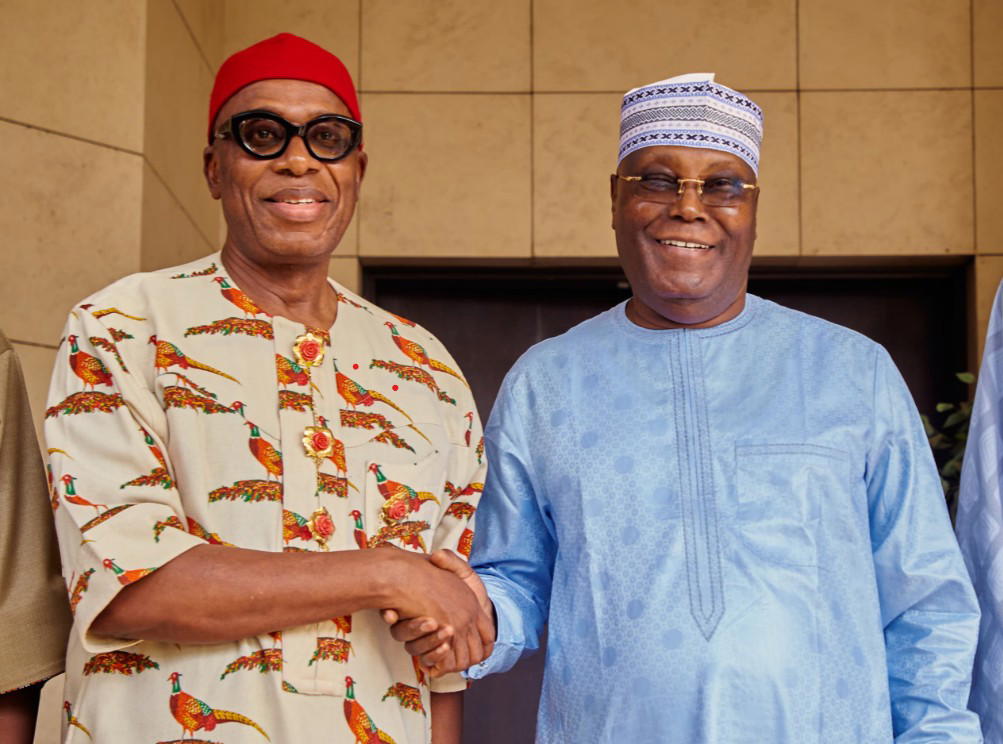
Within hours of the controversy, Atiku visited Amaechi in Abuja alongside coalition figures including former Sokoto State governor Aminu Tambuwal and former ADC National Chairman Ralph Nwosu.
Officially, discussions centred on unity, insecurity, the economy and strategies for defeating the APC in 2027. Reports of relaxed moments involving Arsenal banter and fisherman soup projected familiarity and political brotherhood at a moment when the coalition badly needed reassurance.
Nwosu dismissed suggestions of division.
“There is no faction in ADC. What you are seeing are efforts by powerful interests to throw mud at a party that Nigerians now see as a credible alternative,” he said.
Still, the speed of the reconciliation effort raised its own questions. In Nigerian politics, speed often reveals fear. And the speed of the ADC’s peace moves suggested the coalition understood how dangerous public distrust could become if left unattended.
ADC’s biggest battle may already be internal
Former Senate President and ADC National Chairman, David Mark, attempted to steady the coalition’s nerves by framing the crisis as part of a broader democratic struggle.
“We will not surrender, because what is at stake is not just the ADC or the opposition, but the survival of our democracy,” he declared.
But the ADC’s first major national exercise may already have revealed both the coalition’s greatest strength and its deepest weakness at the same time.
Its strength lies in its ability to gather powerful political actors under one platform against the ruling party.
Its weakness lies in the lingering suspicion among some of those same actors that influence inside the coalition may already be unevenly settled.
And if that internal struggle is not carefully managed, the ADC may come to find that defeating the APC is less difficult than managing the ambitions gathered under its own roof.
The post Was ADC presidential primary ever a contest? – Amaechi’s fury, Atiku’s peace mission expose cracks in opposition coalition appeared first on Vanguard News.
www.vanguardngr.com
Politics
2027: Gov Sule presents INEC nomination forms to APC National Assembly candidates in Nasarawa

Nasarawa State Governor, Abdullahi Sule, has officially presented the Independent National Electoral Commission, INEC, nomination forms to the All Progressives Congress, APC, candidates for the National Assembly ahead of the 2027 general elections.
The presentation took place on Tuesday during a brief ceremony at the Government House in Lafia, where Governor Sule, who is also the APC candidate for the Nasarawa North Senatorial District, formally handed over the nomination documents to the party’s candidates.
The event was attended by all the APC National Assembly candidates except the party’s Nasarawa West Senatorial candidate, Dr Faisal Shuaib.
Addressing the candidates, Governor Sule congratulated them on their emergence and urged them to conduct issue-driven campaigns capable of promoting unity, strengthening the party, and delivering victory for the APC in the forthcoming polls.
He also encouraged the candidates to remain focused on engaging the electorate with policies and programmes that would advance the development of Nasarawa State and the country.
Responding on behalf of the candidates, the APC senatorial candidate for Nasarawa South, Abubakar Hassan Nalaraba, thanked the governor for his leadership and support throughout the nomination process.
Nalaraba assured the governor that the candidates would remain committed to the principles of the APC and work collectively to secure victory for the party while promoting sustainable development across the state.
The APC House of Representatives candidates include Mohammed Al-Makura (Lafia/Obi Federal Constituency), Daniel Ogazi (Karu/Keffi/Kokona), Mohammed Albasheer (Nasarawa/Toto), Dalhatu Araf Jr. (Awe/Doma/Keana), and Tony Bala Shammah (Akwanga/Nasarawa Eggon/Wamba Federal Constituency).
dailypost.ng

The Vice Presidential candidate of the Nigeria Democratic Congress, NDC, Rabi’u Kwankwaso, says the party is fully focused on the mission of attaining victory in the 2027 general elections.
Kwankwaso made the assertion on Tuesday while briefing the national leader of the party, Seriake Dickson, details of which were released in a post on his verified X handle on Tuesday.
He said that Dickson has confirmed the submission of his candidacy and also announced that his name has been duly uploaded on the INEC portal as the Vice Presidential candidate Peter Obi on the platform of the party.
“We remain steadfast, united, and fully focused on the mission ahead.
“I was delighted to welcome my brother and National Leader of our great party, the NDC, His Excellency Henry Seriake Dickson, to my residence in Abuja.
“I took the opportunity to brief him on the highly productive engagements and consultations I have undertaken across the North West states, which have yielded very encouraging results,” he said.
dailypost.ng
The Independent National Electoral Commission, INEC, has called on media practitioners in Osun State to make the fight against vote buying a major focus of their coverage ahead of the August 15, 2026 governorship election.
The appeal was made during a one-day Media Stakeholders’ Forum held in Osogbo on Tuesday, where the National Commissioner and Chairman of the Information and Voter Education Committee, Malam Mohammed Kudu Haruna, urged journalists to investigate and expose electoral malpractice.
Represented by the Osun State Resident Electoral Commissioner, Mrs Oluwatoyin Babalola, Haruna described vote buying as the most disturbing issue observed during the June 20, 2026 Ekiti State governorship election, alleging that political actors and their agents offered cash to voters at polling units and, in some instances, distributed numbered vouchers redeemable away from voting centres.
He said journalists should gather evidence capable of supporting prosecution by documenting incidents with precision.
“Reporters should capture names, locations, amounts involved and the structure of coordination in their investigations,” he said, adding that such reports would strengthen efforts to prosecute offenders.
The National Commissioner cited Section 22 of the Electoral Act 2026, stating that anyone convicted of vote trading faces a fine of not less than N5 million, imprisonment for up to two years, or both, as well as a 10-year ban from contesting public office.
He explained that evidence gathered by the media would support enforcement efforts involving INEC, the Economic and Financial Crimes Commission, the Nigeria Police Force and the State Security Service.
According to him, editors should assign dedicated resources to investigating vote buying before, during and after election day.
Haruna also disclosed that the commission had completed major preparations for the Osun governorship election, including the clearance of candidates from 14 political parties, the registration of 381,817 new voters during the Continuous Voter Registration exercise and plans to deploy the Bimodal Voter Accreditation System and the INEC Result Viewing Portal across all 30 local government areas.
Referring to the recent Ekiti governorship election, he said the BVAS recorded a 96 per cent functionality rate, while the IReV achieved a 98 per cent result upload completion rate.
While expressing confidence that the same technologies would support a credible electoral process in Osun, the National Commissioner also raised concern over declining voter turnout across the country, noting that fewer than four out of every 10 registered voters were accredited during the Ekiti election.
He urged media organisations to intensify voter education and encourage citizens to participate in the electoral process while promoting awareness of IReV for result verification.
In her welcome address, Mrs Babalola described the media as an essential partner in strengthening democracy through accurate reporting and public enlightenment.
She called for sustained collaboration between journalists and the commission to ensure a peaceful and credible governorship election.
Also speaking, the Director of Voter Education and Publicity, Mrs Victoria Eta-Messi, represented by the Deputy Director of Information and Publicity, Mr Wilfred Ifogah, said the forum was organised to improve collaboration between INEC and media professionals, provide updates on preparations for the election and explain the commission’s responsibilities under the Electoral Act 2026.
The Chairman of the Nigeria Union of Journalists, Osun State Council, Adeyemi Aboderin, pledged the support of journalists in combating vote trading and mobilising voters ahead of the poll.
He expressed optimism that the August 15 governorship election, in which 14 political parties, including the ruling party, will participate, would produce better outcomes than the recent Ekiti governorship election.
dailypost.ng


What Miroslav Klose Said About Kylian Mbappe Breaking World Cup Record

16 Favourites to Land NBA Icon

World Cup Player Ratings and Match Highlights

Simi Sanya and Femi Dapson Are Now Legally Married and It Is Beautiful to See

FCT Area Council Election: Live results from polling units

Premier League Set-Piece Goals (2025/2026)
-
 Sports16 hours ago
Virgil van Dijk Slammed For Comments After Netherlands’ World Cup Exit v Morocco
-
 Sports15 hours ago
Kevin Pietersen Causes Stir With Tweet About His International Cricket Retirement
-
 Sports15 hours ago
Carlo Ancelotti Explains Why He Didn’t Celebrate Brazil’s Winner v Japan
-
 Sports18 hours ago
Zlatan Ibrahimovic Blames Netherlands’ Shock World Cup Exit on Ronald Koeman
-
 Sports10 hours ago
Leon Goretzka Slammed For Not Taking Penalty in Germany vs Paraguay
-
 Sports1 day ago
Roger Federer Names His Top 5 Tennis Players of All Time
-
 Sports2 days ago
How Much Emma Raducanu Will Earn Despite Withdrawing Through Injury
-
 Sports13 hours ago
Virgil van Dijk Blasted For Not Taking a Penalty in Netherlands’ World Cup Exit v Morocco