Cody Gakpo’s girlfriend, Noa van der Bij, has posted an emotional statement to confirm that their son has passed away during pregnancy.
The Liverpool star and his partner announced in May that they were expecting another boy. They already have one son, Samuel, who was born in 2024.
Gakpo is currently representing the Netherlands at the 2026 World Cup, while Van der Bij is in the United States of America to support him from the stands. The latter took to Instagram to share the news that their baby, who they named Elijah Raphael Gakpo, had passed.
Cody Gakpo and Noa van der Bij Lose Son
Jay Biggerstaff (IMAGN IMAGES via Reuters)
Van der Bij posted to her Instagram story on Saturday afternoon, saying: “With broken hearts, we share the devastating news that our baby boy passed away during pregnancy. Thank you for your love and support. Elijah Raphael Gakpo Forever loved. Forever our son.”
She then shared a heartbreaking story of how the couple and their son, Samuel, went to light a candle at church and came across another little boy called Elijah. Her next post stated:
“We went to church to light a candle. Afterwards, we walked to the church playground with our son Samuel. There was only one other child there. His name was Elijah.
“There could not have been a more beautiful sign from God He reminded us that our little boy is never far away.”
WWE legend Triple H has discussed the future pool of talent currently catching his eye as he appeared on The Stephen A. Smith show to promote upcoming Premium Live Events.
The host asked him if wrestling follows a similar model he had previously discussed with Dallas Cowboys owner Jerry Jones when it comes to harnessing young talent for the future of their respective sports.
Triple H responded with agreement, stating that young wrestlers are important for the future of the brand. He went on to name four rising stars that he tips to be the next main event stars, even backing them to headline WrestleManiaone day.
Triple H on Retiring Legends & WWE’s Future
Not only did he name-drop four current WWE Superstars as the future of the company, he also pointed out how many veterans are calling time on their illustrious careers right now.
With the likes of John Cena and AJ Styles both hanging up their boots in recent months, Triple H has spoken out about how having young talent waiting around the corner to catch their opportunity is so crucial.
The 85-year-old’s condition is rapidly deteriorating as sad news emerges from the WWE Hall of Fame.
“You always have to be thinking about the future. Jerry is correct. It’s about hiring youth, putting youth around you, and keeping yourself young in that sense. As a brand, you see that John Cena’s retiring, AJ Styles is retiring, and some of these talents are at the peak of their careers. You have to have those young talent underneath them.”
He mentioned in the same interview that we could see these young talents emerging to the top of the brand as soon as a couple of years. Among the several rising stars, Triple H singled out a total of four names who are destined to go to the very top, according to him.
Triple H’s Four Future WrestleMania Main Eventers
“When you see this next crop of talent, Oba Femi is going to be as big as anybody has ever been in this business,” Triple H said.
He also mentioned Sol Ruca, saying she has an opportunity to be a standout star.
“Je’von Evans is one of the young guys. He reminds me of a young Jeff Hardy. He has this incredible move set, but he also has a youth about him that you can look away from,” Triple H continued to say.
Evans made his wrestling debut in 2018, when he was just 14 years old, and signed for WWE in November 2023, at 19 years of age.
The other name Triple H mentioned was Trick Williams, who debuted in 2020.
“Trick is a personality plus. Again, he is another guy you can’t look away from,” Triple H said.
Summarising the four, The Game said: “These are the young talent that are going to take WWE into the future. You’re seeing them rise now, but two, three, four years from now, these are going to be the main events of WrestleMania. I promise you.”
After making an initial bid for the Brazilian, it appears as though the North London club are stepping up their efforts with another offer on the way.
Arsenal Prepare Another Bruno Guimaraes Bid
via Reuters
Arsenal’s initial £55 million bid for Guimaraes wasn’t enough to tempt Newcastle into a deal, as the star enters the final two years of his contract.
Despite that rejected, the Gunners look set to ramp up their efforts to land the Brazilian, as TeamTalk claims an £80 million bid is soon on the way.
It’s unclear whether that will be enough to tempt Newcastle, with no public valuation set on the 28-year-old while the club faces a battle to keep hold of him.
It looks like an increasingly tough prospect, however, as the report adds that Guimaraes has told the Magpies that he has no intention of signing a contract extension that would take his stay beyond the next two years.
That may prompt an exit while the star player, who has been described as “brilliant”, is still able to maximise his value for the club on the transfer market.
It plays a key role behind Arsenal’s pursuit of the midfielder, alongside deals elsewhere that could have a knock-on effect.
You scored
out of 20
Arsenal Impact From Sandro Tonali Deal
via Reuters
Arsenal’s move for Guimaraes has been accelerated in recent days, which could well be an impact from another Newcastle deal this summer.
Sandro Tonali continues to be linked with an exit from St. James’ Park, as the Italian international has caught the eye of many top clubs in the market.
Arsenal are preparing their first bid of the transfer window for a Premier League star, after already pushing to sign Bruno Guimaraes.
Tottenham are frontrunners to sign him, with a £100 million valuation set, which could have a major impact on whether Newcastle feel obliged to sell Guimaraes.
It means Arsenal could look to get a deal done before their rivals, to ensure they are able to land their top target to help improve the midfield ranks.
On July 8 2014, in front of 58,141 fans at the Estadio Mineirao in Belo Horizonte, Brazilian footballdied in a very public humiliation.
Germany tore apart the tournament hosts in a World Cup semi-final that defied all logic, racing into a 5-0 lead after just 29 minutes before eventually running out 7–1 winners.
It wasn’t a football match; it was a demolition. A nation that had spent four years building towards this tournament, the first on Brazilian soil since 1950, was reduced to rubble.
Thomas Müller opened the scoring after just 11 minutes, and the Germans didn’t stop. Miroslav Klose, Toni Kroos (twice) and Sami Khedira added four more in an eight-minute spell before the game had even hit the half-hour mark. André Schürrle added two further goals in the second half before Oscar gave the shell-shocked crowd a last-minute consolation. By then, Brazil had long since ceased to exist as a competitive football team.
A Perfect Storm: Why Brazil Fell Apart
Andrew Couldridge via Action Images
The seeds of disaster had been planted long before kick-off. Brazil arrived at the semi-final without Neymar, their talisman and the tournament’s standout player, who had fractured a vertebrae in the quarter-final after a reckless knee from Colombia’s Juan Zuniga. His absence removed not just Brazil’s best player, but their entire creative identity. Neymar had scored four goals and provided two assists in the group stages alone; there was no plan B without him.
Captain Thiago Silva was also suspended, leaving Brazil without both their defensive leader and their most composed presence under pressure. Manager Luiz Felipe Scolari had run out of ideas, handing the armband to David Luiz and trusting a makeshift defensive unit to hold one of Europe’s most technical sides. The decision proved catastrophic. Brazil was carved open again and again.
Scolari’s approach had been to build everything around Neymar rather than produce a collective quality side. So when Neymar gets taken out, the plan goes to waste.
Brazil’s midfield was overrun from the first whistle, and there was a wider sense of complacency, a belief born from home-crowd pressure that tournament destiny would carry them through. Germany didn’t cater to that opinion; they pressed high, moved the ball quickly, and exploited every single yard of space.
The Mineiraco: The wound that would not close
Brazil had a history of heartbreak on the world stage, but nothing had prepared the country for this. The defeat was immediately compared to the Maracanzo — the 1950 World Cup final loss to Uruguay on home soil, widely regarded as the greatest trauma in Brazilian sports history. Where the Maracanazo had been a narrow defeat, this was something a lot more damming.
Journalists and pundits scrambled for new vocabulary, and they found it in Mineiraco, using the suffix often used in journalism to describe a devastating, catastrophic defeat, the same one used for the 1950 defeat. Within hours, it had entered the Brazilian vocabulary permanently.
⚽
World Cup History Quiz
You scored
out of 20
The images from inside the Mineirao told the full story. Grown men wept openly in the stands. Children buried their teary faces in their hands. The Brazil players stood motionless, some in tears, as the scoreboard ticked all the way up to seven. The emotional weight of hosting a World Cup, a tournament Brazil had won five times, collapsed under the scale of the defeat. The sense of shame was immediate.
The internet had its own response. Such was the volume of video highlights uploaded to Pornhub in the hours after the final whistle that the platform was forced to issue a public statement asking users to stop — its sports category had been flooded.
The episode, as darkly comic as it was, underscored the extent to which Brazil’s humiliation had transcended football and become a cultural event. Even the world’s largest adult content site was not immune to fallout.
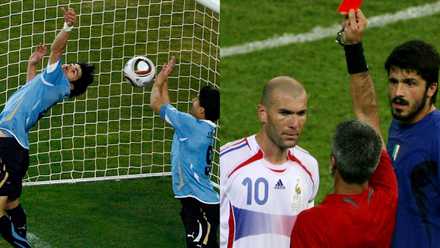
Some of these will stay in the minds of fans forever.
Scolari resigned within days, and a 3-0 third-place playoff defeat to the Netherlands compounded the misery. The Mineiraco didn’t just end a tournament; it ended an era, exposed structural rot within Brazilian football, and forced a long-overdue reckoning with a culture that had coasted too long on individual quality.
12 years on, it remains the benchmark for sporting catastrophe. Some wounds never fully heal. Brazil haven’t won the World Cup since 2002, with the Mineiraco being the closest they have got to lifting the trophy. The humiliating defeat set them back years, and it still lingers on the country, who are desperate to return to glory.