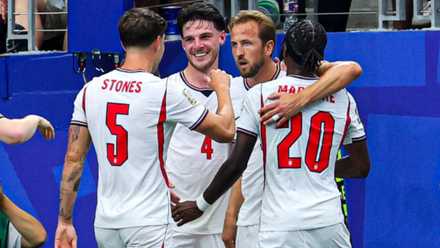
The Spurs fullback has stood out on the pitch, not just for his performances, but also for the protective face mask that he’s been wearing throughout the tournament. It’s a look that naturally sparks curiosity.
Here is the reason why Spence has been wearing the protective mask.
Why Is Djed Spence Wearing the Mask?
Action images via Reuters
Spence’s face mask is the result of a minor facial fracture sustained in the weeks leading up to the tournament. The 25-year-old was involved in an aerial duel with Chelsea striker Liam Delap, whose elbow clashed with Spence, although he was able to continue through until the end of that particular game.
Spence took to social media following the game to complain about the challenge with Delap, perhaps unhappy with the Chelsea striker’s aggressive antics resulting in Spence breaking his jaw.
Just five days later, Spence took to the field for Tottenham wearing the face mask, as Spurs secured their Premier League safety on the final day of the season with a win against Everton.
A broken jaw can normally take three months to heal, and with Spence wanting to feature in the World Cup, he opted to wear the custom-fitted jaw guard throughout the competition, as well as in training sessions.
The ultimate guide to following England through the 2026 World Cup, with schedule, TV information and more
Spence told the BBC: “It is a little bit uncomfortable, but it is what it is. I have a broken jaw, so I have to wear it throughout the tournament. It is something I will have to get used to. It will be three months until it is fully healed, so it is a long time. It was painful, but luckily I play football with my feet and not my jaw.”
“It was a crazy challenge, but it is in the past now. I’ve just got to focus on this tournament now.”
⚽
England World Cup Quiz
You scored
out of 20
How Does the Mask Help?
Brett Davis via Action Images via Reuters
The mask’s primary function is simple: to offer protection. It shields the affected area from direct blows, accidental elbows, and the kind of incidental contact that can occur during high-tempo matches.
It also offers Spence psychological support, as he might have been hesitant to go into duels without a protective mask, but the guard now reassures him to commit fully. The moulded fit also keeps the affected area stable, reducing the risk of sudden pressure or movement that could worsen the fracture.
It also, of course, means Spence can still play, as without the mask he might have been forced to miss the tournament entirely.
Whilst the mask can feel unfamiliar at first, it shouldn’t affect Spence’s game, and he will be able to adapt quickly. Spence’s performances so far haven’t shown that this new mask is affecting him, putting in consistent performances in the place of injured Reece James, and it leaves Thomas Tuchel with a selection headache for when he has a fully fit right-hand side operating again.
As any England fan will tell you, the men’s national team never like to do things the easy way. Sometimes that presents itself as a last-gasp winner. But sometimes that comes in the form of a few disciplinary detours.
Whether it stems from geographical proximity or a controversial chapter in a major tournament, England’s tapestry of fierce rivals is an intriguing one to unpick. But who are the biggest sporting enemies on The Three Lions’ list?
Germany
REUTERS/Kai Pfaffenbach JOH/AA
This rivalry goes beyond football. The historical ties from the two World Wars of the 20th century have informed this great feud, with their incredible clashes creating some of the most memorable footballing moments in recent times. Who could forget the drama of England’s 1966 World Cup Final win at the expense of Germany? But the Germans inflicted their own heartbreak at the 1990 World Cup and Euro ’96, eliminating England on penalties at the semifinal stage on both occasions.
More recently, England fans still fondly remember the 1-5 thumping in Munich. But they also wince at the thought of Frank Lampard’s ghost goal in 2010.
It would be reignited at the 1998 tournament, with David Beckham controversially being sent off for kicking out at Diego Simeone before England crashed out on penalties. Beckham would have his revenge though. His winning penalty in the 2002 World Cup encounter helped to condemn Albiceleste to a shock group stage exit.
The oldest international fixture in world football, England and Scotland’s rivalry began on November 30th 1872 with a 0-0 draw. Since then, there have been many memorable episodes.
The rivalry was renewed every year by the annual British Home Championship that took place from 1884 to 1984. There was also the incredible spectacle of Scotland victory at Hampden Park in 1937. Just under 150,000 fans packed into the stadium for the match — an all-time European attendance record that still stands today. And who could forget the 1977 Wembley pitch invasion after Scotland’s 2-1 win? The Tartan Army stormed on, famously snapping the crossbars in celebration.
England’s record against Scotland
Played
Wins
Draws
Losses
116
49
41
26
Ireland
REUTERS/Damien Eagers
Despite just 18 encounters overall, the England-Ireland rivalry has endured in part thanks to the two nations’ complex social and political relationship.
Ireland made history in 1949 with their 0-2 win at Goodison Park. They became the first non-British team to beat England on home soil. Ireland also won the first major tournament meeting between the two, courtesy of a Ray Houghton winner at Euro ’88. The rivalry is also infamously remembered for the 1995 Lansdowne Road riot that saw a friendly in Dublin abandoned after 27 minutes due to severe rioting by a number of English hooligans.
The rivalry was recently renewed by the debate over dual nationality. Both Declan Rice and Jack Grealish switched eligibility to England, having already represented Ireland. Grealish had played for the U21s six times, whilst Rice made three senior appearances for Ireland. Both players were heavily booed during the 2024 Nations League clash before both ironically scored the game’s only two goals.
England’s record against Ireland
Played
Wins
Draws
Losses
19
8
8
2
Croatia
Christian Hartmann via Reuters
Not quite a bitter rivalry, but one forged in destiny. England, for some reason, are inexplicably linked to the south-east European side. And whilst the two nations lack historical hatred, their respectful rivalry is marked by several dramatic modern moments.
Chief among them, England’s 2018 World Cup heartbreak. After Kieran Trippier’s opening goal in the semifinal, Croatia fought back to force extra time. Mario Mandzukic’s 109th minute winner was ecstasy for Croatia, but agony for the Three Lions.
Croatia also shockingly knocked ended England’s Euro 2008 qualifying campaign. With England needing a win to break into the top two in Group E, the excellent Croatian team defeated England 2-3 at Wembley. The enduring image of that night was England manager Steve McLaren shielding himself with an umbrella as European qualification slipped away. He was relieved of his duties the following day.
Pubs across the country are set to stay open until the early hours for England’s Round of 16 match against Mexico. The World Cup knockout kicks-off at 1am on Monday, July 6, which equates to 6pm in Mexico City, and Keir Starmer is set to introduce an emergency law change so that pubs can remain open until 5am.
The UK Prime Minister is set to leave his position on July 9, but has won back some people’s trust following one of his final decisions in Number 10.
There is a lot of excitement in N17 at present with Tottenham splashing the cash for Roberto De Zerbi.
Following back-to-back 17th place finishes, Spurs are spending big as they look to get back to their previous heights towards the top of the Premier League table.
Signing Martin Dubravka, Andy Robertson and Marcos Senesi on free transfers to bolster their squad, last month the club also completed the £52m signing of centre-back Jan Paul van Hecke from Brighton & Hove Albion.
Much more still needs to be done in improving De Zerbi’s squad, with attacking players required after the club’s struggles in the final third last season.
Leao option
One position Tottenham need to address is on the left of their attack after failing to replace Son Heung-min following his switch to LAFC last August.
According to The Independent, Bournemouth ace Eli Junior Kroupi tops a three-player shortlist for that position.
Arsenal and Paris Saint-Germain are also keen, with the Cherries looking to receive over £80m if they decide to cash in on their highly-rated attacker.
In terms of Leao, he would be another statement signing if Tottenham can agree on a deal with Milan for ‘one of the best wingers in Europe’.
Mainly operating from the left but also capable of playing centrally, the Portugal international has contributed regularly for the Rossoneri with 80 goals and 65 assists in 291 games for the Italian giants.
After already agreeing on transfers for Fernandes and Tonali, a move for Leao would be a real signal of intent from Tottenham that they really do mean business in the transfer market after their recent Premier League woes.
Tottenham’s attacking needs
Richarlisonvia Reuters
Tottenham desperately need to improve in the final third if they are to climb the Premier League table.
Last season, Richarlison finished top goalscorer in all competitions with 12 goals, and it was defensive players Joao Palhinha, Micky van de Ven and Cristian Romero who were next in line in the charts.
Dominic Solanke could only manage six goals in an injury-hit campaign, with Xavi Simons and Randal Kolo Muani both contributing five and Mathys Tel chipping in with four.
Given the need for goals, Leao could more than play his part after hitting double figures for Milan in each of his last five seasons at the San Siro.
Following the club’s desire to improve their midfield with the additions of Fernandes and Tonali, Tottenham now need to do likewise in attack if they are to make big strides under De Zerbi.