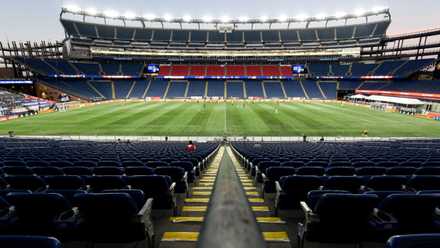
Estadio Azteca is the highest stadium of all 16 venues used at the 2026 World Cup by a wide margin, and one of the most storied grounds in football history, having hosted three separate World Cups, a feat that no other stadium can claim.
So, what is the altitude of the stadium and what are the effects? GIVEMESPORT takes a look.
The Azteca is high by 2026 World Cup standards, but modest next to South America’s true altitude giants, several of which sit above FIFA’s old 2,500m threshold for international matches.
The highest altitude stadium in the world is Peru’s Estadio Daniel Alcides Carrion, which sits an incredibls 4,338m above sea level, nearly twice as high as the Azteca.
You can see a list of some of the highest stadiums below for comparison.
Eagle-eyed fans may be confused as to why there are different names for the World Cup arenas than usual – the answer is frighteningly simple.
Does Altitude Give Mexico an Advantage?
Raquel Cunha via Reuters
The short answer is yes, it’s a very big advantage. The national team have lost just twice in 89 competitive matches at the stadium, and has gone unbeaten there for well over a decade — a record few nations can touch on home soil anywhere in the world.
As per The Guardian, Mexican football commissioner Mikel Arriola: “We have a massive advantage because we’re playing at the Estadio Azteca with our fans and the altitude. It is a very potent setting.”
You scored
out of 20
Thinner air at 2,200m means less resistance on the ball, so it travels faster and dips less than at sea level – a wrinkle that can catch out goalkeepers and defenders unfamiliar with the conditions.
More significantly, it means less oxygen in every breath, which hits visiting players hardest in the legs and lungs: heart rates climb quicker, sprints are harder to repeat, and pressing intensity drops off as the game wears on — exactly the kind of high-tempo football most European and South American sides are built to play.
There’s no quick fix for it either, with sports scientists generally agreeing that two to three weeks at altitude is needed to meaningfully boost red blood cell production and oxygen-carrying capacity — a luxury a tight tournament schedule doesn’t allow.
Some squads, like South Korea, base themselves in elevated cities to adapt to the conditions, whilst teams like Colombia arrive with a natural edge from training at similar altitude levels back home. But those flying in directly from sea level are faced with a rough opening half, and are advised to hydrate heavily and avoid overexertion in their first 24 hours in the city.
What Have Players and Coaches Said?
REUTERS/Peter Cziborra
The altitude conversation resurfaces every time a lowland side draws Mexico, and the 2026 World was no exception.
Ahead of facing Mexico in the Round of 16 at the Azteca, England manager Thomas Tuchel told the BBC: “The altitude will be a big disadvantage because we cannot physically adapt to it. And in four days, it’s just impossible. More obstacles may come, we are ready for that.”
My understanding is that we cannot adapt to the altitude. That is just a huge advantage that Mexico will have. We have only three days in between these matches. Its physically just not possible to adapt to the altitude, which is quite high.”
Former West Ham midfielder Nigel Reo-Coker is one of few English players to have played at the Azteca stadium, and is fully aware of the challenges sides face, saying:
“It’s the most physically demanding place I have ever played football. To come from Europe and play in that altitude is so difficult. You cannot catch your breath. The first 45 to 55 minutes, you’re just trying to keep breathing.”
Senior Research Fellow at Leeds Beckett University, Dr Barney Wainwright, also told the BBC: “Maximum aerobic capacity at this kind of altitude usually drops around 10%, and that has a knock-on to performance. There will usually be a 15–20% increase in fatigue. For the distance it’s possible to cover, we would expect that to drop by 5-10%.
“Maximum sprint speeds won’t be affected, but players will need to wait a bit longer to recover from each one and go again. England might want to slow things down more to allow players time to recover between bouts of high-intensity play.”
Whether it is the intense home atmosphere, Mexico’s quality, the high altitude, or a combination of the three. One thing for certain is that the Azteca Stadium is one of the most difficult environments in world football, with visiting sides at a disadvantage before a ball has been kicked.
FIFA have been urged to delay an upcoming 2026 World Cup fixture amid an increased risk of “heat related illness or even death” due to a dangerous heat wave.
All matches at this summer’s showpiece international tournament in the United States, Canada and Mexico have featured three-minute hydration breaks, one in each half, to allow players to take on fluids in an effort to prevent overheating.
However, hydration breaks may not be sufficient for one upcoming last 16 clash at Lincoln Financial Field, otherwise known as the Philadelphia Stadium at the 2026 World Cup.
Heat Wave Threatens to Impact Last 16 Fixture
REUTERS/Peter Cziborra
Temperatures are set to his record highs in Philadelphia, where Paraguay and France go head-to-head on Saturday.
Per talkSPORT, the heat index, including humidity, is expected to be between 37 and 46 degrees Celsius (100F – 115 Fahrenheit) this weekend.
As things stand, France’s last 16 fixture against Paraguay is scheduled to get underway at 5pm local time (10pm BST). Temperatures are still expected to be dangerously high at this point in the day, sparking concern for players, officials and fans.
FIFA’s current heat guidelines state that matches are at risk of being postponed if the wet bulb temperature reaches 32 C (89 F). There’s currently a high chance this temperature will be exceeded when Kylian Mbappe and co. face their South American opponents at the 67,594-capacity stadium which is home to NFL side Philadelphia Eagles.
“When you’re exerting yourself on a particularly hot day, the likelihood of experiencing heat related illness or even death is much higher,” Bahart Venkat, director of the Heat Lab at the University of California, told the Associated Press.
It’s warned that intense exercise on such a hot day can lead to extreme fatigue, impaired performance, headache, irritability, nausea, dizziness, cramping and dehydration – all symptoms of exertional heat illness.
You scored
out of 20
FIFA Urged to Push Kick-Off Time Back
REUTERS/Mandel Ngan
Journalist Ian Nicholas Quillen has written an article for Forbes, urging FIFA to delay kick-off for Paraguay vs France.
“Let’s start with the obvious: This was entirely predictable when FIFA decided to engage in wishful thinking and schedule knockout phase matches outdoors on the East Coast during the middle of the day,” Quillen writes.
“Put bluntly, playing this fixture at its scheduled time will put players, fans and match officials at unnecessary risk. And even for TV viewers in the comfort of their own homes, it will significantly impact the product on the field.”
He adds: “But FIFA can still rectify its own mistake with relatively minimal consequences by preemptively delaying kick-off until the evening.”
Pushing the kick-off time back would mean “conditions would become considerably more playable just by delaying matches a few hours until the evening, when at least the impact of the sun could be mitigated.”
He warns that FIFA may find themselves in a similar predicament later in the knockout stages due to the risk of another heat wave impacting the north-east of the United States this month.
Following the game at Torono Stadium, Ronaldo made his way over to Modric and the two former teammates had a few words with each other before sharing an emotional embrace.
Speaking after the match, Ronaldo revealed what he said to the legendary midfielder. He said, per Manchester Evening News: “I played with Luka so many matches and we are nearly the same age. He is a legend of football.
“I said to him, ‘Congratulations for everything. I would love to see you again and all the best for the next years of your career’. It was nice to play him once again.”
You scored
out of 20
Luka Modric Rages at VAR After Portugal 2-1 Croatia
REUTERS/Dylan Martinez
Modric vented his frustrations at VAR following the match. He said, via Sportske Novosti: “We can look at the game in two parts, in the first half we were not at our best level, we were quite withdrawn, but in the second half we played a phenomenal game.
“That’s one of our better games. We could have easily finished it earlier, but we didn’t manage it. We missed, and then some things happened that are unbelievable to me.
“What is, is there. It’s hard to say what is smart after the game, I don’t want to say something wrong. We can be proud of how we played the second half; we deserved more, but simply, football is like that. “
On the disallowed goal, he said: “He says Matanović touched the ball, but we watched the footage, there’s no evidence that he touched the ball. If he doesn’t touch the ball, it’s not offside.”
He added: “Some things didn’t go our way. That penalty… If it were the other way around, VAR would never have been involved.
“I said about VAR in the beginning, when it was first introduced, that I didn’t like it. Later, over time, it’s good for some things, but they use it incorrectly or use it selectively, or depending on the size of the team.
“VAR should intervene if it’s 200 per cent a mistake, but if it’s not, if it’s in the grey zone, you have no say in it. There’s no point in calling VAR.
“This is no penalty. Both teams are replaying, pushing, Vlašić didn’t pull it, he held it, and both of them fell. That’s why you can’t judge a penalty like that in a game like this.
“That’s why I say, it has to be used if the mistake is 200 per cent. If you can treat something this way or that, you have no say in it.
“That annoys me and always works to our detriment. What is, it is, let’s move on, we won’t complain about it, but of course, some things bother me because fate decides.
“They decide the mood for everything you do, what you give up, you tear yourself apart, you fight. There are young players who come here, and then you do something like this to them… You are to blame for that, and it is always to our detriment.”
Joao Palhinha has confirmed that he won’t be a Tottenham Hotspur player next season following a big U-turn by manager Roberto De Zerbi.
Tottenham have been the busiest Premier League club by far in the summer transfer window, with Sandro Tonali set to become their sixth addition imminently after Spurs agreed a club-record £100m fee with Newcastle United for the Italy international.
The 26-year-old follows fellow midfielder Mateus Fernandes through the door at the Tottenham Hotspur Stadium, which has meant that De Zerbi has had to backtrack on his previous comments.
The Italian boss had previous said that Palhinha was someone he ‘100%’ wanted to sign this summer, after the Portugal international played a huge part in the club’s survival last season.
Palhinha scored two crucial goals against Wolverhampton Wanderers and Everton during the run-in, and while Tottenham didn’t take up the option they had to sign him on a permanent basis, it was expected that they would try and renegotiate the terms.
However, the north Londoners have now turned their back on a deal for the Bayern Munich star, having landed both Fernandes and Tonali for their midfield in big-money deals.