
Sports
Keith Hackett Casts Verdict Over Argentina 3-2 Egypt ‘Fixed’ Claims


Former FIFA referee and ex-PGMOL chief Keith Hackett has cast a strong verdict over claims Argentina’s 3-2 victory over Egypt at the 2026 World Cup was ‘fixed’.
Argentina benefitted from several controversial refereeing decisions in their last 16 tie at the Atlanta Stadium. Egypt led 2-0 midway through the second half, and were on the cusp of one of the most famous results in World Cup history, before conceding three times before the end of normal time as Lionel Messi and co. completed a remarkable comeback.
Egypt had a goal controversially disallowed in the 58th minute following a VAR review after Lisandro Martinez was fouled at the opposite end of the pitch. The Pharaohs were also convinced they should have been awarded a penalty for an alleged foul on Mohamed Salah moments before Enzo Fernandez scored Argentina’s winning goal.
Mostafa Ziko, scorer of Egypt’s second goal, claimed the tournament was “rigged” in favour of Argentina during an explosive post-match interview. Hossam Hassan, Egypt’s head coach, added: “They want Argentina and Messi to stay in the World Cup for marketing.”
Claims the fixture was ‘rigged’ to benefit the reigning world champions have been shut down by Pierluigi Collina, FIFA’s Chief Refereeing Officer, who has explained in detail why the game’s most controversial decisions were made.
Keith Hackett’s Strong Verdict on ‘Fixed’ Claims

Meanwhile, ex-FIFA ref Hackett has cast an equally strong verdict over the ‘fixed’ claims in a video for Football Insider.
“One area that I would dispute very strongly are claims that games are being fixed at World Cup level or any level of the game,” he said.
“There are sufficient checks and balances in place, and a filtering system to ensure that this does not happen.
“The laws of the game are subjective. I can get 100 referees in a room looking at a potential incident and not necessarily getting 100 referees to agree with the outcome. That’s the game of football. Those are the laws of the game.”
You scored
out of 20
Hackett continued: “I have no doubt Collina, like myself when I was boss of the PGMOL, worked hard in training and educating referees to achieve a degree of consistency in the application of the law.
“The comments I’ve made about the Martinez incident… as a referee, I wouldn’t want a goal of that quality ruled out. I wouldn’t want VAR to come in. But once VAR has gone through that forensic check, we see a really good goal ruled out.
“In the same way, in the same game, we have the alleged foul on [Mohamed] Salah. I’ve given my view but where the inconsistency comes in is why didn’t VAR, in checking that, which he’s allowed to do because a goal has been scored, check that phase of play?
“Why didn’t he bring the referee to the screen to make a decision?
“And when referees go the screen, I want them to stick with what they believe to be correct. Not influenced by the VAR.”
Hackett concluded:
“So, no corruption, for me. No fix, for me. It’s not even on my radar.
“But as the former boss of the PGMOL, I can tell you that we put a lot of systems in place to ensure the integrity of our group of referees and ensure that they are aiming all the time for consistency.”
Argentina will now face Switzerland in the quarter-finals this weekend before a potential return to the Atalanta Stadium, where England or Norway will be the opponents.

Footballers cutting holes in their socks has become an increasingly common trend in recent years, but now some players are even making holes in their boots.
A host of high-profile footballers have played games with holes in their socks including Real Madrid and England star Jude Bellingham, Arsenal’s Bukayo Saka and Brazilian icon Neymar.
One man who isn’t a fan of the trend is revered manager Jose Mourinho, now back at Real Madrid. Several years ago, the Portuguese tactician posted a series of photos of socks with holes alongside the caption: “Beautiful socks for the Beautiful Game… Approved by the football authorities.”
However, it turned out there was a good reason why footballers were cutting their socks up with scissors.
Players found that cutting holes reduced the pressure on their calf muscles, improving blood flow and circulation, as well as breathability.
A senior member of medical staff at a Premier League club revealed: “Many players feel the current socks are too tight and compressive on their legs, and some of them relate this to getting cramp in their calves.”
Now we’re seeing footballers beginning to cut holes in their boots – and the reason why has now emerged.
For example, Portugal’s Pedro Neto was seen with holes in his pink Nike Mercurial boots during the 2026 World Cup clash against Spain. Eagle-eyed fans spotted the Chelsea star’s boots had a hole in the back, exposing the socks, sparking much confusion on social media.
Neto swapped his boot after the first pair tore at the pre-cut hole, which made it too unusable to continue wearing, so he switched to a second pair with another deliberately cut, more controlled hole, per Footy Headlines.
Other footballers who have cut similar holes in their boots in the past include former Liverpool duo Roberto Firmino and Philippe Coutinho. Italian icon Daniele De Rossi did the same thing, way back in 2019 while playing for Argentine giants Boca Juniors.
Explained: Why Players Cut Holes in Boots

According to various sources, including The Athletic, the most likely explanation is due to a condition that certain players suffer called Haglund’s deformity – an issue that affects the heel and can make tight footwear difficult to tolerate.
Haglund’s deformity is described as a “bony enlargement on the heel, close to where the Achilles tendon attaches.”
Michael Robson, a specialist musculoskeletal physiotherapist at LDN Physio, has revealed that some people have the extra bony prominence without experiencing any symptoms.
“It really only becomes a painful syndrome when that enlarged bone repeatedly irritates the soft tissue around it,” Robson told The Athletic.
You scored
out of 20
Bartholomew Hudson-Gill, a physiotherapist at Opus Biological who has worked with top-level footballers at a FIFA Medical Centre of Excellence, describes Haglund’s deformity as a combination of the shape of the heel bone, thickening of the Achilles tendon and irritation of the bursa.
“That bursa, essentially, is like a shock absorber,” Hudson-Gill said. “The tendon becomes thicker, the bursa gets irritated, then the bone starts to get irritated.
“They load it more, it gets more sore. That soreness means there are changes in the bone, which means it then gets more sore.”
Another reason players may opt to cut a hole in their expensive footballer boots is due to a blister or another form of irritation.
In any case, it’s safe to say this isn’t a new fashion trend that footballers have suddenly decide to adopt.
Footballers struggling with various foot issues, including Haglund’s deformity, are cutting their boots as a last resort to ensure they can play matches pain-free.

Eddie Hearn has revealed there is a “very good chance” Anthony Joshua and Tyson Fury‘s long-awaited heavyweight showdown will take place at Wembley Stadium, while explaining why a controversial middle-of-the-night start time is now under serious consideration.
Speaking exclusively to GiveMeSport’s Sam Cohen, the Matchroom chairman addressed the biggest talking point in British boxing after reports emerged that Turki Alalshikh is exploring a late-night start.
While many fans have questioned whether such a late ring walk would be fair on supporters attending the event, Hearn says the reality is far more complicated.
Matchroom Has Rejected Moving Fury vs Joshua to America

The fight has been contracted to take place in the United Kingdom, despite interest in staging it in the United States. Hearn revealed Matchroom rejected the idea of moving the contest across the Atlantic, insisting Joshua wanted the biggest fight of his career on home soil.
“They came to us and said: “Look, we’d like to look at doing the fight in America.’ We said no. We insisted the fight was in the UK. AJ wants to fight in the UK. We’ve signed for the fight in the UK. So if you want the fight in America, we’ve got to renegotiate the contract.”
Instead, discussions have turned towards finding a compromise that allows Wembley to remain the venue while delivering a more favourable broadcast slot for American viewers.
“They’re trying to find a solution. That solution might be keeping the fight in the UK but running it at a slightly later time.”
A later start would require significant logistical support, including Transport for London operating through the early hours to allow more than 90,000 fans to travel home safely.
“It can only be possible with the support of probably Sadiq Khan and the Mayor of London, but also the infrastructure of Transport for London that would enable fans to leave the stadium. Otherwise you’re leaving at two or three in the morning and you can’t get home.”
Hearn Reveals Biggest Issue With Having Fury vs Joshua in UK Prime Time

“The truth is Netflix, who are the broadcaster of the fight, and Turki Alalshikh are paying a huge amount of money for this fight,” Hearn explained.
“So essentially, they want the biggest audience possible globally.”
“We’ve seen with Fury vs Makhmudov that a fight at 4pm eastern time in America [9pm UK] doesn’t do good numbers against college football and all the other plethora of sports that exist in America. It’s trying to find a way to make it close to prime time in the US and not too far out of prime time in the UK.”
Despite the challenges, Hearn believes there is genuine momentum behind the proposal because of the economic impact such an event would have on London.
“It’s also economically a big win for the city and for the UK to have that fight there. Those conversations exist now with Turki Alalshikh and those people. I think there’s a very good chance that you could see the fight at Wembley but with a slightly later kickoff.”
Hearn also questioned whether boxing supporters would really object if it guaranteed the undisputed blockbuster remained in Britain.
“Do we really care? We’re mad fans. Does it really matter if it’s after 11pm? Everyone’s going to go. You just go after the pub. Let’s try and find a way to put that fight in its rightful place, which is the UK.”
Anthony Joshua Final Hurdle Before Facing Tyson Fury

Before Joshua can finally meet Fury, however, he must first negotiate a dangerous return to the ring against Prenga later this month.
Hearn stressed there is no room for complacency, admitting the Fury fight would immediately collapse if Joshua suffered an upset defeat.
“It’s very important because if he loses, the fight’s off. We’ve signed for the Tyson Fury fight as long as he beats Prenga, so it would be a disaster if he didn’t.”
Although Joshua will start as the overwhelming favourite, Hearn warned that heavyweight boxing remains the sport’s most unpredictable division.
“It’s not going to be easy. People are quick to forget what AJ went through six months ago, not just physically but with the grief he suffered after losing one of his friends. I couldn’t be a bigger admirer of AJ in terms of how he’s applied himself in this training camp. He’s worked harder than he’s ever trained. He’s going into the fight in great shape.”
Prenga arrives with an intimidating knockout record, something Hearn believes should prevent anybody overlooking the challenge.
“He’s fighting a guy with 21 wins and 20 knockouts. It’s not going to be easy. On paper AJ should go through this guy, but heavyweight boxing is always seat-of-your-pants stuff.”
Should Joshua come through successfully, attention will immediately turn towards a face-to-face meeting with Fury. Hearn even hinted that fans may not have to wait long for official confirmation.
“Get through this and hopefully we’ll see Mr Fury in Jeddah face-to-face with an official announcement that may even come with a date and venue as well.”
For boxing fans who have waited years to see Britain’s two biggest heavyweight stars share a ring, the biggest obstacle may no longer be making the fight, it might simply be deciding what time the opening bell rings.

The 2026 World Cup has been thrilling. There was optimism that this summer’s tournament could be one of the best ever, and it has not disappointed. There’s been incredible drama on the pitch, while there’s also been a lot of controversy off it.
The tournament has now reached the quarter-final stage and 40 teams have already been eliminated. Co-hosts Mexico, the United States and Canada all bowed out in the last 16, while the likes of Scotland, Germany, Brazil, Portugal and the Netherlands also suffered early exits.
Eight teams now remain, all with the aim of being crowned champions on July 19: France, Morocco, Spain, Belgium, England, Norway, Argentina and Switzerland.
Ahead of the quarter-finals, it has been revealed how much money every nation has earned in the competition so far.
Knocked Out in the Group Stage (48-33)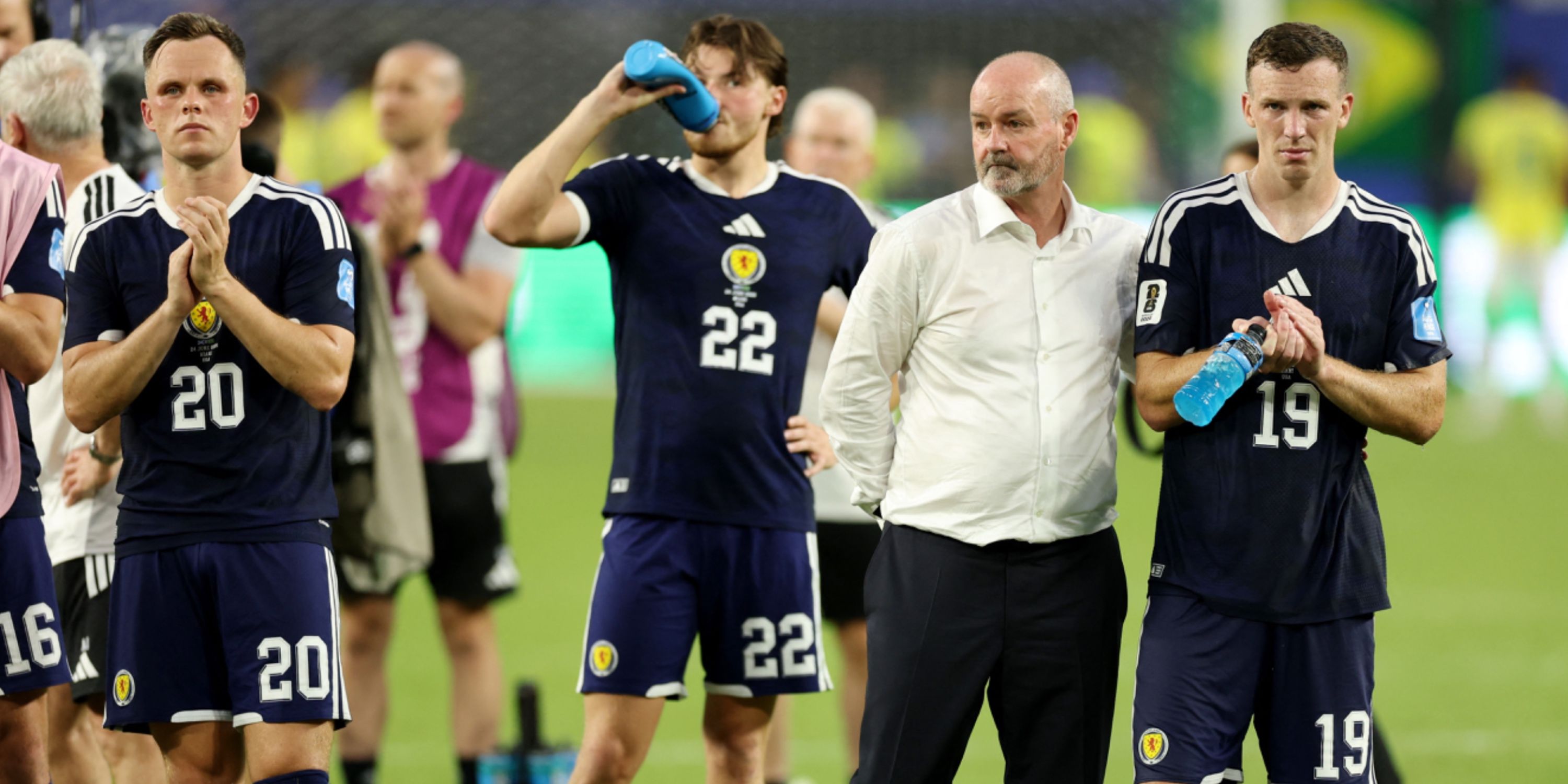
Teams that failed to make it past the group stage were paid $9m (£6.7m) for the three matches they played.
Among the teams that bowed out at this stage of the competition were Scotland. Scotland, who were competing in their first World Cup since 1998, were looking to progress from the group stage for the first time in their history.
Their campaign got off to a good start as they beat Haiti. But a narrow defeat to Morocco and then a 3-0 drubbing at the hands of Brazil condemned them to an early exit. Steve Clarke lost his job as a result.
Turkey and Uruguay were expected to qualify to the knockout rounds, but both had miserable tournaments. Also failing to progress from the group stage was Iran, who suffered an early exit despite going unbeaten in their three matches.
|
Prize money for nations knocked out in the group stage (48-33) |
|||
|---|---|---|---|
|
Nation |
Group |
Total in $ |
Total in £ |
|
South Korea |
A |
$9m |
£6.7m |
|
Czechia |
A |
$9m |
£6.7m |
|
Qatar |
B |
$9m |
£6.7m |
|
Scotland |
C |
$9m |
£6.7m |
|
Haiti |
C |
$9m |
£6.7m |
|
Turkey |
D |
$9m |
£6.7m |
|
Curacao |
E |
$9m |
£6.7m |
|
Tunisia |
F |
$9m |
£6.7m |
|
Iran |
G |
$9m |
£6.7m |
|
New Zealand |
G |
$9m |
£6.7m |
|
Uruguay |
H |
$9m |
£6.7m |
|
Saudi Arabia |
H |
$9m |
£6.7m |
|
Iraq |
I |
$9m |
£6.7m |
|
Jordan |
J |
$9m |
£6.7m |
|
Uzbekistan |
K |
$9m |
£6.7m |
|
Panama |
L |
$9m |
£6.7m |
Knocked Out in the Last 32 (32-17)

The 16 teams that successfully made it out of the group stage, but were then knocked out in the last 32, earned $11m (£8.2m).
The two most high profile teams to exit at this stage were the Netherlands and Germany. The Netherlands were impressive in their three group stage matches as they hit the back of the net 10 times. However, their reward for finishing top of Group F was a very tricky tie against Morocco, which they lost on penalties.
Big things were also expected of Germany going into the tournament, and they got their campaign off to a terrific start when they thrashed Curacao 7-1. They failed to build on that result, though, as they suffered a penalty shootout defeat to Paraguay.
Among the other teams to bow out at this stage of the competition were Senegal, 2022 World Cup semi-finalists Croatia, and Japan.
|
Prize money for nations knocked out in the last 32 (32-17) |
||
|---|---|---|
|
Nation |
Total in $ |
Total in £ |
|
South Africa |
$11m |
£8.2m |
|
Netherlands |
$11m |
£8.2m |
|
Germany |
$11m |
£8.2m |
|
Sweden |
$11m |
£8.2m |
|
Senegal |
$11m |
£8.2m |
|
Bosnia and Herzevogina |
$11m |
£8.2m |
|
Austria |
$11m |
£8.2m |
|
Croatia |
$11m |
£8.2m |
|
Japan |
$11m |
£8.2m |
|
Ivory Coast |
$11m |
£8.2m |
|
Ecuador |
$11m |
£8.2m |
|
DR Congo |
$11m |
£8.2m |
|
Algeria |
$11m |
£8.2m |
|
Ghana |
$11m |
£8.2m |
|
Australia |
$11m |
£8.2m |
|
Cape Verde |
$11m |
£8.2m |
Knocked Out in the Last 16 (16-9)

The eight teams that won their first knockout round, but then lost in the last 16, earned $11m (£8.2m). That includes the three co-hosts: Mexico, the United States and Canada.
Mexico were mightily impressive in their run to the last 16, but they were eliminated at that stage after a thoroughly entertaining 3-2 defeat to one of the tournament favourites, England.
The United States were thumped 4-1 by Belgium at the same stage of the competition, while Canada bowed out of the tournament a few days prior when they were beaten by Morocco.
Portugal and Brazil’s defeats to Spain and Norway respectively means they also earned $15m, as did Colombia, Egypt and Paraguay.
|
Prize money for nations knocked out in the last 16 (16-9) |
||
|---|---|---|
|
Nation |
Total in $ |
Total in £ |
|
Canada |
$15m |
£11.2m |
|
Paraguay |
$15m |
£11.2m |
|
USA |
$15m |
£11.2m |
|
Portugal |
$15m |
£11.2m |
|
Brazil |
$15m |
£11.2m |
|
Mexico |
$15m |
£11.2m |
|
Colombia |
$15m |
£11.2m |
|
Egypt |
$15m |
£11.2m |
Competing in the Quarter-finals (8-1)

The eight teams that have made it to the quarter-finals have all guaranteed themselves $19m (£14.1m) in prize money. However, that figure could rise exponentially should they continue to progress in the competition.
The team that loses in the third-placed match will earn $27m (£20.1m), while the side that wins that match will be paid $29m (£21.6m).
The nation that makes it all the way to the final, but then falls at the final hurdle, will have earned $33m (£24.6m) in prize money, while the victor will be paid a whopping $50m (£37.2m).
France, who are currently the tournament favourites, play Morocco in the last eight. Reigning champions face Switzerland, while England take on Norway and Spain face Belgium.
|
Prize money for nations still in the competition (8-1) |
||
|---|---|---|
|
Nation |
Total in $ |
Total in £ |
|
France |
$19m |
£14.1m |
|
Morocco |
$19m |
£14.1m |
|
Spain |
$19m |
£14.1m |
|
Belgium |
$19m |
£14.1m |
|
England |
$19m |
£14.1m |
|
Norway |
$19m |
£14.1m |
|
Argentina |
$19m |
£14.1m |
|
Switzerland |
$19m |
£14.1m |


Three suspects in police net over alleged murder of teacher in Kogi
Reason Why Footballers Cut Holes in Their Boots

Six ISWAP fighters killed, seven wounded as troops repel deadly Borno base attack

Meaning Behind Egypt Manager’s ‘X’ Gesture vs Argentina

Simi Sanya and Femi Dapson Are Now Legally Married and It Is Beautiful to See

Premier League Set-Piece Goals (2025/2026)
-
Sports2 days ago
Meaning Behind Egypt Manager’s ‘X’ Gesture vs Argentina
-
 Sports1 day ago
Ian Wright Claims Argentina Winning Goal vs Egypt Should Have Been Disallowed
-
 Sports1 day ago
Arsene Wenger Says Only Spain Can Stop France Winning the 2026 World Cup
-
 Sports14 hours ago
France Boss Didier Deschamps Praises Argentina vs Egypt Referee
-
 Sports2 days ago
VAR Expert Claims Egypt Should Have Had Penalty vs Argentina
-
 Sports20 hours ago
Thierry Henry Drops Verdict on Lionel Messi’s Argentina Tears vs Egypt
-
 Sports2 days ago
The ‘Real Reason’ Roger Federer Was Sitting Alone at Wimbledon
-
 Sports1 day ago
Thierry Henry and Alexi Lalas in Awkward Exchange Over FIFA’s Balogun Decision