
Politics
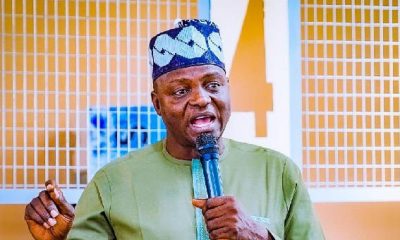
We won’t bow to intimidation — Adeleke


•SSG regains freedom, APC kicks
•They plan to arrest me too — Osun speaker
OSOGBO— FOLLOWING the detention of Secretary to the State Government, SSG, Mr Teslim Igbalaye, by operatives of the police command over alleged vote buying, Governor Ademola Adeleke, yesterday, declared that the people of the state will not succumb to any form of external interfereance or intimidation as the August 15 governorship election draws near.
This came as the Police command confirmed the release of the SSG from its custody.
Igbalaye was detained along with five others for allegedly committing vote-buying-related offences, as the police recovered Permanent Voter Cards, PVCs, cash sums and voters’ register from his house.
He was detained alongside five others after the police raided his private residence in Osogbo.
Although Adeleke did not directly address the detention in his post, he maintained that no amount of intimidation or harassment would make the people of the state succumb to fear ahead of the election.
The governor maintained that the verdict of the people would prevail, adding that “independent polls consistently point to a clear and decisive victory for Accord Party, because the people can see and feel the impact” of his administration.
He stated: “Throughout the history of Osun State, our people have never bowed to intimidation. We are resilient, determined, and fiercely protective of our rights.
“As we approach the August 15 governorship election, I have absolute confidence that no amount of external interference or intimidation can override the collective will of the people of Osun State.
“From infrastructure and education to healthcare, workers’ welfare, and pension reforms, our record speaks for itself.
“By the grace of God and with the continued support of the good people of Osun, our second term will build on these achievements and deliver even greater progress for every community. The best days of Osun are still ahead.”
Osun SSG regains freedom, APC kicks
The Osun State Police Command has confirmed the release of the SSG from its custody.
The Police also identified the other suspects arrested at the residence as Abiodun Arowomole, popularly known as “Ashipa,” who was described as a wanted murder suspect on the Command’s watch list, alongside Taiwo Akande, Lukman Adeyemo, Muftau Olaoye, and Musiliu Aderemi.
However, the command’s spokesperson, DSP Abiodun Ojelabi, said the SSG has been released this afternoon but investigation is ongoing in the matter.
Ojelabi said: “I can only tell you that the SSG, Mr Teslim Igbalaye has been released this afternoon and investigation is still ongoing.”
APC calls for SSG’s resignation
However, the Campaign Council of the All Progressives Congress, APC, yesterday, called for the sack of the SSG for harbouring “wanted criminals”, since the governor pledged before the IGP to arrest his son if found wanting.
The council’s Media Committee Chairman, Remi Omowaye, tasked the governor to be true to his pledge and should not sack only the SSG but also released other wanted criminals to the police for proper investigation.
He said: “The APC Governorship Campaign Council in Osun State expresses deep concern over the frightening revelation that Governor Ademola Adeleke is working frantically to free criminals found at the residence of the Secretary to the Osun State Government, Alhaji Teslim Igbalaye, particularly the release of the criminal suspect on the wanted list of the police, Abiodun Oladele Arowomole (aka Abbey Ashipa).
“It is strange and disheartening that Governor Ademola Adeleke, who has failed abysmally to protect the lives and property of the people of Osun, is mounting pressure on the police authorities to free a terror like Abbey Ashipa who is being wanted for the murders of no fewer than 20 citizens of Osun, mostly members and supporters of the APC in the state.
“The APC Governorship Campaign Council urges the good-spirited citizens to impress it on Governor Adeleke to stop harbouring these criminals because those who harbour criminals are no less criminals.”
They plan to arrest me too — Osun speaker
Meanwhile, Speaker of the House of Assembly, Mr Adewale Egbedun, yesterday, that Police is planning to “implicate and arrest” him ahead of the forthcoming governorship election.
Egbedun was reacting to the arrest of the SSG and five others by operatives of the state police command over alleged vote-buying.
The Speaker, in a post, described Igbalaye’s arrest as an “abuse of power” by the police commissioner, which “should be a source of concern and embarrassment to every patriotic Nigerian.”
“For the past two weeks, I have received information suggesting that some of his officers have been moving around, allegedly planning and strategising on how to implicate and arrest me,” Egbedun claimed.
The speaker said his alleged disagreement with the police commissioner began after he confronted him over a reported plan by some political thugs to attack his residence.
www.vanguardngr.com
The Independent National Electoral Commission, INEC, has warned Supervisory Presiding Officers, SPOs, and transport unions against partisanship.
It directed them to ensure the timely deployment of personnel and election materials across the state.
The warning is coming ahead of the August 15 Osun State governorship election.
INEC Chairman, Prof. Joash Amupitan, issued the directives on Friday during separate engagements in Osogbo as part of his readiness assessment tour ahead of the off-cycle governorship election.
Addressing leaders of transport unions at the INEC State Office, Amupitan said the Commission expected complete neutrality from all transport providers engaged for the election, stressing that vehicles contracted for the exercise would operate strictly under INEC’s supervision.
He said the commission had entrusted the unions with election logistics because of their operational capacity, but warned that any display of political allegiance by drivers or transport operators would not be tolerated during the electoral process.
“The moment we engage you for the purpose of this election, we are supposed to own your fleet, and therefore use it in accordance with our regulations.
“We are not supposed to take sides with anyone,” Amupitan said.
The INEC Chairman also emphasised the importance of punctual logistics, directing that vehicles should be available before Registration Area Centres, RACs, become operational at noon on the eve of the election.
He added that election personnel and materials must arrive at polling units by 7.30 a.m. to enable voting to commence at 8.30 a.m. as scheduled.
According to him, the Commission has introduced a real-time monitoring dashboard to track the opening of polling units nationwide, noting that delays caused by vehicle breakdowns or driver unavailability would not be accepted.
He added that Osun’s 30 local government areas, 322 registration areas and 3,763 polling units would require efficient logistics, particularly in difficult terrains.
The INEC Chairman while addressing Supervisory Presiding Officers undergoing training at Ataoja School of Science, Osogbo, warned them against compromising the integrity of the electoral process by yielding to pressure from politicians.
He instructed the officers to comply strictly with the Commission’s operational manuals, insisting that election materials must not be delayed, diverted or released in instalments during the exercise.
“No delay of materials on your part, no diversion of materials, and please don’t allow politicians to use you,” Amupitan told the trainees, describing the Osun governorship poll as the final off-cycle election before the 2027 general elections and one that would attract nationwide attention.
Responding on behalf of the National Union of Road Transport Workers, NURTW, the union’s Head of Organisation, Olayioye Adesina, assured INEC that adequate measures had been put in place to guarantee smooth logistics throughout the election despite the union’s internal leadership disputes.
Adesina said the National Executive of the union had assumed responsibility for coordinating the Osun assignment to avoid allegations of factional influence.
He added that only roadworthy, unbranded vehicles would be deployed, while drivers and coordinators had undergone sensitisation on INEC’s operational guidelines in collaboration with the Federal Road Safety Corps.
dailypost.ng

Former Deputy Campaign Manager for the Obi/Datti Presidential Campaign, Comrade Isaac Balami, on Friday led Obidient leaders and professionals to a meeting with the President’s son, Seyi Tinubu, in Abuja, where they declared their support for President Bola Ahmed Tinubu ahead of the 2027 general elections.
Balami joined the All Progressives Congress (APC) after the 2023 general elections, citing what he described as a lack of purposeful leadership within the Labour Party.
The former Trade Union Congress (TUC) spokesman officially led professionals and conveners of various support groups who had worked for the Peter Obi presidential campaign to express solidarity with President Tinubu and pledge their commitment to mobilising support for his re-election bid in 2027.
Among those at the meeting were leaders of the Obidient Movement from the Middle Belt, North-Central support groups, popular social media influencers, representatives of about 100 support groups from across the country, professional associations, journalists, pastors, imams, and representatives of Igbo Obidient leaders from both the North and the South-East.
In his remarks, Balami recounted what he described as the injustices suffered by members of the Obidient Movement under the Obi/Datti Campaign Council, citing several instances. He declared that the group was now “obediently BATIFIED.”
“It is exactly three years since I left the Labour Party with my political structure. Throughout that period, we have remained patient. Now, we believe it is time to work earnestly for the APC and support the leadership of President Bola Tinubu.
“That is why we have decided to formally present our entire Obidient structure to you today. These are the people who delivered more than six million votes to Peter Obi in the 2023 presidential election. today, they have resolved to double that figure and work towards delivering 12 million votes to Asiwaju Bola Ahmed Tinubu.
“Everyone gathered here represents an active political group from different parts of the country. Many worked tirelessly for the Obidient Movement and made significant contributions to Peter Obi’s campaign. today, however, they have chosen to join me in building a new political structure within the APC.
“Politics is driven by interests, and based on their experiences in the Obidient Movement, they believe those interests were neither recognised nor protected,” Balami said.
Leaders of the various support groups and other Obidients who also addressed the gathering alleged that they suffered neglect and unfair treatment within the movement, particularly from those they worked with during the Obi campaign.
Several of them said they would return to their respective communities with what they described as a renewed message of hope and mobilise support for the APC, urging Nigerians to “sweep away papa and mama with the broom.”
The speakers also recounted the personal sacrifices they made while campaigning for Peter Obi across the country, saying they abandoned their families, spent their personal resources and risked their health, only to receive neither recognition nor appreciation for their efforts.
Welcoming the delegation into the APC and the Renewed Hope Movement, Seyi Tinubu thanked them for their support and for what he described as recognising the achievements of President Tinubu’s administration.
“We welcome you and appreciate your support, as well as your recognition of what Asiwaju has done for the country.
“Our movement is inclusive, and everyone will be treated fairly. You have joined us because you believe in building a better Nigeria. While it is unfortunate that you were not treated fairly where you came from, that experience has brought us together today.
“I want to especially thank Isaac Balami for the sacrifices he has made. I appeal to him and to all of you to remain patient. We will not disappoint Nigerians. Together, we can build a better country for ourselves and for future generations.”
Seyi Tinubu also highlighted what he described as key achievements of the Tinubu administration, including infrastructure development across the country and the Federal Capital Territory, the Nigerian Education Loan Fund (NELFUND), economic reforms, the removal of fuel subsidy, the implementation of a new national minimum wage and other government initiatives.
dailypost.ng

President Tinubu.
By Luminous Jannamike
Less than six months before Nigerians return to the polls, President Bola Tinubu and the African Democratic Congress, ADC, are already battling over something bigger than votes. It is a fight to define what the election itself should be about; political strength or the government’s ability to protect lives.
The exchange lasted barely 24 hours, but it may have offered the clearest glimpse yet into the shape of the 2027 presidential contest.
Standing before members of the Catholic Bishops’ Conference of Nigeria, CBCN, at the State House, President Bola Tinubu sounded less like a leader reflecting on his record than an incumbent settling into campaign mode.
“I asked for this job. I’m in it. Those who will take it from me will try, I won’t give them a red carpet. We wrestle each other to the finishing point,” he declared.
By the following day, the African Democratic Congress, ADC, had struck back. In a statement by its National Publicity Secretary, Mallam Bolaji Abdullahi, the opposition party turned the President’s own language against him with a blunt challenge: “Fight terrorists, not opposition.”
It was more than a rebuttal. It was an attempt to seize control of the political conversation before it hardened. That, perhaps, is the real story.
A Speech that Doubled as a Campaign Signal
Neither intervention was intended only for its immediate audience.
Tinubu was addressing Catholic bishops. ADC issued a press statement. Yet both were ultimately speaking to Nigerians already beginning to size up the 2027 race.
The President’s remarks rested on four carefully chosen pillars.
The first was ‘personal ownership” of the office. By stressing that he sought the presidency, accepted its burdens and would not surrender it without a fight, Tinubu projected resolve rather than vulnerability.
His refusal to offer opponents “a red carpet” reinforced the image of an incumbent determined to dictate the terms of political engagement.
The second was the defence of electoral legitimacy. Tinubu’s insistence that the Independent National Electoral Commission, INEC, “is neutral” was more than a declaration of confidence in the electoral umpire.
It could also be read as an early attempt to blunt what is likely to become one of the opposition’s central campaign arguments, that the electoral playing field could be tilted before the first ballot is cast.
Instead of engaging such concerns directly, Tinubu dismissed critics as politicians “afraid of their own shadows.”
The implication was clear: if confidence in the electoral process becomes an issue, the fault lies with anxious opponents, not with the institution.
The third pillar was selective performance. Rather than attempting a sweeping defence of his administration, the President highlighted achievements likely to resonate with his audience. Universities completing academic sessions without prolonged ASUU strikes became evidence that governance was stabilising.
“Quality of life is improving,” he argued, even while acknowledging that security challenges remained.
Yet even there, responsibility was softened through inheritance. “I inherited it. I didn’t run away,” he said, placing unresolved problems within a narrative of burdens passed on by previous administrations.
The final pillar was audience management. The Catholic bishops had not come merely to exchange courtesies. They raised concerns about insecurity, poverty, credible elections, higher education and the return of mission schools. Their intervention reflected the anxieties of one of Nigeria’s most influential moral voices.
Tinubu engaged respectfully but selectively, responding more fully to education and national unity than to the bishops’ deeper concerns about insecurity and electoral credibility.
When the Opposition Hijacked the Message
ADC understood exactly what had happened. The party did not reject Tinubu’s ‘fight’ metaphor. Instead, it appropriated it.
“The fight Nigerians elected you to lead is not against the opposition,” Bolaji Abdullahi declared. “It is against the terrorists, kidnappers and armed criminals.”
That single rhetorical move changed the entire conversation. Instead of debating whether politics is a fight, ADC argued that the President was fighting the wrong battle. It was a classic case of political inversion, accepting an opponent’s language while redefining its target.
Turning One Attack into a Political Argument
Timing did much of the heavy lifting. Only hours before Tinubu addressed the bishops, gunmen had reportedly killed about 30 people during an attack on Naridon village in Kaduna State.
ADC anchored its response on the fresh tragedy, arguing that while communities mourned their dead, the President was talking about wrestling political opponents.
Abdullahi’s sharpest line followed naturally. “When it comes to insecurity, President Tinubu is a commentator. However, when it comes to the opposition, he is a combatant.”
The contrast between ‘Statement Maker-in-Chief’ and Commander-in-Chief distilled a complicated security debate into a memorable political message.
The statement then pushed the argument even further. Rather than accepting Tinubu’s invitation to frame 2027 as a contest between rival politicians, ADC sought to redefine the election as a referendum on security performance.
Its message was simple: elections are won by results, not declarations of political toughness. That logic underpinned its most provocative conclusion, that the President should be reflecting on his security record rather than seeking another term.
Whether voters ultimately agree is another matter. Politically, however, the strategy is obvious. If security dominates public debate, the opposition believes it enters the campaign on stronger ground.
The battle to define 2027
Viewed together, the two statements reveal a deeper struggle over the meaning of leadership itself. Tinubu wants the conversation centred on resilience, institutional stability and the image of a leader unwilling to be intimidated. His message asks voters to judge an administration that inherited severe economic and security challenges but insists it is gradually restoring order.
ADC wants every political discussion redirected to violent crime, terrorism and the state’s constitutional obligation to protect lives. In its framing, no claim of economic or institutional progress can outweigh persistent insecurity.
In effect, both camps are asking Nigerians different questions. The President asks whether the country should reward resolve under difficult circumstances. The opposition asks whether resolve matters if citizens still feel unsafe.
Even their choice of platforms reflected careful political calculation. Tinubu delivered his message before the country’s leading Catholic bishops, whose influence extends beyond partisan politics into questions of morality, national cohesion and public trust.
ADC chose the speed and reach of a press statement, ensuring that the President’s remarks never enjoyed a full news cycle without challenge.
More Than Words, a Fight over the Ballot
Perhaps the most revealing aspect of the exchange is that neither side was merely responding to the other. Both were trying to define the terms on which the 2027 election will be fought.
One side wants the contest seen as a test of political strength, institutional credibility and steady governance despite inherited burdens.
The other wants it viewed as a verdict on whether the government has fulfilled its first constitutional responsibility, protecting lives and securing communities. That struggle may prove as consequential as the campaigns themselves.
If this week’s exchange is any guide, the fiercest battle in the months ahead may not simply be over who wins power, but over who succeeds in defining what the election is really about.
www.vanguardngr.com


10 Players That Have Scored Most Goals Since 2020

Marcos Llorente Speaks Out After Pictures With Ferran Torres Go Viral

Two police officers killed in Kaduna road crash

Meaning Behind Egypt Manager’s ‘X’ Gesture vs Argentina

Premier League Set-Piece Goals (2025/2026)

Simi Sanya and Femi Dapson Are Now Legally Married and It Is Beautiful to See
-
 Sports2 days ago
Sickening Details Emerge About Ex-UFC Fighter’s Arrest
-
 Politics2 days ago
Tinubu’s infrastructure, human capital investments will drive $1tn economy — APC chairman
-
 Sports1 day ago
Newcastle Plotting to Make £74m Star Froholdt First Signing for Jaissle
-
 Business1 day ago
NGX Group declares N1.30 per share interim dividend in H1’26
-

 Metro2 days ago
Delta court sentences two persons to death over murder of DELSU student
-
 Business1 day ago
Dangote Refinery critical to Nigerian’s $1trn economy vision, says FG
-

 Sports2 days ago
Douglas Luiz Desperate to Join Man Utd as Swap Deal Mooted
-

 Politics2 days ago
Osun Guber: Group raises alarm over rising insecurity, police neutrality