
Agriculture
How changing weather is reshaping life for a Nigerian fishing community (III)

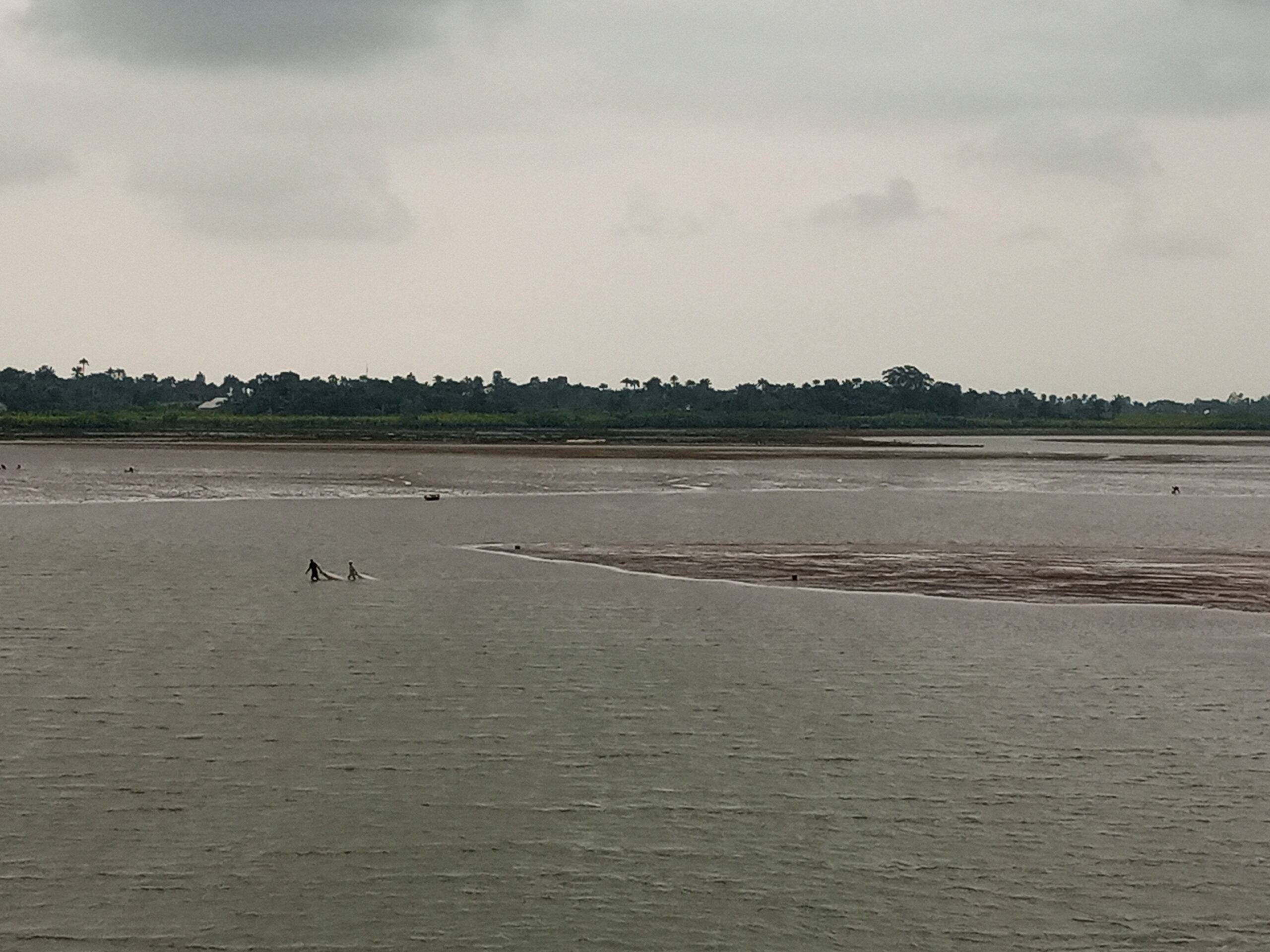
The first part of this series covered piracy and survival among Nigeria’s small-scale fishers and traders. The second showed government inaction. This third instalment shows how shifting weather is battering artisanal fishers, as told through the experience of one community.
The fishermen in Ikuru – a small Andoni community on the coast of Rivers State, Nigeria – have a lot to lament.
For generations, the settlement on the edge of the Atlantic lived by the tides. At dawn, men paddled out in narrow canoes while women waited ashore to buy the day’s catch. The sea provided enough to feed families and sustain the village.


It still does, but far less reliably, especially in some seasons.
On a recent, soggy afternoon, a dozen men and a woman sat on traditional benches under the sparse shade of trees and shrubs rising from the white coastal sand, their eyes on the restless sea. None had gone out to fish for days. The air hung heavy with moisture; the ocean waves crashed, retreated and gathered again with great force.
“It’s too dangerous,” said Fred Fred, the oldest among them, now in his seventies, who has fished here since his youth.
Others nodded. The waters have become less predictable, and venturing out can be fatal. “People have died,” said Nria Friday, a fish trader, who arrived that morning but found no fish to buy.


By their count, six people have died this season alone while braving rough waters to find something to eat or sell.
“If you go down there, you will see two bodies,” Mr Friday said, pointing to the east. “People still have to try to get something.”
In Ikuru, the sea used to have a rhythm. The August rains meant rest – a period known among fishers as a time to repair nets and canoes while waiting for the waters to settle.
“We would not go far,” Mr Fred recalled. “We caught fish near the shore and waited for the water to be quiet.”
That rhythm has disappeared. Sometimes the wind and rain continue for weeks longer than they used to. Storms now slam the shore with such force that paddling out a few metres can be dangerous. “Even near the shore, the waves are terrible, and (there are) no fish there,” Ete Joel, another fisher, said.

Fred Fred, forcing him to choose between having no catch for weeks or risking his
small boat in the dangerous, deeper ocean. Credit: Ini Ekott)
As the men spoke, a motorised boat appeared on the horizon. Two fishers fought the swells, their vessel rising and dropping sharply for about a quarter of an hour before they finally slid onto the sand, to the relief of everyone watching.
Fred remembered a time when locals here and in neighbouring Oyorokoto – reputed as the largest fishing settlement in West Africa – mostly fished using paddle boats. In those days, the seasons of heavy rains served another purpose: they allowed fish populations to regenerate as activities calmed.
Now, boats with powerful engines push deep into the sea all year round. These missions, dangerous during high storms and rains, leave no breathing space for the fish to replenish.
Men like Mr Fred, Mkpa-Teleyem Joel, Unyen-Awaji Nte and Michael Obi, who still rely on paddle boats or boats with weak engines, feel doubly stranded – by the furious weather and by the relentless fishing of those who can still go out with motorised boats.
“Before now (even 20 years ago), people avoided the water this time because of risks. Now, because of engines, they go any time, and they run into risks too,” said Mr Nte.
“But their engine and the type of net some use also take too much fish, and it’s a problem.”

Shrinking Stock
Fish provides about a quarter of the animal protein Nigerians eat, and in coastal and riverine areas, it can supply up to 80 per cent. The average Nigerian consumes around 8 kg of fish per year – far below the global average of about 21 kg.
To meet a portion of this demand, Nigeria produces an estimated 1.1 million tonnes of fish yearly: 36 per cent from marine waters, 36 per cent from inland waters, and 28 per cent from aquaculture.
In recent years, shifting weather patterns and rising water temperatures have affected fish survival, abundance, and migration, reshaping how fishers and traders work. As ocean temperatures rise, fish move toward cooler waters.
The people of Ikuru do not use the words “climate change.” However, what they describe aligns with what scientists say is unfolding along Nigeria’s southern coast.
Rainfall has become heavier and less predictable. Storms are more severe. And research shows that warming driven by rising carbon emissions will sharply diminish global fisheries, with catches projected to fall by about 7.7 per cent and revenues by more than 10 per cent by 2050.
The projections for West Africa are even grimmer. Studies warn that waters along the equatorial stretch will experience some of the steepest declines, with Nigeria among the most vulnerable. Fish stocks in Nigerian waters could drop by as much as 53 per cent – compared with losses of roughly 56 per cent in Côte d’Ivoire and around 60 per cent in Ghana.
Fishers say they already feel the shift. Species no longer appear where they once did, rendering long-held knowledge of where and when to fish less reliable. Many now travel farther offshore and spend more on fuel than they earn from their shrinking catches.
“With a good engine and fuel, you can get enough fish. You can go deep inside,” said Ala Magnus, another fisher.
Experts say the community’s observations reflect broader scientific trends. Isangadighi Isangadighi, head of the Fisheries and Aquatic Environmental Management Department at the University of Uyo, said rising temperatures are disrupting fish reproduction and survival.
“The climate has become unpredictable,” said Mr Isangadighi, an associate professor who researches hydrobiology, fisheries, and biodiversity. “The temperature actually affects the reproduction of fish. Before now, you could predict at this point you will have so-so level of reproduction… but when the temperature is fluctuating like that, you cannot really predict what is going to happen.”
He explained that warmer waters come with cascading problems. “Increase in temperature can lead to other things. It can reduce the quantity of dissolved oxygen. The higher the temperature, the lower the oxygen,” he said. Reduced water volume from evaporation and higher rates of fish spoilage – especially for artisanal fishers without proper storage – are also emerging concerns.

fish during persistent rains, due to violent storms and rising waves. They now
confront the danger of fishing far from shore. Credit: Ini Ekott)
Death at the Channel
Declining fish stocks, shifting species, and harsher storms, combined with piracy and crude-oil pollution, are among the biggest challenges facing small-scale fishers and traders across Niger Delta communities
Further east of Ikuru, some 172 kilometres away, fishers face yet another weather-related problem that has gone unreported. At Ibeno in neighbouring Akwa Ibom State, they described a deadly narrow channel at the mouth of the Qua Iboe River that connects to the Atlantic Ocean. Each rainy season, sandbars choke this passage, causing boats to capsize.
This year, 29 people have died at the Ibeno end of the ocean, they told us.
The deaths, locals say, are partly due to siltation – the build-up of sand and sediment that has narrowed the channel over the years.
“That one is a very serious problem for us in Ibeno,” said Nduekiden Eshiet, a local chief. “We have called on the government to help remove the sand as it is done in other places. But no answer.”
The Akwa Ibom State Government, through its Ministry of Agriculture, which oversees the sector, did not respond to questions on policies supporting the fishery subsector.
READ ALSO: How refinery and highway project wiped out Akwa Ibom’s Stubbs Creek Forest
Battered by Pollution
From Bori, a major Ogoni town, the 43-minute ride to Ikuru cuts through some of the region’s richest ecosystems – bright farmland, swamp forests and a thick mangrove belt that deepens into a lush, cinematic green.
But the landscape keeps breaking. Creeks along the route are not only polluted, but many are also drying out. Large stretches of sand now sit exposed in the middle of waterways, where men wade across what used to be deeper channels to fish in ankle-deep pools.
Oil pollution adds its own scars. Blackened mangroves, stagnant pools and slicked surfaces appear repeatedly.
After a December 2024 spill from a Shell facility in Bonny spread down to Andoni’s Asarama, Oyorokoto and Agbama, fouling nets and boats, officials said cleanup began quickly. But driving towards Ikuru, the signs remain: oily surfaces, dark mangroves and creeks, charred roots and dark water.
Fishers in Ikuru said their community has seen many changes, but they are hopeful the catch will soon be better again. No one, however, could tell when that will be.
“If you come back when we have fish, we’ll have some for you,” Mr Fred told the reporter who visited.
This story was supported by the Pulitzer Center.

Africa’s next food crisis may not begin on the farm, but in a distant shipping lane. With the Iran war, international attention has focused on oil flows through the Strait of Hormuz and related shortages or price spikes in energy and fuel. Less visible is another vulnerability moving through the same corridor: the fertilisers underpinning global food production.
Fertiliser supply disruptions feed directly into food prices and agricultural output, and most African countries have high import volumes and are ill-positioned to absorb the shock. Domestic production in Africa is insufficient to meet the growing demand.
Production capacity exists in parts of North and West Africa, driven by massive phosphate deposits and natural gas reserves. Morocco leads in phosphates, accounting for over 50 per cent of Africa’s supply and ranks among the top five global phosphate fertiliser exporters, while Nigeria, Egypt and Algeria dominate in nitrogenous (urea) fertiliser production.
A significant share of global fertiliser output is tied to energy-rich regions, particularly in the Gulf. The Middle East is a major hub for nitrogen-based fertilisers, reflecting the local availability of natural gas, which underpins ammonia and urea production.
The Strait of Hormuz connects these production hubs to global markets through a single, highly exposed shipping route. Almost 50 per cent of the globally traded sulphur used in phosphate fertilisers moves through it, making it a critical corridor for global agricultural inputs.
In parts of the Gulf, fertiliser plants have reduced output or paused operations. Even major producers like Morocco’s OCP Group are affected.
Fertiliser production relies on critical inputs like sulphur, much of which is sourced from the Persian Gulf, particularly the United Arab Emirates and Saudi Arabia, regions entangled in these disrupted trade routes. As sulphur supply tightens, production cannot be scaled up, even where phosphate reserves are abundant, and domestic logistics remain intact.
Constrained production will also erode export revenues for Africa’s major fertiliser exporters. Morocco and Egypt, together accounting for roughly 70 per cent of the continent’s fertiliser exports, could be disproportionately affected. At the same time, net importers, like Ethiopia, Côte d’Ivoire, Zambia, Kenya and the Democratic Republic of the Congo, face heightened risks of food inflation and declining crop yields.
The combined effect is a dual shock: export earnings weaken for producers, while import-dependent economies absorb rising costs and agricultural stress, amplifying macroeconomic and food security pressures.
Urea prices have surged from just under $500 per tonne before the conflict to above $700 per tonne in recent weeks. In South Africa, where roughly 80 per cent of crop production inputs are imported, and fertiliser constitutes a major share, grain farmers face input cost increases of up to 35 per cent. As Africa’s largest supplier of packaged foods, these pressures will likely transmit through the food system, worsening inflation.
Disruptions place disproportionate pressure on Africa’s low-industrialised farming systems. Fertiliser use remains far below global levels, averaging just 17 kg to 23 kg per hectare compared with a global average of 135 kg per hectare, reflecting persistent constraints on affordability and access. Reduced access to fertiliser is likely to lower application rates, with direct knock-on effects on crop yields and overall production across the growing season.
The stakes are particularly high given the central role of agriculture in African economies. The sector employs between 60 per cent and 70 per cent of the workforce, with rates exceeding 80 per cent in countries like Burundi, Malawi and Madagascar. However, it is dominated by smallholder farmers with limited capacity to absorb rising input costs or supply disruptions, making them acutely vulnerable to fertiliser shocks.
The lesson is not only about exposure tied to price volatility risks. It is also one of the structural vulnerabilities and untapped capacities. Africa holds many of the inputs required to reduce this dependency: natural gas reserves in Nigeria, Mozambique, Tanzania and Senegal; significant phosphate resources in Morocco and Tunisia; and rapidly growing demand driven by the need to boost agricultural productivity and contain food crises.
Converting this resource base into production and supply capacity is achievable, but requires focusing on three priorities.
First, production must be scaled strategically. Not every country needs to produce fertiliser, but a core group with comparative advantages could anchor regional supply. Second, markets must be integrated. Without efficient cross-border trade, lower transport costs and reliable distribution, increased production won’t translate into access. The African Continental Free Trade Area agreement provides a ready framework, but it must be operationalised.
Third, fertiliser policy must extend beyond production. Supply depends on functioning ecosystems: storage, blending, transport, finance and last-mile delivery. Without these, fertiliser will not reach farmers at scale. These segments create space for local entrepreneurship. The growth of agri-tech platforms such as Hello Tractor and Apollo Agriculture shows what’s possible, but these remain the exception, not the norm.
Self-sufficiency is neither feasible nor necessary. However, the current disruption exposes the cost of leaving a strategic input to external markets. Greater regional capacity would not eliminate global exposure, but would reduce the extent to which distant crises dictate African food systems.
The Hormuz shock is a warning about the fragility of supply chains. It exposes a persistent blind spot in agricultural policy debates. While financing gaps and farm-level productivity dominate the agenda, less attention is given to upstream supply chains that shape access to critical inputs such as fertiliser.
It’s a reminder that agricultural stability and food security depend not just on seeds, rainfall and land, but on whether Africa can build the industrial foundations that address the fertiliser system deficit and make food production less vulnerable to external dependencies.
A previous version of this article was published in Africa Tomorrow, the blog of the ISS African Futures and Innovation Programme.
Julia Baum, Website Consultant and Marvellous Ngundu, Research Consultant, Institute for Security Studies (ISS).
(This article was first published by ISS Today, a Premium Times syndication partner. We have their permission to republish).

The National Biosafety Management Agency (NBMA) says it has ordered the suspension of four new transgenic cotton hybrid varieties in Nigeria.
The varieties are MIC 561 BGII, MIC 563 BGII, BIOSEED-FIYAH CH1001, and BIOSEED-FIYAH CH1002. They were allegedly registered by the National Committee on Naming, Registration and Release of Crop Varieties, Livestock Breeds and Fisheries on 26 March 2026 without the requisite approval of NBMA.
In a statement issued Tuesday and signed by NBMA’s Head of Information and Public Relations, Gloria Ogbaki, the agency said its regulatory surveillance and compliance-monitoring mechanisms identified “serious compliance abnormalities” in the varieties.
“The National Biosafety Management Agency (NBMA) wishes to inform the public of recent developments concerning the registration of four new transgenic cotton hybrid varieties in Nigeria – MIC 561 BGII, MIC 563 BGII, BIOSEED-FIYAH CH1001, BIOSEED-FIYAH CH1002,” the statement said.
Background
Genetically modified (GM) crops are plants whose DNA has been altered using genetic engineering to introduce desirable traits such as resistance to pests, diseases, or environmental conditions, as well as improved nutritional value.
In Nigeria, the adoption of GM crops has remained contentious. While proponents argue that the technology can boost food production and enhance food security, critics have raised concerns about environmental and health risks, weak regulatory enforcement, and inadequate labelling.
According to the International Service for the Acquisition of Agri-biotech Applications (ISAAA), more than 30 major food crops have been genetically modified globally. Nigeria has approved four crops—maize, cowpea, cotton, and soybean—for commercialisation and is among six African countries leading in biotech crop adoption.
In 2024, the government approved four varieties of Tela maize, further intensifying debates over GM crop safety and transparency.
Concerns also persist over farmers’ limited knowledge of GM seed characteristics, potential dependence on seed companies, and the broader impact on traditional farming systems.
An investigation by PREMIUM TIMES and international partners in 2024 revealed how the U.S. government, through the now-defunct USAID, funded pesticide and GM-related advocacy campaigns in Nigeria, including efforts that profiled critics of GMOs.
As debates continue, the suspension of the new cotton varieties underscores ongoing challenges around biosafety compliance and regulatory oversight in Nigeria’s biotechnology sector.
Findings
The agency said its findings confirmed that confined field trials and related activities involving the varieties were conducted without prior authorisation, inspection, or regulatory oversight.
“At no time did the National Biosafety Management Agency grant any approval for the confined field trials, multi-locational trials, or commercial release of the new GM cotton varieties,” the statement said.
Under the NBMA Act, the agency said, no person or institution is permitted to conduct confined field trials, multi-locational trials, or the commercial release of genetically modified organisms without its explicit approval.
It added that any action outside this framework constitutes a violation of national biosafety regulations.
NBMA said it has directed the National Committee on Naming, Registration and Release of Crop Varieties, Livestock Breeds and Fisheries to suspend further action on the varieties pending the outcome of ongoing investigations.
READ ALSO: BUA Foods Posts N1.77 Trillion Revenue, announces N28 Dividend
“The Agency will apply all appropriate regulatory measures and sanctions as provided under the law,” the statement added.
The agency assured Nigerians that it is handling the matter with seriousness.
“There is no evidence at this time of any immediate risk to public health or the environment and all necessary steps are being taken to ensure continued safety and regulatory integrity,” the statement said.
NBMA reiterated its commitment to ensuring that biotechnology activities in Nigeria comply with national laws and international best practices, adding that the public will be kept informed as investigations progress.

The National Biosafety Management Agency (NBMA) says it has ordered the suspension of four new transgenic cotton hybrid varieties in Nigeria.
The varieties are MIC 561 BGII, MIC 563 BGII, BIOSEED-FIYAH CH1001, and BIOSEED-FIYAH CH1002. They were allegedly registered by the National Committee on Naming, Registration and Release of Crop Varieties, Livestock Breeds and Fisheries on 26 March 2026 without the requisite approval of NBMA.
In a statement issued Tuesday and signed by NBMA’s Head of Information and Public Relations, Gloria Ogbaki, the agency said its regulatory surveillance and compliance-monitoring mechanisms identified “serious compliance abnormalities” in the varieties.
“The National Biosafety Management Agency (NBMA) wishes to inform the public of recent developments concerning the registration of four new transgenic cotton hybrid varieties in Nigeria – MIC 561 BGII, MIC 563 BGII, BIOSEED-FIYAH CH1001, BIOSEED-FIYAH CH1002,” the statement said.
Background
Genetically modified (GM) crops are plants whose DNA has been altered using genetic engineering to introduce desirable traits such as resistance to pests, diseases, or environmental conditions, as well as improved nutritional value.
In Nigeria, the adoption of GM crops has remained contentious. While proponents argue that the technology can boost food production and enhance food security, critics have raised concerns about environmental and health risks, weak regulatory enforcement, and inadequate labelling.
According to the International Service for the Acquisition of Agri-biotech Applications (ISAAA), more than 30 major food crops have been genetically modified globally. Nigeria has approved four crops—maize, cowpea, cotton, and soybean—for commercialisation and is among six African countries leading in biotech crop adoption.
In 2024, the government approved four varieties of Tela maize, further intensifying debates over GM crop safety and transparency.
Concerns also persist over farmers’ limited knowledge of GM seed characteristics, potential dependence on seed companies, and the broader impact on traditional farming systems.
An investigation by PREMIUM TIMES and international partners in 2024 revealed how the U.S. government, through the now-defunct USAID, funded pesticide and GM-related advocacy campaigns in Nigeria, including efforts that profiled critics of GMOs.
As debates continue, the suspension of the new cotton varieties underscores ongoing challenges around biosafety compliance and regulatory oversight in Nigeria’s biotechnology sector.
Findings
The agency said its findings confirmed that confined field trials and related activities involving the varieties were conducted without prior authorisation, inspection, or regulatory oversight.
“At no time did the National Biosafety Management Agency grant any approval for the confined field trials, multi-locational trials, or commercial release of the new GM cotton varieties,” the statement said.
Under the NBMA Act, the agency said, no person or institution is permitted to conduct confined field trials, multi-locational trials, or the commercial release of genetically modified organisms without its explicit approval.
It added that any action outside this framework constitutes a violation of national biosafety regulations.
NBMA said it has directed the National Committee on Naming, Registration and Release of Crop Varieties, Livestock Breeds and Fisheries to suspend further action on the varieties pending the outcome of ongoing investigations.
READ ALSO: BUA Foods Posts N1.77 Trillion Revenue, announces N28 Dividend
“The Agency will apply all appropriate regulatory measures and sanctions as provided under the law,” the statement added.
The agency assured Nigerians that it is handling the matter with seriousness.
“There is no evidence at this time of any immediate risk to public health or the environment and all necessary steps are being taken to ensure continued safety and regulatory integrity,” the statement said.
NBMA reiterated its commitment to ensuring that biotechnology activities in Nigeria comply with national laws and international best practices, adding that the public will be kept informed as investigations progress.


Man Utd’s Chido Obi in Loan Talks with Bundesliga Club FC Koln

Troops neutralise suspected bandits, recover rustled livestock in Plateau

DSS frees farmer cleared of Boko Haram links, pays compensation

Simi Sanya and Femi Dapson Are Now Legally Married and It Is Beautiful to See

FCT Area Council Election: Live results from polling units

Premier League Set-Piece Goals (2025/2026)
-
 Sports1 day ago
FIFA Allow Rainbow Flags at World Cup ‘Pride Match’ Featuring Iran vs Egypt
-
 Sports2 days ago
Thomas Partey Could Be Blocked From Knockout Tie
-
 Sports18 hours ago
Raphinha’s Wife Debunks ‘Financial Problems’ Claim From World Cup Winner
-
 Sports2 days ago
Rory McIlroy Risks Breaking PGA Tour Rule That Led to One-Year Ban
-
 Sports1 day ago
Uruguay Players ‘Revolt Against Marcelo Bielsa’ Ahead of Spain Game
-
 Sports2 days ago
Supercomputer Predicts 2026-27 Championship Table
-
 Sports2 days ago
Trent Alexander-Arnold Could Have Played For the USMNT Instead of England
-
 Sports2 days ago
Cristiano Ronaldo’s Reaction to Lionel Messi’s Argentina Retirement in 2016