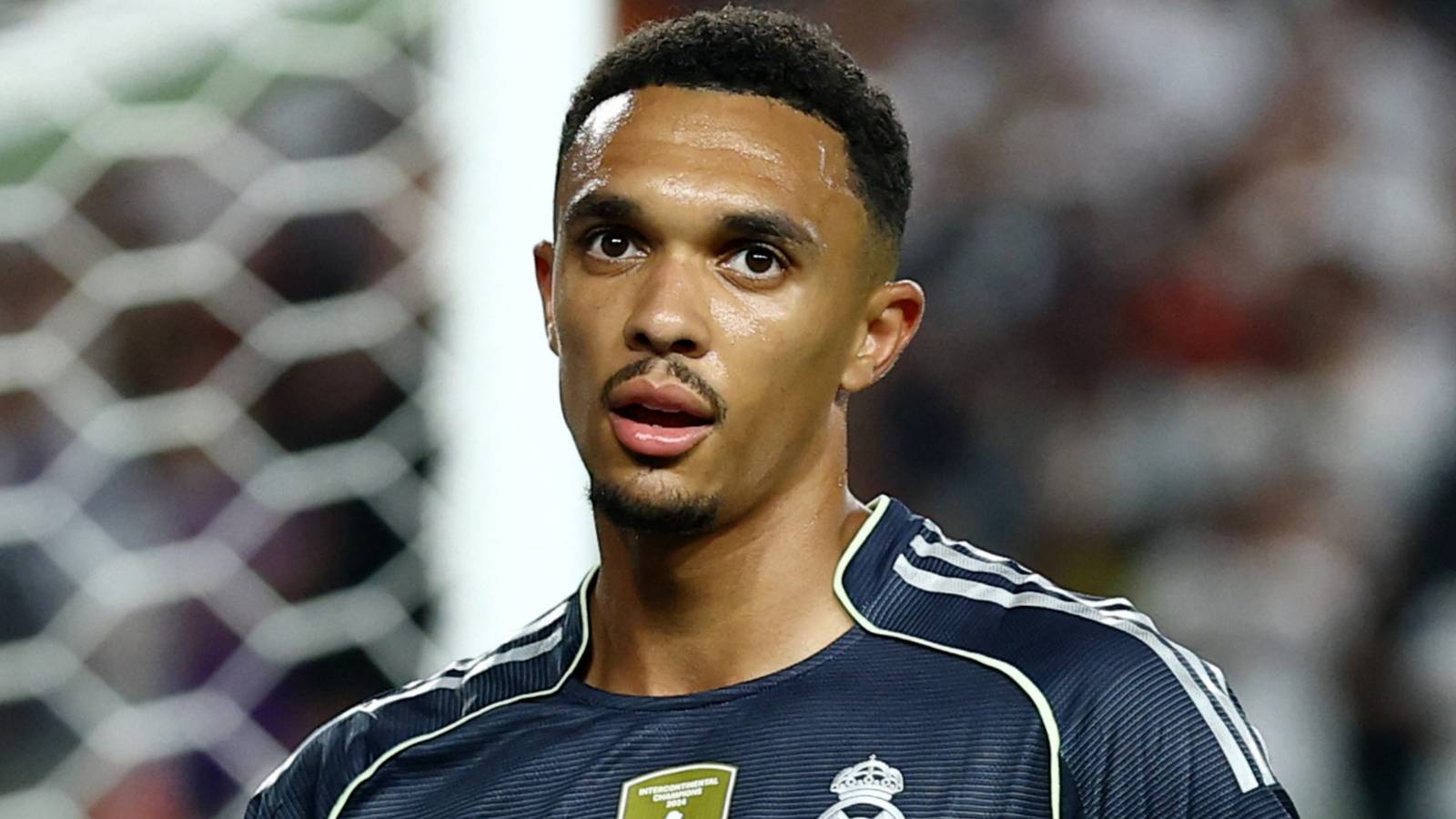
One of the biggest transfer sagas of 2025 focused on the future of Trent Alexander-Arnold. The homegrown Liverpool star decided he would not renew his contract at Anfield, and instead moved to Real Madrid last summer.
Alexander-Arnold is currently halfway through his first season in Spain, but has already seen manager Xabi Alonso depart. With Alvaro Arbeloa now calling the shots at Real Madrid, the local press have shared an interesting update on their relationship.
Arbeloa’s Behind-the-Scenes Treatment of Trent
Alexander-Arnold hasn’t exactly had the best of time in Madrid so far, with injury issues keeping him from finding his best form. He’s played just 11 times in all competitions and is yet to score, picking up just one assist.
In December, there was even talk that he could leave for a cut price with Manchester City, Manchester United, and Newcastle among the teams keeping an eye on the situation. However, with Arbeloa now in charge, it doesn’t seem as though that is likely.
As per the Spanish publication AS, there is no truth to any reports that the Spanish manager doesn’t like Alexander-Arnold or that he will be looking to offload the defender. Quite the opposite, in fact, as the Englishman is said to have received assurances from the club from the moment he suffered his most recent injury setback against Athletic Club in early December.
The report even adds that the new boss has also been supportive in recent weeks, which speaks volumes about Arbeloa’s faith in the 27-year-old coming good. Indeed, it’s claimed that Arbeloa has been looking after the player during his recovery, hoping to potentially get him back into action this weekend against Valencia.
The English defender has been back in training this week, having missed the last seven La Liga matches with a muscle tear.
Trent Alexander-Arnold at Real Madrid 2025/26
Games
11
Starts
7
Minutes
497′
Goals
0
Assists
1
Would Liverpool Look to Bring Alexander-Arnold Back to Anfield?
Before this latest news had put to bed the idea that Arbeloa and Madrid could be aiming to sell the right-back this summer, there was some talk about Liverpool’s potential interest in bringing him back to Anfield. However, that never seemed to be likely.
Even if he was put up for sale, the Reds reportedly have little interest in entering the race for his signature. The English outfit signed Jeremie Frimpong in the summer as a replacement, while they also believe in Conor Bradley. As such, they feel that a return for Alexander-Arnold would affect the squad plans that are already in place.
Having left only last summer, sparking such spectacular anger from many members of the Liverpool fanbase, it seems unlikely that either player or club would be keen on a quick reunion. The first half of his Madrid career has been patchy at best, but with Arbeloa’s apparent faith, and a return from injury close, perhaps a return in form is just around the corner for Alexander-Arnold.
Following the game at Torono Stadium, Ronaldo made his way over to Modric and the two former teammates had a few words with each other before sharing an emotional embrace.
Speaking after the match, Ronaldo revealed what he said to the legendary midfielder. He said, per Manchester Evening News: “I played with Luka so many matches and we are nearly the same age. He is a legend of football.
“I said to him, ‘Congratulations for everything. I would love to see you again and all the best for the next years of your career’. It was nice to play him once again.”
You scored
out of 20
Luka Modric Rages at VAR After Portugal 2-1 Croatia
REUTERS/Dylan Martinez
Modric vented his frustrations at VAR following the match. He said, via Sportske Novosti: “We can look at the game in two parts, in the first half we were not at our best level, we were quite withdrawn, but in the second half we played a phenomenal game.
“That’s one of our better games. We could have easily finished it earlier, but we didn’t manage it. We missed, and then some things happened that are unbelievable to me.
“What is, is there. It’s hard to say what is smart after the game, I don’t want to say something wrong. We can be proud of how we played the second half; we deserved more, but simply, football is like that. “
On the disallowed goal, he said: “He says Matanović touched the ball, but we watched the footage, there’s no evidence that he touched the ball. If he doesn’t touch the ball, it’s not offside.”
He added: “Some things didn’t go our way. That penalty… If it were the other way around, VAR would never have been involved.
“I said about VAR in the beginning, when it was first introduced, that I didn’t like it. Later, over time, it’s good for some things, but they use it incorrectly or use it selectively, or depending on the size of the team.
“VAR should intervene if it’s 200 per cent a mistake, but if it’s not, if it’s in the grey zone, you have no say in it. There’s no point in calling VAR.
“This is no penalty. Both teams are replaying, pushing, Vlašić didn’t pull it, he held it, and both of them fell. That’s why you can’t judge a penalty like that in a game like this.
“That’s why I say, it has to be used if the mistake is 200 per cent. If you can treat something this way or that, you have no say in it.
“That annoys me and always works to our detriment. What is, it is, let’s move on, we won’t complain about it, but of course, some things bother me because fate decides.
“They decide the mood for everything you do, what you give up, you tear yourself apart, you fight. There are young players who come here, and then you do something like this to them… You are to blame for that, and it is always to our detriment.”
Joao Palhinha has confirmed that he won’t be a Tottenham Hotspur player next season following a big U-turn by manager Roberto De Zerbi.
Tottenham have been the busiest Premier League club by far in the summer transfer window, with Sandro Tonali set to become their sixth addition imminently after Spurs agreed a club-record £100m fee with Newcastle United for the Italy international.
The 26-year-old follows fellow midfielder Mateus Fernandes through the door at the Tottenham Hotspur Stadium, which has meant that De Zerbi has had to backtrack on his previous comments.
The Italian boss had previous said that Palhinha was someone he ‘100%’ wanted to sign this summer, after the Portugal international played a huge part in the club’s survival last season.
Palhinha scored two crucial goals against Wolverhampton Wanderers and Everton during the run-in, and while Tottenham didn’t take up the option they had to sign him on a permanent basis, it was expected that they would try and renegotiate the terms.
However, the north Londoners have now turned their back on a deal for the Bayern Munich star, having landed both Fernandes and Tonali for their midfield in big-money deals.
The Azteca Stadium in Mexico sparked conversations across football during the 2026 World Cup, with venue sitting 2,200m above sea level. It has been argued that the home stadium of the Mexico national team gives the host nation a huge advantage, as visiting teams struggle with the high altitude and limited oxygen.
It is an argument with merit, considering that Mexico have only lost two competitive matches at the stadium since it opened in 1966. Build-up to games often revolves around the ‘thin air’ narrative, with sports scientists lining up to explain how the lack of oxygen would hit visiting legs by the hour mark.
However, the twist is that the Azteca doesn’t even crack the top 10 highest football stadiums on the planet – it isn’t even close. There is a cluster of grounds that make Mexico City’s altitude look almost pedestrian, plus outliers on three other continents that rarely get a mention. Some of these venues sit so high that the pitches themselves have had to be rebuilt with artificial turf, because grass simply doesn’t work at such elevation.
Top 10 Highest Altitude Stadiums in the World
Stadium
Location
Altitude
Estadio Daniel Alcides Carrion
Cerro de Pasco, Peru
4,338m (14,232ft)
El Alto Municipal Stadium
El Alto, Bolivia
4,088m (13,412ft)
Estadio Victor Agustin Ugarte
Potosi, Bolivia
3,890m (12,762ft)
Estadio Enrique Torres Belon
Puno, Peru
3,829m (12,562 ft)
Estadio Guillermo Briceno Rosamedina
Juliaca, Peru
3,825m (12,549ft)
Estadio Jesus Bermudez
Oruro, Bolivia
3,735m (12,254ft)
Estadio Hernando Siles
La Paz, Bolivia
3,582m (11,752ft)
Estadio Inca Garcilaso de la Vega
Cusco, Peru
3,402m (11,161 ft)
Estadio Huancayo
Huancayo, Peru
3,259m (10,690ft)
Estadio El Campin
Bogota, Colombia
2,553 (8,376 ft)
Topping the list by some distance is Estadio Daniel Alcides Carrion in Cerro de Pasco, Peru. It is officially recognised as the highest football stadium in the world at 4,338m above sea level. It’s the home of Union Minas, and the ground holds around 10,000 supporters,tucked into one of the highest cities on earth. Extraordinarily, the stadium sits higher than some Mount Everest base camps and well above the altitude at which altitude sickness can become a genuine concern for those unfamiliar with it.
Cerro de Pasco itself has been a silver-mining town, and the stadium’s synthetic pitch, installed in 2012, exists because natural grass genuinely struggles to grow at such heights. It’s a detail that sums up how extreme the conditions are, with the stadium needing to be completely redesigned for it to function.
Bolivia, meanwhile, dominates the rest of the upper table, with three of the top six venues on this list found within its borders.
There is a wider context to this matter as well. FIFA temporarily banned international matches above 2,500m in May 2007after Brazilian club Flamengo needed bottled oxygen during a Copa Libertadores match in Potosi, sparking anger among Bolivians. The ban was revoked before it had even been in place for a year, but it remains the reference point for any conversation about altitude and the sport, and it’s why acclimatisation schedules are now standard practice for touring squads.
The fans in these venues are among the most passionate in the world, making for some incredible atmospheres.
South America
Estadio Daniel Alcides Carrion, Peru – 4,338m
The undisputed summit of world football, Estadio Daniel Alcides Carrion, sits inside Cerro de Pasco, one of the highest cities on the planet. Home to Union Minas and a regular Copa Peru venue, the stadium fitted an artificial surface in 2012 after natural grass was unable to grow. FIFA officially recognises it as the world’s highest ground.
Africa
Addis Ababa Stadium, Ethiopia – 2,400m
Africa’s entry sits in Ethiopia’s capital, itself one of the highest capital cities on the continent at somewhere around 2,350–2,400m above sea level (precise figures vary depending on the exact measuring point in the city). The stadium has long served as the home of Ethiopian football and hosts both domestic league fixtures and international matches for the national side. It doesn’t threaten the Andean giants for altitude, but it’s a useful reminder that thin-air football isn’t purely a South American story, and other continents such as Africa can produce similar conditions.
⚽
World Cup History Quiz
You scored
out of 20
North America
Estadio Azteca, Mexico – 2,200m
Estadio Azteca, rebranded as Mexico City stadium for World Cup 2026, hosted the opening match of the tournament between Mexico and South Africa, becoming the first venue to host three separate World Cup openers, after previously staging the tournament in 1970 and 1986. At roughly 2,200m above sea level, it’s the end of Mexico’s altitude spread, and it’s tough on unacclimatised visitors, even if it’s nowhere near the top of the global ranks.
Europe
Ottmar Hitzfield Arena, Switzerland – 2,012m
Europe’s answer is a world away from purpose-built elite level stadiums. The Ottmar Hitzfield stadium sits in Gspon, a car-free Swiss hamlet reachable only by cable car, and is the continent’s highest football pitch at just over 2,000m. Home to amateur side FC Gspon, the artificial surface is smaller than regulation size and hemmed in by a safety net to stop wayward shots tumbling hundreds of feet down the mountainside. It’s named after former Bayern Munich and Switzerland boss Ottmar Hitzfeld, who took the ceremonial kick-off when it opened in 2008.
Asia
Dasharath Rangasala, Nepal 1,400m
Nepal’s national stadium in Kathmandu is Asia’s highest-profile entry, sitting somewhere around 1,300-1,400m above sea level depending on the exact measuring point in the valley. Built in 1956, Dasharath Rangasala has hosted the AFC Challenge Cup, the SAFF Championship and multiple South Asian games, though it’s carried a dark history too; a 1988 stampede during a hailstorm killed dozens of spectators. There are almost certainly higher, unrecorded pitches scattered across Central Asia’s mountain interior, particularly in Afghanistan, Kyrgyzstan and Tajikistan, but reliable published data is minute, and none hosted organised top-level football like the Dasharath Rangasala has.