
Sports
Spurs’ Final 25/26 Premier League Fixtures Ranked Compared to Rivals


We are now into the final stretch of the 2025/26 Premier League season, and while there is plenty of interest in the title race between Arsenal and Manchester City, there is just as much excitement in the relegation battle. This is mainly because Tottenham Hotspur are now one of the prime candidates to go down.
At the foot of the table sit Wolves, and despite a recent resurgence, Rob Edwards’ men look all but set to finish in the bottom three. As do Burnley, who have just three more points. The final spot, however, is up for grabs.
West Ham United and Nottingham Forest both have 28 points, with the Hammers in 18th due to goal difference. Tottenham sit just one place and one point ahead with nine games to play. Leeds, in 15th, then place another spot higher and two points clear of Spurs.
Fans of each team will be desperately checking the fixtures list, trying to work out which games they might have a chance of picking up a few vital points in. With that in mind, their final run of matches have each been ranked.
Leeds United

The good news for Leeds United is that they have, on paper, the easiest run of fixtures. Across their final nine games of the season, Daniel Farke’s men hold an average league position of 13.2. While away trips to Manchester United and Bournemouth could be tricky, the ‘strongest’ team they will face at Elland Road is now Brentford, currently 7th.
A 1-0 home loss against Sunderland last time out wouldn’t have helped nerves, but Leeds are masters of their own destiny here. The main worry, though, will be that they have to travel away to Tottenham and West Ham in two of the final three games of the season. That final-day trip to the London Stadium could be a relegation decider for the two teams.
|
Leeds United Remaining Premier League Fixtures |
||
|---|---|---|
|
Fixture |
Position |
Date |
|
Crystal Palace (A) |
13 |
15 March |
|
Brentford (H) |
7 |
21 March |
|
Man Utd (A) |
3 |
13 April |
|
Wolves (H) |
20 |
18 April |
|
Bournemouth (A) |
9 |
25 April |
|
Burnley (H) |
19 |
2 May |
|
Tottenham (A) |
16 |
9 May |
|
Brighton (H) |
14 |
17 May |
|
West Ham (A) |
18 |
24 May |
|
Average League Position of Remaining Opponents: 13.2 |
||
Tottenham Hotspur

While many are shocked to see Tottenham languishing in 16th with just nine league games to finish, it should not be forgotten that the north London outfit finished 17th in 2024/25. Perhaps relegation would be a natural regression for a team that appears to have got so much wrong both on and off the pitch in the past few years. The club will be desperate to avoid the drop, and fortunately, they have an easier run-in than the two teams directly below them.
While an away trip to Liverpool next up is especially daunting, seeing as interim coach Igor Tudor has lost all three league games so far, Tottenham can fix things just a week later. Indeed, a home visit of Nottingham Forest could help Spurs wrestle back some control. Leeds also have to visit the Tottenham Hotspur Stadium, which could make for a pivotal encounter. Trips to Aston Villa and Chelsea in two of their final four games, however, almost guarantee a nervy end to the season.
|
Tottenham Remaining Premier League Fixtures |
||
|---|---|---|
|
Fixture |
Position |
Date |
|
Liverpool (A) |
6 |
15 March |
|
Nottingham Forest (H) |
17 |
22 March |
|
Sunderland (A) |
11 |
12 April |
|
Brighton (H) |
14 |
18 April |
|
Wolves (A) |
20 |
25 April |
|
Aston Villa (A) |
4 |
2 May |
|
Leeds (H) |
15 |
9 May |
|
Chelsea (A) |
5 |
17 May |
|
Everton (H) |
8 |
24 May |
|
Average League Position of Remaining Opponents: 11.1 |
||

Arsenal, Man City, Man Utd and Aston Villa’s Remaining 25/26 Premier League Fixtures Ranked
Arsenal, Manchester City, Manchester United and Aston Villa are the top four Premier League teams – but how difficult are their remaining fixtures?
Nottingham Forest

It says something that Nottingham Forest are on their fourth manager of the campaign, with Nuno Espirito Santo, Ange Postecoglou and Sean Dyche all sacked before Vitor Pereira came in. The Portuguese manager has been tasked with steadying things on the pitch, but with Forest chief Edu Gaspar also now fired, the City Ground is not exactly a picture of stability right now.
With all that chaos in mind, the club will be concerned by a fairly tricky run of fixtures to come, with the average league position of their final nine opponents being 9.8. A surprise point against Manchester City will have boosted spirits and the upcoming home match against Fulham will be targeted as a big opportunity to pick up just an eighth win of the season. After that, all eyes will be on Forest’s trip to Tottenham – whatever happens there could be a turning point for either team.
|
Nottingham Forest Remaining Premier League Fixtures |
|||
|---|---|---|---|
|
Fixture |
Position |
Date |
|
|
Fulham (H) |
10 |
15 March |
|
|
Tottenham (A) |
16 |
22 March |
|
|
Aston Villa (H) |
4 |
11 April |
|
|
Burnley (H) |
19 |
18 April |
|
|
Sunderland (A) |
11 |
24 April |
|
|
Chelsea (A) |
5 |
2 May |
|
|
Newcastle (H) |
12 |
9 May |
|
|
Man Utd (A) |
3 |
17 May |
|
|
Bournemouth (H) |
9 |
24 May |
|
|
Average League Position of Remaining Opponents: 9.8 |
|||
West Ham

West Ham United have has a strange season which started miserably under Graham Potter and has only marginally improved under Nuno Espirito Santo. As a result, which nine games to play, they are stuck in the relegation zone and may have a tricky time as they try to escape.
The host Man City next before then going away to Aston Villa. Any kind of result against either team will be seen as a big bonus, with fans likely pessimistic about their team’s chances. At least Wolves’ visit will be viewed as a welcome opportunity to come into a game as favourites for once, but the remaining fixture list from that point on isn’t too friendly. The only direct relegation rival West Ham play from then on is Leeds at home on the final day of the season. The loser of that may well find themselves playing Championship football in 2026/27.
|
West Ham Remaining Premier League Fixtures |
|||
|---|---|---|---|
|
Fixture |
Position |
Date |
|
|
Man City (H) |
2 |
14 March |
|
|
Aston Villa (A) |
4 |
22 March |
|
|
Wolves (H) |
20 |
10 April |
|
|
Crystal Palace (A) |
13 |
20 April |
|
|
Everton (H) |
9 |
25 April |
|
|
Brentford (A) |
7 |
2 May |
|
|
Arsenal (H) |
1 |
9 May |
|
|
Newcastle (A) |
12 |
17 May |
|
|
Leeds (H) |
15 |
24 May |
|
|
Average League Position of Remaining Opponents: 9.2 |
|||

Germany stands as one of the most historic international football institutions, boasting both iconic players and teams across the ages.
Whether it’s the dominant force that prevailed in the 1970s that cleaned up at both European and world level, the famed sides in the 1980s and 90s, or the triumphant winning squad of 2014, they have always been a contender.
As a result, the famous white-and-black strip is an unmistakable feature of Die Mannschaft, and is a design known all over the world and associated with football royalty.
However, when a kit clash occurs at international level, they are forced to switch to a far-less witnessed green strip. This is the unexpected trivia behind the colour that isn’t found anywhere on their national flag.
The Reason Why Germany’s Away Kit is Green

Interestingly, the truth behind the inception of the green kit is shrouded in an urban myth. One story claims that, following the aftermath of World War Two, Germany was isolated from international sports and Ireland became the first country to agree to a friendly match, resulting in them adopting the country’s green look.
However, the timelines simply don’t match up. Their first match actually came a year earlier in 1950 against Switzerland. Instead, the true origin lies with the German Football Association.
The Fascinating Reason Why Brazil Wear Yellow Kits
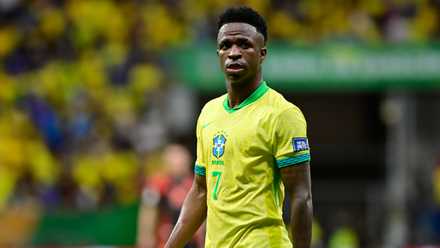
Brazil’s famous yellow kits are remembered throughout the world, being deeply associated with the country’s footballing prowess.
Green and White are the official colours of the DFB, matching the governing body’s crest and logo. It is also matched to the colours of the pitch, ensuring it is more a neutral sports identity rather than a political one. Despite it being the lesser worn kit, it was worn during iconic moments such as their winning 1972 European Championship campaign and later 1990 penalty shootout victory over England.
Ballon d’Or winner Lothar Matthäus later remarked that:
“When you think of classic German football, you think of those fighting performances in the green shirts. It wasn’t our flag, but it felt entirely like our history.”
Why Germany Wear White

The famed home jersey is indeed rooted heavily in the history of Germany. Dating back to the 19th century, the white and black refer to the colours of the Prussian Flag — the state that led the unification of the German Empire.
Even though the political landscape changed dramatically over decades, it remains loyal to the traditional sporting identity. The colours were also favoured for their simplicity of early athletic wear. Countless icons have helped to elevate it to cultural significance; Franz Beckenbauer leading the country to glory in the 1970s stands out.
Plus, the introduction of Adidas as the designer from 1980 onwards gave us the iconic 1990 kits, with the simple home design possessing the three colours of the flag running across steeped in football culture. And the aforementioned green away strip is also a stunning creation.
Not many countries can boast football attire that is as beloved in the football vintage kit community as Germany’s — combining style with the rich history of being one of football’s elite nations.

10 Most Iconic Kits in Football History [Ranked]
The 10 most iconic kits in football history have been named and ranked in order.

US police have issued a statement after a shooting at a World Cup fan zone left one dead and another ‘seriously injured’ in San Jose, California, on Sunday night.
There were no World Cup games being screened at the time of the shooting, with the only match of the day in the tournament finishing around 2pm local time. But the spot, on San Pedro Square, is one of the most popular entertainment zones in the San Francisco Bay Area.
The Bay Area has hosted five World Cup matches so far, with the last game a knockout match on Wednesday between Bosnia and co-hosts the United States.
Shooting at World Cup Fan Zone Leaves One Dead & Another in Critical Condition

Police in California have since released a statement about the incident, with several roads now closed while the investigation continues. They wrote on X (see the full post below):
“One victim was pronounced deceased on scene. The second victim was transported to a local hospital with life-threatening injuries. This incident is being investigated as a homicide. Several surrounding streets are closed in the area.”
A Reuters journalist at the scene saw a heavy police presence, multiple police vehicles and a person on a stretcher partially covered by a white sheet being rushed away from the area by people in uniforms, as per the Daily Mail. The scene was cordoned off and most bars in the area were closed after the incident.
Condition of Other Victim Emerges

A security guard, who declined to be named because she was not authorized to speak to media, said she saw the injured person in distress. “The person was still moaning and groaning. There was blood around his neck and upper back,” she said. “Police were talking to security and a couple of witnesses.”
Unfortunately, shootings and crime have not been rare at the 2026 World Cup, with five reported shootings taking place in Kansas City between the week before England were due to fly to their group-stage training base and now. The dangers of allowing gun licenses has cropped up in several flashpoints this summer so far.

Japan’s blue shirt has become one of their most recognisable features in world football.
From the days of Hidetoshi Nakata to the modern era of Kaoru Mitoma and Takefusa Kubo, the Samurai Blue have made that deep, vivid shade of blue their own, winning admirers across the globe for their football and their identity in equal measure.
But if you look at the Japanese flag, there isn’t a single shade of blue to be found. Just a red disc on a white background. So why does Japan play in blue at all? The answer stretches back nearly a century, and involves a university kit, an unlikely comeback, and a word that sounds a lot like ‘victory’.
Why Japan Play in Blue

The story starts in 1930, when the Japan Football Association first assembled a proper national squad for the Far Eastern Championship Games. Before that point, the top-ranked university team of the year would simply represent the country in their own colours.
When the JFA brought together players from across the nation for the first time, the squad was dominated by students from Tokyo Imperial University, and their kit was light blue. The players chose to adopt that colour, and Japan wore blue for the first time as a unified national team.
The colour stuck, but it was a match six years later that turned it from a practical choice into a national superstition. At the 1936 Berlin Olympics, Japan faced Sweden, one of the tournament favourites, in the first round. They fell 2-0 behind in the first half. What happened next became known as the ‘miracle of Berlin’. Japan came back to win 3-2, the first ever Olympic or World Cup victory by an Asian nation. They were wearing blue.
You scored
out of 20
The JFA admits that the true origin of the Blue kit is not definitively documented. But the 1936 comeback cemented the association between blue and good fortune, and the colour has been a cornerstone of Japan’s footballing identity ever since.
Blue has not always been permanent. In the late 1980s, Japan switched to a red and white kit to better reflect the colours of its flag. It didn’t go well. They failed to qualify for the 1990 World Cup and the 1992 Olympics. Blue was restored in 1992, and the team hasn’t looked back since, qualifying for every World Cup from 1998 onwards.
Kachi-Iro and the Samurai Connection

For the 2018 World Cup, the JFA introduced a specific shade of deep indigo called Kachi-Iro for the home kit. The choice was deliberate, as Kachi sounds identical to the word ‘victory’, and the colour was historically worn by Samurai under their armour, which was believed to bring strength in battle.
That link gave Japan’s nickname, the Samurai Blue, officially adopted after a public vote ahead of the 2006 World Cup in Germany. The Samurai spirit, the indigo dye, the sound of the word for victory, all of it wrapped into a single colour.
The Badge on the Shirt

The crest that sits on every Japanese shirt adds another layer of mythology to the picture. It features the Yatagarasu: a three-legged crow from ancient Japanese tradition, said to have guided the legendary first emperor through treacherous mountains. The JFA adopted the Yatagarasu as its official emblem in 1931, and it has appeared on the shirts ever since. The three legs are said to represent heaven, earth and humanity — a symbol of guidance, purpose and direction.
It is a fitting emblem for a team that has spent the better part of a century finding its own path — and doing so, always, in blue.
The Fascinating Reason Why Brazil Wear Yellow Kits
Brazil’s famous yellow kits are remembered throughout the world, being deeply associated with the country’s footballing prowess.

Why Germany wears green away kits in football

Police arrest 50-year-old man over alleged defilement of minor

Police arrest suspect over murder of Delta cleric, Bishop Okonkwo

Simi Sanya and Femi Dapson Are Now Legally Married and It Is Beautiful to See

FCT Area Council Election: Live results from polling units

Premier League Set-Piece Goals (2025/2026)
-
 Sports1 day ago
Statement Released as Lucas Trejo’s Wife and Children Die in Earthquake
-
 Sports19 hours ago
Jesse Marsch’s Full Speech After Canada vs South Africa
-
 Sports2 days ago
Cody Gakpo’s Son Passes Away During Pregnancy, Girlfriend Confirms
-
 Sports1 day ago
Spain’s Nico Williams Calls Out Uruguay Ace After He Suffers Injury
-
 Sports1 day ago
Pele and Diego Maradona’s Private Chat About Lionel Messi in 2016
-
 Sports2 days ago
2026 World Cup Nation Punish Players By Cancelling Their Flight Home
-
 Sports2 days ago
Supercomputer Predicts Entire F1 Race After Qualifying
-
 Sports6 hours ago
How Much Emma Raducanu Will Earn Despite Withdrawing Through Injury