
Sports
Everton and Nottingham Forest Unhappy as Chelsea Avoid Points Deduction


Two top-flight clubs are considering a possible legal challenge against the Premier League following the decision not to hit Chelsea with a points deduction.
Chelsea were fined £10.75 million and slapped with a suspended transfer ban by the Premier League on March 16 after reporting £47.5 million of secret payments to unregistered agents and players made over a seven-year period between 2011 and 2018.
It’s the largest fine ever imposed by the Premier League, surpassing the £5.5 million financial penalty given to West Ham United in 2007 following the signings of Argentines Javier Mascherano and Carlos Tevez.
However, Chelsea controversially avoided any sporting sanction – including a potential points deduction – due to what the Premier League have called “voluntarily self-reporting… historical breaches of rules”.
Two Premier League Clubs Angry Over Premier League’s Chelsea Decision

According to The Guardian, several clubs have contacted Premier League chief executive Richard Masters – and the chair, Alison Brittain – asking for clarity on the terms of their agreed settlement with Chelsea.
The report adds that Everton feel ‘particularly aggrieved’ as they were docked eight points during the 2023-24 season for two separate profit and sustainability regulations breaches. Unlike their case, sporting sanctions do not appear to have been considered in the Premier League’s punishment of Chelsea.
Everton, who currently sit eighth in the Premier League table after an impressive debut campaign at their new Hill Dickinson Stadium, are also at risk of a further punishment as a result of their PSR breaches with Burnley demanding £50 million at an arbitration hearing in 2025 after being relegated from the Premier League at the end of the 2021-22 season, when the Toffees were found to have breached PSR rules.
However, Everton aren’t the only Premier League club unhappy that Chelsea haven’t been deducted points.

Nottingham Forest, who were hit with a four-point deduction in 2023-24 for a PSR breach, reportedly held talks with Everton this week about joining forces to challenge the Premier League. A final decision has not been made at the time of writing.
However, both clubs are ‘likely to write to the Premier League’, The Guardian say, requesting a formal explanation for Chelsea’s punishment and the process behind it.
It’s understood the move would have some support from other clubs in the Premier League.
There are also concerns throughout the Premier League that the lack of sporting sanctions imposed on Chelsea could set a precedent before the verdict of Manchester City’s 115 charges case.

Every Premier League Winner if Man City Are Stripped of Titles – Arsenal Won’t Get Any
Several teams could win belated league titles if Man City are found guilty over their 115 charges, but Mikel Arteta’s men still wouldn’t get a trophy.
Curiously, there is no mention of “sporting advantage” in the Chelsea judgment, despite the Blues winning eight major trophies, including two Premier League titles, during the period the illicit payments were made.
Everton and Forest are currently taking legal advice, with any challenge likely to be based on claims the Premier League have been inconsistent in applying their own rules.

Japan’s blue shirt has become one of their most recognisable features in world football.
From the days of Hidetoshi Nakata to the modern era of Kaoru Mitoma and Takefusa Kubo, the Samurai Blue have made that deep, vivid shade of blue their own, winning admirers across the globe for their football and their identity in equal measure.
But if you look at the Japanese flag, there isn’t a single shade of blue to be found. Just a red disc on a white background. So why does Japan play in blue at all? The answer stretches back nearly a century, and involves a university kit, an unlikely comeback, and a word that sounds a lot like ‘victory’.
Why Japan Play in Blue

The story starts in 1930, when the Japan Football Association first assembled a proper national squad for the Far Eastern Championship Games. Before that point, the top-ranked university team of the year would simply represent the country in their own colours.
When the JFA brought together players from across the nation for the first time, the squad was dominated by students from Tokyo Imperial University, and their kit was light blue. The players chose to adopt that colour, and Japan wore blue for the first time as a unified national team.
The colour stuck, but it was a match six years later that turned it from a practical choice into a national superstition. At the 1936 Berlin Olympics, Japan faced Sweden, one of the tournament favourites, in the first round. They fell 2-0 behind in the first half. What happened next became known as the ‘miracle of Berlin’. Japan came back to win 3-2, the first ever Olympic or World Cup victory by an Asian nation. They were wearing blue.
You scored
out of 20
The JFA admits that the true origin of the Blue kit is not definitively documented. But the 1936 comeback cemented the association between blue and good fortune, and the colour has been a cornerstone of Japan’s footballing identity ever since.
Blue has not always been permanent. In the late 1980s, Japan switched to a red and white kit to better reflect the colours of its flag. It didn’t go well. They failed to qualify for the 1990 World Cup and the 1992 Olympics. Blue was restored in 1992, and the team hasn’t looked back since, qualifying for every World Cup from 1998 onwards.
Kachi-Iro and the Samurai Connection

For the 2018 World Cup, the JFA introduced a specific shade of deep indigo called Kachi-Iro for the home kit. The choice was deliberate, as Kachi sounds identical to the word ‘victory’, and the colour was historically worn by Samurai under their armour, which was believed to bring strength in battle.
That link gave Japan’s nickname, the Samurai Blue, officially adopted after a public vote ahead of the 2006 World Cup in Germany. The Samurai spirit, the indigo dye, the sound of the word for victory, all of it wrapped into a single colour.
The Badge on the Shirt

The crest that sits on every Japanese shirt adds another layer of mythology to the picture. It features the Yatagarasu: a three-legged crow from ancient Japanese tradition, said to have guided the legendary first emperor through treacherous mountains. The JFA adopted the Yatagarasu as its official emblem in 1931, and it has appeared on the shirts ever since. The three legs are said to represent heaven, earth and humanity — a symbol of guidance, purpose and direction.
It is a fitting emblem for a team that has spent the better part of a century finding its own path — and doing so, always, in blue.
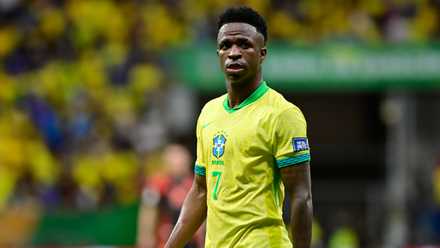
The Fascinating Reason Why Brazil Wear Yellow Kits
Brazil’s famous yellow kits are remembered throughout the world, being deeply associated with the country’s footballing prowess.

Manchester United will be sweating over the availability of one of their midfielders ahead of the 2026-27 season, after Manuel Ugarte was stretchered off whilst representing Uruguay at the World Cup.
The injury is another disappointing blow to the €50m midfielder’s stop-start beginning to his Manchester United career. The Uruguayan arrived at Old Trafford from Paris Saint Germain in the summer of 2024, but has struggled to build momentum. During the 2025-26 season, Ugarte started only eight times for United in the Premier League.
Every Manchester United Player’s Wage [2026]
The wages of every player at Manchester United, including Mason Mount and Casemiro.
What is Manuel Ugarte’s Injury?

The 25-year-old was injured during Uruguay’s 1-0 group stage loss to Spain. Ugarte appeared in some distress after twisting his knee awkwardly whilst chasing down Spain’s Gavi. The midfielder was unable to carry on and was stretchered off the field just before halftime.
Whilst Ugarte has failed to nail down a regular starting spot at United, he has been ever present for Uruguay since debuting in 2021. He has made 39 appearances for his country and was a part of the squad that finished third at the Copa América in 2024.
Manchester United released the following statement in light of Ugarte’s injury: “Manchester United can confirm that Manuel Ugarte has suffered a knee ligament injury whilst representing Uruguay in Friday’s World Cup group-stage match against Spain.
“Assessment of the injury is ongoing to determine the best course of treatment and the rehabilitation timescale.
Everyone wishes Manuel a successful recovery and we will be supporting him every step of the way.”
How Long Will He Be Out & Return Date

Whilst confirming that Ugarte had suffered a knee ligament injury, there were no further details concerning the severity of the damage. Whether Ugarte has injured his anterior cruciate or medial collateral ligament remains unknown at this time.
Now at the beginning of his road to recovery, Ugarte has taken to social media to reflect on the injury.
Ugarte’s reflective post was supported by a number of his Manchester United teammates. The likes of club captain Bruno Fernandes, Bryan Mbeumo, and Luke Shaw, who has had his own difficulties with career-threatening injuries, responded supportively. Shaw commented in reply, “We are with you brother.”
The club have remained tight-lipped over a recovery timeframe for the Uruguayan, but his Instagram post stated that his knee ligament injury was “the most serious injury a footballer can face.”
If the knee ligament injury does fall into the most severe category, grade three, Ugarte could require surgery. Depending on which ligament the midfielder has damaged, he could be facing anywhere between three and 12 months on the sidelines, with a lengthy rehabilitation programme expected.
Should Ugarte get off lightly for his injury, he could be fit enough to contribute by the end of the autumn 2026. And with the busy Christmas schedule and a Champions League campaign to come, his availability could prove crucial for United’s fortunes across all competitions.
However, if the Uruguay international has suffered a grade three injury, fans may not see him in a United or Uruguay shirt until 2027. And if Ugarte is looking at potentially a year out, there could be doubts over whether he makes an appearance during the 2026-27 campaign at all.
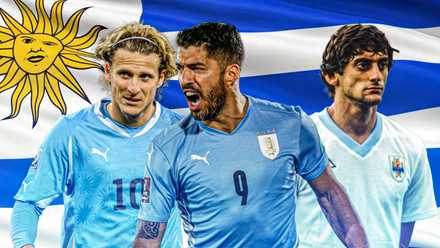
The Greatest Uruguay Players in Football History [Ranked]
Some of the game’s best players have hailed from the small South Amercian nation

Tennis icon Roger Federer once revealed the five players he considers the greatest to ever grace the sport.
The Swiss superstar spent 237 consecutive weeks at the top of the ATP rankings during a glittering career filled with silverware. Across more than two decades on tour, Federer claimed 20 Grand Slam singles titles, including a record eight Wimbledon crowns, which he has often described as his favourite tournament.
Before retiring in 2022, Federer collected 103 ATP titles, with only Jimmy Connors finishing his career with more. His triumph at the 2009 French Open completed his career Grand Slam after falling short in the previous three Roland Garros finals.
Federer also formed a coaching partnership with his childhood hero Stefan Edberg between 2014 and 2015, making it little surprise that the Swedish great was the first player he selected.
Roger Federer’s 5 Greatest Tennis Players of All Time
Stefan Edberg

Widely regarded as one of the finest serve-and-volley players ever, Edberg remains Federer’s personal GOAT. The Swede lifted six Grand Slam titles during his career, with the French Open being the only major to elude him. He successfully defended his US Open title in 1991 and 1992, beating Jim Courier before overcoming Pete Sampras a year later.
Although he was renowned for attacking the net, Edberg’s elegant one-handed backhand was also a standout weapon. It became one of the most admired shots in men’s tennis during his era.
Speaking about Edberg’s influence, Federer said: “For me, I needed my GOAT, people who were on the wall at home, and I wanted to be like them. For me, that was Stefan Edberg, Swedish guy. He always attacked the net and was super elegant. He was the coolest.”
Boris Becker

Another legendary rival from Edberg’s generation, Boris Becker, was next on Federer’s list.
Perhaps Becker’s defining achievement came at Wimbledon in 1985. Aged just 17 years, seven months, and 15 days, the unseeded German stunned the tennis world by defeating Kevin Curren in the final. It marked the first of his three Wimbledon titles, while he also secured two Australian Open trophies and one US Open crown. Becker later helped Germany win Olympic doubles gold alongside Michael Stich.
🎾
Wimbledon History Quiz
You scored
out of 20
Becker is often credited with helping evolve all-court tennis during an era dominated by serve-and-volley specialists. His explosive athleticism, booming serve, and powerful groundstrokes earned him the famous nickname “Boom Boom.”
His remarkable Wimbledon breakthrough transformed Becker into a global star, with his fearless style and exciting brand of tennis making him one of the sport’s most popular figures.
Rafael Nadal

The rivalry between Rafael Nadal and Federer is widely regarded as one of tennis’ greatest and ranks alongside iconic sporting debates such as Ronaldo vs Messi and LeBron James vs Michael Jordan.
Their unforgettable 2008 Wimbledon final is still viewed by many as the greatest match ever played. Nadal eventually prevailed 6-4, 6-4, 6-7, 6-7, 9-7, ending Federer’s dominance at the All England Club. The victory symbolised a changing of the guard, and Nadal soon replaced Federer as world number one before beginning his own era of success.
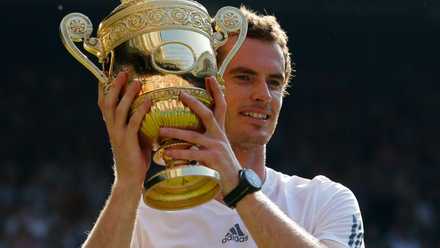
Andy Murray Named Which of Federer, Nadal, and Djokovic He Didn’t Mind Playing
Murray clearly had a preference when it came to playing against the three legends of tennis.
The Spaniard enjoyed one of the most decorated careers in tennis history, winning 22 Grand Slam singles titles. His record 14 French Open triumphs may never be surpassed and earned him the nickname “The King of Clay.” Nadal also recorded an astonishing 81-match winning streak on clay during the Open Era.
He completed the career Grand Slam at just 24 years old after winning the US Open, becoming the youngest player in the Open Era to achieve the feat. Nadal would later add three more US Open titles to his collection.
Novak Djokovic

Novak Djokovic has since gone on to surpass the achievements of both Federer and Nadal. Even in the later stages of his career, he continues to compete deep into Grand Slam tournaments following the retirements of his two biggest rivals.
The Serbian owns a record 24 Grand Slam singles titles and remains the only player to complete the career Grand Slam on three separate occasions. Djokovic also holds the record for 428 weeks as world number one and has finished the season atop the rankings a record eight times.
For many observers, those accomplishments have placed him at the very top of the GOAT discussion.
Pete Sampras

The fifth and final player selected by Federer was Pete Sampras, the American legend whose Wimbledon legacy Federer would eventually surpass.
Sampras ruled men’s tennis throughout much of the 1990s, winning a then-record seven Wimbledon titles. During his time at the summit of the sport, he spent 286 weeks as world number one and captured 14 Grand Slam singles titles.
Armed with one of the greatest serves tennis has ever seen, Sampras mastered the serve-and-volley game. His powerful delivery and aggressive shot-making earned him the nickname “Pistol Pete.”
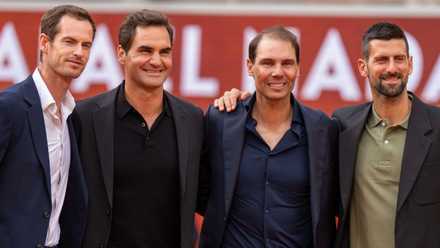
25 Greatest Male Tennis Players in History [Ranked]
Unsurprisingly, Rafael Nadal, Roger Federer, and Novak Djokovic all make the list, but who else joins them?
His rivalry with fellow American Andre Agassi played a huge role in increasing the sport’s popularity during the 1990s. Their contrasting styles – Sampras’ attacking tennis against Agassi’s baseline brilliance – produced memorable clashes, including the 1995 US Open final.
Sampras unexpectedly brought his playing career to an end in 2003 at the age of 31.

Why Do Japan Wear Blue in Football?

Politicians steal result sheets, risk lives of INEC staff – Amaechi warns
How Long Man Utd Midfielder Will Be Out For

Simi Sanya and Femi Dapson Are Now Legally Married and It Is Beautiful to See

FCT Area Council Election: Live results from polling units

Premier League Set-Piece Goals (2025/2026)
-
 Sports1 day ago
Statement Released as Lucas Trejo’s Wife and Children Die in Earthquake
-
 Sports18 hours ago
Jesse Marsch’s Full Speech After Canada vs South Africa
-
 Sports2 days ago
Cody Gakpo’s Son Passes Away During Pregnancy, Girlfriend Confirms
-
 Sports1 day ago
Spain’s Nico Williams Calls Out Uruguay Ace After He Suffers Injury
-
 Sports2 days ago
2026 World Cup Nation Punish Players By Cancelling Their Flight Home
-
 Sports1 day ago
Pele and Diego Maradona’s Private Chat About Lionel Messi in 2016
-
 Sports2 days ago
Supercomputer Predicts Entire F1 Race After Qualifying
-
 Sports2 days ago
World’s Richest Tennis Player Refuses to Stay at Same Hotel as Other Players