
Politics
Nigeria has had no direction since 1960 – APC chieftain Ajiboye


A chieftain of the All Progressives Congress, APC, and Executive Secretary of the National Institute for Cultural Orientation, Abiodun Ajiboye, has said Nigeria has lacked a clear developmental direction since independence in 1960.
Speaking on Arise Television’s Prime Time programme on Tuesday, Ajiboye described the country’s infrastructure development as largely uncoordinated, arguing that successive governments failed to implement long-standing development plans.
According to him, some of the infrastructure projects currently being executed by President Bola Tinubu’s administration were conceived as far back as 1983 but were neglected by previous administrations.
Ajiboye also lamented what he described as the failure to deliberately build a culture of patriotism and nationalism among Nigerians.
He stressed that addressing the nation’s challenges requires collective responsibility, noting that the problems facing Nigeria should be regarded as the concern of every citizen.
Ajiboye said, “The situation with Nigeria is like a country that has existed since 1960, with no direction in terms of infrastructure. We didn’t have any direction.
“Some of the infrastructure projects that President Bola Tinubu is executing now are development plans of 1983 that subsequent governments did not touch.
“Also, a conscious effort wasn’t made to build a society of nationalistic, patriotic and civil Nigerians. The problems of Nigeria should be every individual’s problem.”
dailypost.ng

The Court of Appeal in Abuja on Tuesday suspended the execution of a Federal High Court judgment that ordered the deregistration of five political parties, including the African Democratic Congress, ADC.
DAILY POST reported that the appellate court granted a stay of execution of the judgment delivered by Justice Peter Odo Lifu of the Federal High Court, Abuja, which had directed the Independent National Electoral Commission, INEC, to deregister the ADC, Action Peoples Party, APP, Action Alliance, AA, Accord Party, AP, and Zenith Labour Party, ZLP.
In a strongly worded ruling, the Appeal Court condemned the lower court’s action, describing it as “the highest form of judicial impertinence” and a direct violation of the hierarchy of courts.
The panel held that Justice Lifu proceeded with the matter despite an earlier order of the Court of Appeal and while the case was still pending before it.
According to the court, such conduct amounted to judicial rascality and an affront to the constitutional structure governing judicial authority in Nigeria.
The justices stressed that lower courts are bound by the decisions and directives of higher courts and must not act contrary to them.
“Courts are enjoined to protect their integrity. This Court has supervisory authority over the trial court. The decision of the lower court to proceed with the judgment despite the express order of this court is a brazen violation of the hierarchy of the courts and the 1999 Constitution,” the appellate court ruled.
The court subsequently ordered that the enforcement of the Federal High Court judgment be stayed pending further proceedings.
The ruling effectively restores the affected parties’ legal status for now and removes the immediate threat to their participation in future elections.
How it all started
The controversy began on Monday when Justice Peter Odo Lifu of the Federal High Court, Abuja, ordered INEC to deregister the ADC, Accord Party, and three other political parties over alleged constitutional violations.
The judgment stemmed from a suit filed by the Incorporated Trustees of the National Forum of Former Legislators (NFFL), which argued that the parties failed to satisfy constitutional requirements necessary for their continued recognition.
Justice Lifu directed INEC to stop recognising the parties, accepting nominations from them, or permitting them to participate in the 2027 general elections.
The court also ordered the affected parties to cease presenting themselves as registered political parties.
The plaintiffs contended that the parties had failed to meet constitutional electoral performance thresholds, including winning elective offices or securing the minimum percentage of votes required under the law.
They contended that allowing such parties to remain registered undermined electoral integrity and constituted a waste of public resources.
Judiciary still has opportunity to redeem itself – Atiku
Presidential candidate of the ADC, Atiku Abubakar, welcomed the Appeal Court’s decision, describing it as a victory for democracy and constitutional order.
Reacting to the ruling, Atiku, in a statement via X on Tuesday, noted that it was particularly significant that INEC itself sought the stay of execution.
He warned against what he described as increasing judicial contradictions and politically charged decisions that have placed the judiciary under public scrutiny.
According to him, any attempt to weaken Nigeria’s democratic process through judicial manipulation poses a grave threat to the nation.
“I welcome the Court of Appeal’s decision to stay the execution of the Federal High Court judgment seeking the deregistration of our great party, the ADC, and four other political parties.
“The disturbing spectacle of judicial contradictions and politically charged rulings playing out in our courts has placed the judiciary under intense public scrutiny.
“Any attempt to undermine Nigeria’s hard-won democracy through judicial manipulation is a grave danger to the Republic,” Atiku stated.
He added that the judiciary still has an opportunity to redeem itself by standing firmly on the side of the Constitution, the rule of law, and the Nigerian people.
What happened smacks of judicial insubordination — Senior lawyer
Senior Advocate of Nigeria (SAN), Jibrin Okutepa, also criticised the Federal High Court judgment, describing it as a clear case of judicial insubordination.
Speaking on Arise Television’s Prime Time programme on Tuesday, Okutepa argued that under Nigerian law, lower courts have an obligation to obey and enforce decisions of superior courts regardless of their personal views on such rulings.
He maintained that the rule of law depends on strict adherence to judicial hierarchy.
According to him, a High Court has no discretion to disregard or question an order issued by the Court of Appeal.
“What happened appeared to be a problem of judicial insubordination, judicial impertinence.
“The High Court is obligated mandatorily to obey and enforce the orders of the Court of Appeal without question; whether that order was rightly or wrongly given.
“The duty under our law is for the lower court to bow in obedience to the order from the higher court.
“Where the rule of law holds sway, no one, no matter what status, has the audacity of arrogance to question the authority of the court,” he said.
DAILY POST reports that his comments echoed concerns raised by the Appeal Court regarding respect for judicial hierarchy and the integrity of the judiciary.
‘More deregistration coming’ — Oseni Rufai
Meanwhile, Arise Television anchor Rufai Oseni has alleged that the attempted deregistration of opposition parties could be part of a broader effort to reshape the political landscape ahead of the 2027 elections.
Speaking on The Morning Show on Tuesday, Oseni described the Federal High Court judgment as a “test run” aimed at gauging public reaction before more far-reaching actions are taken.
He claimed there may be attempts to prevent major opposition figures, including Peter Obi and Atiku Abubakar, from appearing on the ballot in 2027.
“ADC and NDC should be careful because there will be attempts, and this is me predicting now, to ensure that Obi, Atiku, and other big contenders are not on the ballot.
“What you saw yesterday is just a test. This is not the real place where the whole thing is going.
“They want to see the reactions of Nigerians. More is still coming,” Oseni said.
He questioned the basis of the deregistration judgment, arguing that some of the affected parties had recorded electoral victories in recent elections and therefore did not meet the criteria for deregistration.
Oseni further called for urgent judicial reforms, warning that Nigerians must remain vigilant in defending democratic institutions ahead of the next general election.
According to him, protecting the integrity of the judiciary has become just as important as addressing the country’s security challenges.
Nobody is safe when courts ignore boundaries — Analyst
A political analyst and communication expert at Peaceland University, Enugu, Nduka Odo, has warned that democracy is endangered when institutions fail to respect constitutional boundaries and judicial hierarchy.
Speaking with DAILY POST on Tuesday while reacting to the Court of Appeal’s decision to stay the execution of the Federal High Court judgment ordering the deregistration of the African Democratic Congress (ADC) and four other political parties, Odo said the issue transcends partisan interests and touches on the foundation of the rule of law.
According to him, the controversy is not about supporting the ADC, Accord Party, or any of the affected parties, but about whether a lower court can act in a manner that appears to disregard the authority of a superior court.
He warned that once such a precedent is allowed to stand, no individual or institution would be immune from similar actions in the future.
“Today, it may be a political party. Tomorrow, it could be a governor, a legislator, a businessman, or an ordinary citizen. The rule of law survives only when everyone agrees to play by the same rules,” he said.
Odo also noted the irony of politicians who previously applauded judicial interventions when such decisions favoured their interests but now criticise the judiciary when outcomes go against them.
He stressed that institutions are built to serve society beyond immediate political interests, warning that precedents established Today could have far-reaching consequences Tomorrow.
The communication expert further argued that democracy is sustained not by politicians but by strong and independent institutions.
“The real lesson here is that democracy is not protected by politicians; it is protected by strong institutions. The legislature must be independent. The judiciary must be courageous. Electoral bodies must be impartial. Once any arm of government begins to function according to the wishes of another, democracy starts losing its meaning.
“The Appeal Court’s decision may have provided temporary relief for the affected parties, but the bigger challenge remains rebuilding public confidence in institutions that must be seen as fair, consistent, and faithful to the Constitution,” Odo added.
dailypost.ng

By Omeiza Ajayi
ABUJA — President Bola Ahmed Tinubu is entering the 2027 presidential race as the clear frontrunner, not necessarily because of widespread popularity, but because his opponents remain divided, according to a new forecast by political consulting and data analysis firm CellHub.
The firm projects the president as the favourite to secure a second term, arguing that its assessment is based less on his approval ratings — currently estimated in the low 30 per cent range — and more on the fractured state of the opposition and Nigeria’s winner-takes-all electoral system.
According to CellHub, Nigeria’s electoral framework, which awards victory to the candidate with the highest number of valid votes rather than an outright majority, gives a significant advantage to a united ruling party facing a fragmented opposition.
The firm pointed to the 2023 presidential election as an example. Tinubu won with 36.61 per cent of valid votes, while Atiku Abubakar secured 29.07 per cent, Peter Obi garnered 25.40 per cent, and Rabiu Musa Kwankwaso received 6.23 per cent.
Although more than 60 per cent of valid votes were cast for candidates other than the winner, the opposition’s division enabled Tinubu to emerge victorious with a comfortable lead.
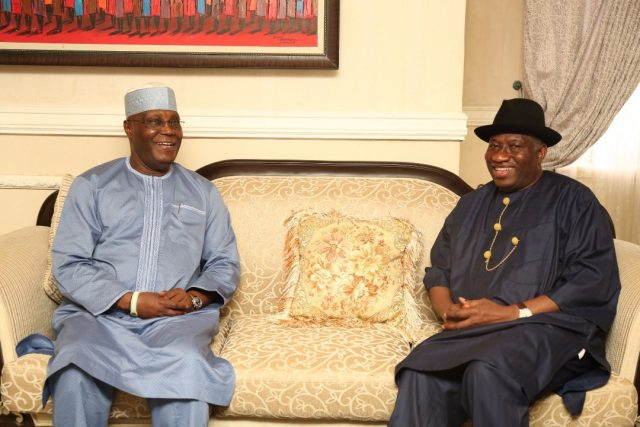
CellHub noted that a similar pattern has emerged ahead of the 2027 election. Atiku is running on the African Democratic Congress (ADC) ticket alongside Rotimi Amaechi, while Obi and Kwankwaso were ratified as candidates of the Nigeria Democratic Congress (NDC) on May 30. A faction of the Peoples Democratic Party (PDP) has also advanced Goodluck Jonathan, though the nomination remains contested within the party.
With three opposition candidates targeting the anti-incumbent vote, CellHub believes the political landscape strongly favours the president.
Tinubu’s position, the report added, has been strengthened by a wave of defections that has left the All Progressives Congress (APC) in control of 31 of Nigeria’s 36 states and holding a two-thirds majority in the National Assembly. The party formally confirmed him as its presidential candidate on May 23.
The firm also highlighted historical trends, noting that among Nigeria’s elected presidents, only Jonathan failed to win re-election. His 2015 defeat came against a united opposition coalition, a strategy the current opposition has yet to adopt.
“Our modelling is not a statement about who deserves to win, or about how people feel, both of which point in a hard direction for the incumbent,” said Mohammed Aliyu, Managing Partner and Lead Data Scientist at CellHub.
“It is a statement about distribution. A unified bloc beats a divided one almost regardless of mood. Right now the opposition is divided and the governing party is not.”
CellHub acknowledged that many Nigerians report being worse off economically than they were in 2023. However, it argued that such sentiment would pose a more serious threat to the president only in a direct one-on-one contest.
The firm also challenged perceptions of Obi’s electoral strength, arguing that his substantial online following does not necessarily translate into votes. According to the report, social media audiences are disproportionately young, urban and connected, while rural northern voters — who historically account for higher turnout levels — remain underrepresented online.
CellHub said its projections are based on voting intentions and turnout probabilities across geopolitical zones rather than digital engagement metrics.
The report further suggested that the administration’s defence of key economic reforms, including fuel subsidy removal and the floating of the naira, is beginning to resonate with a growing segment of voters.
While macroeconomic indicators such as growth, foreign reserves and inflation have shown some improvement, CellHub acknowledged that household incomes and poverty levels have worsened. Nevertheless, it believes more voters are accepting the government’s argument that the reforms helped avert a deeper economic crisis.
Geographically, the firm identified the North-Central region and the broader Middle Belt as the likely battleground for the 2027 election.
“The South-West is largely decided, and the South-East in the other direction,” said Efemena Peter, Senior Political Risk Analyst at CellHub.
“The result is set in the North Central and the FCT. Those states moved against the President in 2023, and they are the states we watch most closely for 2027. Whoever carries the Middle Belt carries the election.”
However, CellHub said a merger between the Atiku and Obi camps could dramatically alter the political equation by creating a direct two-way contest between the opposition and the incumbent.
Such a development, it noted, would shift the election from a contest shaped by vote distribution to one focused squarely on the president’s record in office, making the outcome far less predictable.
Until then, the firm maintains that the arithmetic of a divided opposition continues to favour the incumbent.
CellHub said it would update its projections should any opposition consolidation occur and plans to release revised electoral scenarios quarterly ahead of the polls scheduled for January 16, 2027.
The post ‘Jonathan, Atiku, Obi doing Tinubu’s campaign work for him’ appeared first on Vanguard News.
www.vanguardngr.com

The Nigeria Democratic Congress (NDC) has introduced a new anti-defection policy requiring candidates seeking elective offices on its platform to sign legal documents committing to vacate their positions if they leave the party after winning elections.
The development was disclosed during a ceremony held at the party’s National Secretariat in Abuja, where party officials unveiled indemnity and affidavit forms for aspirants and candidates ahead of future elections.
According to the National Chairman of the party, Moses Cleopas, the policy will apply to candidates contesting presidential, governorship, National Assembly and other elective positions under the NDC platform.
Cleopas said the decision was aimed at strengthening party discipline and preventing situations where politicians secure electoral victories on a party platform and later defect to another political party.
“In our last NEC meeting, a motion was moved, supported and adopted, establishing that when we take over government, people elected on the platform of our party must respect the party’s instrument,” he said.
The chairman stated that the party was determined to protect its electoral mandates and preserve what he described as the principle of party supremacy.
“One thing we have come to observe is that in the present polity, when people contest elections and win under political parties, they become gods. And within the period they ought to serve, they will, on one minor excuse, dump the platform and perhaps move to the ruling party,” he added.
Cleopas cited experiences from previous election cycles, noting that some opposition parties lost several elected members after elections despite securing victories on their platforms.
“A very typical example that we have all seen in the last three years is the Labour Party, where so many individuals won elections under the platform of the party. Now, we are in another election cycle. Go and check their history. How many of the people who won elections under the Labour Party and were inaugurated are still members of the party?” he said.
He stressed that membership of the party remains voluntary but insisted that anyone seeking elective office under the NDC must agree to abide by its internal regulations.
“If you want to contest an election under the platform of the NDC, you are free to come. Nobody is forcing you. But when you come, you should know that there are certain rules by which we, as a political party, guide our members,” Cleopas stated.
Also speaking, the party’s National Legal Adviser, Reuben Egwuaba, defended the policy, arguing that political parties operate as voluntary associations governed by rules accepted by members.
“A political party is just like a club, church or mosque where there are rules and regulations. That is why the 1999 Constitution, under Section 222, states that a candidate of a political party is merely an agent of the party,” he said.
He maintained that electoral mandates belong to political parties rather than individual candidates.
“So, if you are privileged to win an election after clinching the party ticket, that does not mean the mandate belongs to you,” Egwuaba added.
The party said the affidavit and indemnity forms are intended to reinforce loyalty to the platform and ensure that elected officials remain committed to the party throughout their tenure.
dailypost.ng


Clear Verdict Given After Lionel Messi Avoids Red Card vs Algeria

IMF Prescriptions: Experts warn FG against costly foreign loans, VAT hike
Respite for Atiku, others as Appeal Court halts ADC deregistration

Simi Sanya and Femi Dapson Are Now Legally Married and It Is Beautiful to See

FCT Area Council Election: Live results from polling units

Premier League Set-Piece Goals (2025/2026)
-
 Sports2 days ago
FIFA Forced Into U-Turn on Spanish Press Conference Rule After Backlash
-
 Sports1 day ago
US Denied World Cup Visa For Mum of Cape Verde Goalkeeper Vozinha
-
 Sports19 hours ago
Saudi Arabia the Only 2026 World Cup Flag That Cannot Touch Ground
-
 Sports1 day ago
Rafael van der Vaart Accused of Making Racist Japan Comments
-
 Sports1 day ago
FIFA Ban Pre-Revolutionary Iran Flags From World Cup Stadiums
-
 Sports2 days ago
Manuel Neuer Breaks World Cup Kit Rules in Germany vs Curacao
-
 Sports1 day ago
Emma Hayes Praised For Using Drinks Break For Tactical Analysis
-
 Sports22 hours ago
Rodri Labelled ‘Salty’ For Cape Verde Comments After Spain Draw