
Business
Stronger AI governance needed to safeguard trust in banking


By Providence Ayanfeoluwa
The Group Managing Director and Chief Executive Officer, United Bank for Africa, UBA Plc Mr Oliver Alawuba, has called on internal auditors across the banking industry to embrace artificial intelligence, AI, as the sector navigates a rapidly changing digital landscape.
Alawuba made the call at the Association of Chief Audit Executives of Banks in Nigeria, ACAEBIN’s 64th Quarterly General Meeting, QGMs, held in Lagos with the theme, “Internal Audit Function in the AI Era”.
Speaking in a keynote, Alawuba who was represented by Executive Director, Finance & Risk Management, Ugo Nwaghodoh, said AI is already transforming banking operations, from fraud detection and risk assessment to customer service and transaction monitoring.
He explained that while technology presents significant opportunities for efficiency and innovation, it also introduces new risks that require stronger governance, oversight, and assurance mechanisms.
He stated: “For us, technology is not replacing the auditor. It is strengthening the auditor. It is enabling audit teams to spend less time on manual extraction and more time on judgment, interpretation, challenge, and insight. It is helping the function move from retrospective review to forward-looking assurance.
“The Al era will not wait for us to be ready. It is already here. The institutions that will lead are those that act now: building capacity, strengthening controls, modernizing assurance, protecting customers, and embedding trust into every layer of digital transformation”.
Earlier in her welcome remark, ACAEBIN’s Chairperson, Mrs. Aina Amah, said that banks must constantly review and strengthen their security perimeters as cybercrime remains one of the biggest threats facing the banking industry, with criminals continuously finding new ways to bypass security controls and exploit vulnerabilities in financial institutions.
Amah explained that the ACAEBIN QGMs continue to provide a valuable platform for knowledge sharing, peer engagement, professional development, and collective reflection on emerging risks and opportunities shaping our profession.
She said that financial institutions must go beyond conventional security measures by investing in stronger cyber security capabilities and engaging experts who can think like cyber criminals in order to identify weaknesses before they are exploited.

By Babajide Komolafe
FirstBank has thrown its weight behind the Imo State Government’s One Kindred One Business Initiative (ÓKÓBÌ), a community-based entrepreneurship programme designed to stimulate job creation, expand financial inclusion and promote sustainable wealth creation through collective business ownership.
The bank said its support aligns with its commitment to empowering small and medium enterprises, deepening financial inclusion and driving long-term socio-economic development across Nigeria.
ÓKÓBÌ, conceived by Imo State Governor, Hope Uzodimma, is built on traditional African values of communalism, kinship and collective responsibility. The initiative formalises groups of like-minded individuals into registered businesses, making them more resilient, easier to finance and better equipped to tackle poverty in rural and urban communities.
Launched in 2023, the initiative has registered over 600 businesses with about 20,000 members and is targeting the creation or support of 100,000 jobs within three years.
Speaking on the partnership, Chief Executive Officer of FirstBank Group, Olusegun Alebiosu, said: “Peer accountability remains a powerful driver of sustainable enterprise growth. The ÓKÓBÌ initiative exemplifies this by transforming existing social capital into tangible economic value for communities.”
He added: “FirstBank is proud to support the Imo State Government in this forward-looking programme, which goes beyond traditional financing to embed financial inclusion directly within group-based enterprises.
“By supporting these collectively owned businesses, we are helping to stimulate economic empowerment at scale, creating a self-sustaining ecosystem where wealth creation is inclusive, participatory and widely shared. This initiative aligns with our broader commitment to enabling small and medium enterprises, deepening financial inclusion, and driving long-term socio-economic development across Nigeria.”
Also commenting, Chief Economic Adviser to the Imo State Government, Professor Kenneth Amaeshi, described ÓKÓBÌ as a viable solution to unemployment and informality, saying the programme had demonstrated remarkable success within a short period.
He urged more corporate organisations to adopt and support the model, stressing that it empowers people to become business owners, strengthens group enterprises and promotes sustainable economic development.

By Providence Ayanfeoluwa
The European Union, EU, has donated a 200kW solar PV power system to the Standards Organisation of Nigeria, SON.
Speaking at the commissioning ceremony in Lagos, Head of Cooperation, EU Delegation to Nigeria and ECOWAS, Massimo De Luca, said the EU and Germany have been working closely with SON to deliver the solar project.
According to him, the EU has been supporting SON to develop innovations that improve energy performance in Nigeria, adding that the donation reflects its continued partnership with the agency.
Luca said that SON is a critical partner in domestic trade and reaffirmed the EU’s commitment to supporting Nigeria’s energy transition plan. Also speaking at the event, Head of Development at the German Embassy, Dr. Karin Jansen, said the commissioning reflects efforts to create an enabling environment for businesses to become more resilient.
“We are building strong bridges between both countries, as this facility will help SON verify energy performance standards. It is also an opportunity to strengthen the next phase of Nigeria’s energy future,” she said.
Earlier, Director-General of SON, Mr. Ifeanyi Okeke, described the project as another milestone in the longstanding partnership between SON and the Nigerian Energy Support Programme (NESP).
He described the partnership as a collaboration that has continued to strengthen Nigeria’s quality infrastructure in support of sustainable energy.
He noted that the partnership began in 2018 with the signing of a Memorandum of Understanding between SON and GIZ for the development and implementation of renewable energy and energy-efficiency standards.
According to him, the collaboration has since expanded beyond standards development to include laboratory infrastructure, conformity assessment, capacity building, and support for emerging sectors such as electric mobility.
Okeke disclosed that, with NESP’s support, SON has developed Minimum Energy Performance Standards (MEPS) and energy labelling requirements for key electrical appliances, paving the way for a mandatory energy-labelling scheme.
“This initiative will empower consumers to make informed choices while ensuring that only energy-efficient products gain access to the Nigerian market,
“When fully operational, it will be the first facility of its kind in Nigeria and a reference testing centre for the West African sub-region.
“On average, we spend close to N80 million on diesel annually and about N6.7 million on electricity. This is money we can save by having an alternative energy source,” he said.
“As an agency that is not primarily revenue-generating, whatever money we can save will be very helpful.”
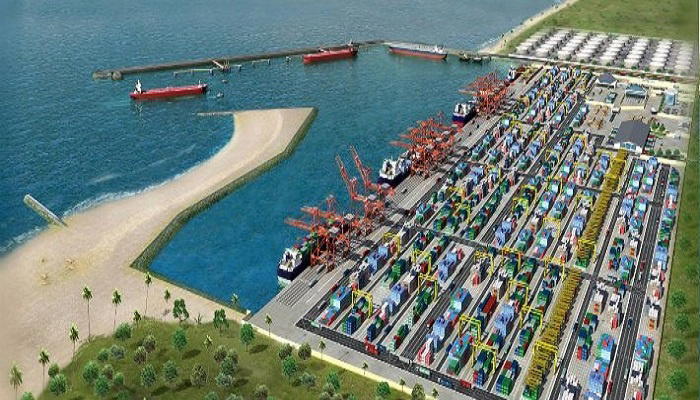
Lekki Deep Seaport.
By Providence Ayanfeoluwa
The Managing Director of Port and Terminal Multiservices Limited (PTML), Mr. Ascanio Russo, has unveiled plans to invest an additional $50 million in the terminal to strengthen port infrastructure, improve operational efficiency and support Nigeria’s ambition of becoming the leading maritime hub in West and Central Africa.
Russo disclosed the proposed investment during a visit to the Minister of Marine and Blue Economy, Dr. Adegboyega Oyetola, in Abuja.
According to a statement by the Minister’s Special Adviser, Dr. Bolaji Akinola, the investment by PTML, a member of the Grimaldi Group, will expand the terminal’s berthing capacity and provide additional state-of-the-art port equipment at the Tin Can Island Port Complex in Lagos.
Russo said: “The Grimaldi Group remains deeply committed to Nigeria and firmly believes in the country’s potential as the leading maritime and logistics gateway in West and Central Africa.
“This proposed investment of $50 million is designed to position PTML for the future by expanding our berthing capacity and deploying additional modern equipment that will significantly enhance operational efficiency, cargo handling capacity and service delivery.”
Responding, Oyetola welcomed the proposal, describing it as a strong vote of confidence in the Federal Government’s ongoing reforms in the maritime sector.
He reaffirmed the government’s commitment to creating an enabling environment for private investment and positioning Nigerian ports as the preferred hub for shipping, logistics and maritime services in West and Central Africa.


Two officers killed as police rescue nine kidnaped victims in Kaduna

Uruguay Players ‘Revolt Against Marcelo Bielsa’ Ahead of Spain Game

Troops raid drug den, arrest four suspects in Borno

Simi Sanya and Femi Dapson Are Now Legally Married and It Is Beautiful to See

FCT Area Council Election: Live results from polling units

Premier League Set-Piece Goals (2025/2026)
-
 Sports1 day ago
Bastian Schweinsteiger Sparks Outrage With Comments Ahead of Germany v Ivory Coast
-
 Sports2 days ago
Why Austria and Algeria May Both Want to Lose Their Final Group Game
-
 Sports17 hours ago
Thomas Partey Could Be Blocked From Knockout Tie
-
 Sports1 day ago
Steve Clarke Slammed For Interview After Scotland 0-3 Brazil
-
 Sports11 hours ago
Rory McIlroy Risks Breaking PGA Tour Rule That Led to One-Year Ban
-
 Sports2 days ago
Jude Bellingham Avoids Red Card For Banned Gesture vs Ghana
-
 Sports2 days ago
What Scotland Need To Qualify For World Cup Knockout Stage
-
 Sports2 days ago
World Cup Nation Submit Complaint to FIFA After Controversy in England vs Ghana