
Sports
Tottenham Told They Can Sign Rafael Leao for Just £51.3m


Tottenham are said to have learned the asking price for one of their attacking transfer targets. Spurs are in the midst of a record-breaking transfer window, with the Mateus Fernandes and Sandro Tonali deals taking the North London side’s spending above what they have ever spent before.
Roberto De Zerbi is being fully backed in this window, and as much as £237million has been spent so far, with more spending still to come. De Zerbi likely demanded summer spending before taking the job, and Spurs have followed up on their promise after surviving the Premier League drop.
With the midfield now seen as complete, Tottenham will now likely prioritise a winger transfer, and AC Milan star Rafael Leao has been heavily linked, along with Manchester City’s Savinho and Manchester United’s Marcus Rashford.
Leao wants out from Milan

It is no secret that Leao is looking for a new club after seven years with AC Milan, and he is likely to have his pick of a number of top clubs this summer.
The winger said before the World Cup: “Personally, I’ve given everything at AC Milan. It’s a club that helped me grow a lot and supported me through tough times.
“Fortunately, I managed to make my mark in their history. Everyone has ambitions and I dream of a new challenge in a new league.
“If that happens, I’ll be very happy and fulfilled because I did my job at AC Milan.”
Tottenham learn Leao price tag

With AC Milan bracing for Leao’s exit, it is reported by Italian journalist Gianluca Di Marzio that the Italian giants want €60-70million (£51.3m-£59.9m) for the winger this summer. Leao is currently away with Portugal at the World Cup, so his future is unlikely to be resolved until after he returns, but a move is almost certain this summer.
The 27-year-old scored 10 and assisted three last season, but it was a disappointing season for him and Milan as a whole, leading to the Italian club missing out on Champions League football. Still, the ‘world-class’ Leao is thought of as one of Europe’s top-bracket wingers, and he has already been linked with Arsenal, Tottenham and many others.
Former Milan boss Massimiliano Allegri said Leao has ‘genius’ while speaking back in 2025. He added: “He’s been out for 45 days, so he’s still finding rhythm. Last week, he came on out of necessity and did well. He’s worked hard this week – we need him back quickly. He and Nkunku are technical players who can solve matches. He played as a striker at Lille, so it’s not new to him. His movement on [Luka] Modric’s pass was perfect.”

The Azteca Stadium in Mexico sparked conversations across football during the 2026 World Cup, with venue sitting 2,200m above sea level. It has been argued that the home stadium of the Mexico national team gives the host nation a huge advantage, as visiting teams struggle with the high altitude and limited oxygen.
It is an argument with merit, considering that Mexico have only lost two competitive matches at the stadium since it opened in 1966. Build-up to games often revolves around the ‘thin air’ narrative, with sports scientists lining up to explain how the lack of oxygen would hit visiting legs by the hour mark.
However, the twist is that the Azteca doesn’t even crack the top 10 highest football stadiums on the planet – it isn’t even close. There is a cluster of grounds that make Mexico City’s altitude look almost pedestrian, plus outliers on three other continents that rarely get a mention. Some of these venues sit so high that the pitches themselves have had to be rebuilt with artificial turf, because grass simply doesn’t work at such elevation.
Top 10 Highest Altitude Stadiums in the World
|
Stadium |
Location |
Altitude |
|---|---|---|
|
Estadio Daniel Alcides Carrion |
Cerro de Pasco, Peru |
4,338m (14,232ft) |
|
El Alto Municipal Stadium |
El Alto, Bolivia |
4,088m (13,412ft) |
|
Estadio Victor Agustin Ugarte |
Potosi, Bolivia |
3,890m (12,762ft) |
|
Estadio Enrique Torres Belon |
Puno, Peru |
3,829m (12,562 ft) |
|
Estadio Guillermo Briceno Rosamedina |
Juliaca, Peru |
3,825m (12,549ft) |
|
Estadio Jesus Bermudez |
Oruro, Bolivia |
3,735m (12,254ft) |
|
Estadio Hernando Siles |
La Paz, Bolivia |
3,582m (11,752ft) |
|
Estadio Inca Garcilaso de la Vega |
Cusco, Peru |
3,402m (11,161 ft) |
|
Estadio Huancayo |
Huancayo, Peru |
3,259m (10,690ft) |
|
Estadio El Campin |
Bogota, Colombia |
2,553 (8,376 ft) |
Topping the list by some distance is Estadio Daniel Alcides Carrion in Cerro de Pasco, Peru. It is officially recognised as the highest football stadium in the world at 4,338m above sea level. It’s the home of Union Minas, and the ground holds around 10,000 supporters, tucked into one of the highest cities on earth. Extraordinarily, the stadium sits higher than some Mount Everest base camps and well above the altitude at which altitude sickness can become a genuine concern for those unfamiliar with it.
Cerro de Pasco itself has been a silver-mining town, and the stadium’s synthetic pitch, installed in 2012, exists because natural grass genuinely struggles to grow at such heights. It’s a detail that sums up how extreme the conditions are, with the stadium needing to be completely redesigned for it to function.
Bolivia, meanwhile, dominates the rest of the upper table, with three of the top six venues on this list found within its borders.
There is a wider context to this matter as well. FIFA temporarily banned international matches above 2,500m in May 2007 after Brazilian club Flamengo needed bottled oxygen during a Copa Libertadores match in Potosi, sparking anger among Bolivians. The ban was revoked before it had even been in place for a year, but it remains the reference point for any conversation about altitude and the sport, and it’s why acclimatisation schedules are now standard practice for touring squads.
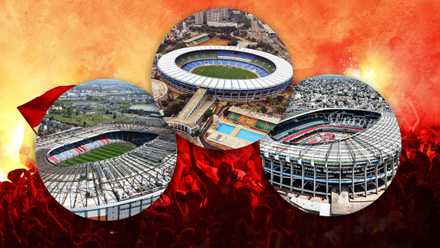
10 Most Intimidating International Stadiums in Football History [Ranked]
The fans in these venues are among the most passionate in the world, making for some incredible atmospheres.
South America
Estadio Daniel Alcides Carrion, Peru – 4,338m
The undisputed summit of world football, Estadio Daniel Alcides Carrion, sits inside Cerro de Pasco, one of the highest cities on the planet. Home to Union Minas and a regular Copa Peru venue, the stadium fitted an artificial surface in 2012 after natural grass was unable to grow. FIFA officially recognises it as the world’s highest ground.
Africa
Addis Ababa Stadium, Ethiopia – 2,400m
Africa’s entry sits in Ethiopia’s capital, itself one of the highest capital cities on the continent at somewhere around 2,350–2,400m above sea level (precise figures vary depending on the exact measuring point in the city). The stadium has long served as the home of Ethiopian football and hosts both domestic league fixtures and international matches for the national side. It doesn’t threaten the Andean giants for altitude, but it’s a useful reminder that thin-air football isn’t purely a South American story, and other continents such as Africa can produce similar conditions.
⚽
World Cup History Quiz
You scored
out of 20
North America
Estadio Azteca, Mexico – 2,200m

Estadio Azteca, rebranded as Mexico City stadium for World Cup 2026, hosted the opening match of the tournament between Mexico and South Africa, becoming the first venue to host three separate World Cup openers, after previously staging the tournament in 1970 and 1986. At roughly 2,200m above sea level, it’s the end of Mexico’s altitude spread, and it’s tough on unacclimatised visitors, even if it’s nowhere near the top of the global ranks.
Europe
Ottmar Hitzfield Arena, Switzerland – 2,012m
Europe’s answer is a world away from purpose-built elite level stadiums. The Ottmar Hitzfield stadium sits in Gspon, a car-free Swiss hamlet reachable only by cable car, and is the continent’s highest football pitch at just over 2,000m. Home to amateur side FC Gspon, the artificial surface is smaller than regulation size and hemmed in by a safety net to stop wayward shots tumbling hundreds of feet down the mountainside. It’s named after former Bayern Munich and Switzerland boss Ottmar Hitzfeld, who took the ceremonial kick-off when it opened in 2008.
Asia
Dasharath Rangasala, Nepal 1,400m
Nepal’s national stadium in Kathmandu is Asia’s highest-profile entry, sitting somewhere around 1,300-1,400m above sea level depending on the exact measuring point in the valley. Built in 1956, Dasharath Rangasala has hosted the AFC Challenge Cup, the SAFF Championship and multiple South Asian games, though it’s carried a dark history too; a 1988 stampede during a hailstorm killed dozens of spectators. There are almost certainly higher, unrecorded pitches scattered across Central Asia’s mountain interior, particularly in Afghanistan, Kyrgyzstan and Tajikistan, but reliable published data is minute, and none hosted organised top-level football like the Dasharath Rangasala has.
Related

Estadio Azteca, temporarily renamed Mexico City Stadium for the 2026 World Cup, sits well over 2,000 metres above sea level in the district of Southern Mexico City. It plays host to the Mexico National team as well as Liga MX side Club America.
Estadio Azteca is the highest stadium of all 16 venues used at the 2026 World Cup by a wide margin, and one of the most storied grounds in football history, having hosted three separate World Cups, a feat that no other stadium can claim.
So, what is the altitude of the stadium and what are the effects? GIVEMESPORT takes a look.
What is the Altitude of Estadio Azteca?

|
Stadium: |
Estadio Azteca |
|---|---|
|
City: |
Mexico City, Mexico |
|
Capacity: |
87,523 |
|
Altitude: |
2,200m (7,218ft) |
|
Map: |
Estadio Azteca sits at 2,200 metres (7,218 ft) above sea level, which makes it the highest altitude stadium in North America.
How Does the Azteca Compare to Other Stadiums?

© Kirby Lee-USA TODAY Sports
The Azteca is high by 2026 World Cup standards, but modest next to South America’s true altitude giants, several of which sit above FIFA’s old 2,500m threshold for international matches.
The highest altitude stadium in the world is Peru’s Estadio Daniel Alcides Carrion, which sits an incredibls 4,338m above sea level, nearly twice as high as the Azteca.
You can see a list of some of the highest stadiums below for comparison.
|
Stadium |
City/Country |
Altitude |
|---|---|---|
|
Estadio Daniel Alcides Carrion |
Cerro de Pasco, Peru |
4,338m (14,232ft) |
|
El Alto Municipal (Villa Ingenio) |
El Alto, Bolivia |
4,088m (13,410ft) |
|
Estadio Hernando Siles |
La Paz, Bolivia |
3,600m (11,800ft) |
|
Estadio Olimpico Atahualpa |
Quito, Ecuador |
2,850m (9,350ft) |
|
El Campin |
Bogota, Colombia |
2,550m (8,370ft) |
|
Estadio Azteca |
Mexico City, Mexico |
2,200m (7,200ft) |
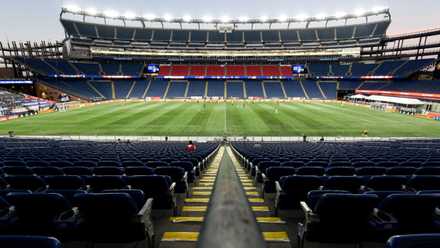
Why FIFA Has Different Names for World Cup Stadiums
Eagle-eyed fans may be confused as to why there are different names for the World Cup arenas than usual – the answer is frighteningly simple.
Does Altitude Give Mexico an Advantage?

The short answer is yes, it’s a very big advantage. The national team have lost just twice in 89 competitive matches at the stadium, and has gone unbeaten there for well over a decade — a record few nations can touch on home soil anywhere in the world.
As per The Guardian, Mexican football commissioner Mikel Arriola: “We have a massive advantage because we’re playing at the Estadio Azteca with our fans and the altitude. It is a very potent setting.”
You scored
out of 20
Thinner air at 2,200m means less resistance on the ball, so it travels faster and dips less than at sea level – a wrinkle that can catch out goalkeepers and defenders unfamiliar with the conditions.
More significantly, it means less oxygen in every breath, which hits visiting players hardest in the legs and lungs: heart rates climb quicker, sprints are harder to repeat, and pressing intensity drops off as the game wears on — exactly the kind of high-tempo football most European and South American sides are built to play.
There’s no quick fix for it either, with sports scientists generally agreeing that two to three weeks at altitude is needed to meaningfully boost red blood cell production and oxygen-carrying capacity — a luxury a tight tournament schedule doesn’t allow.
Some squads, like South Korea, base themselves in elevated cities to adapt to the conditions, whilst teams like Colombia arrive with a natural edge from training at similar altitude levels back home. But those flying in directly from sea level are faced with a rough opening half, and are advised to hydrate heavily and avoid overexertion in their first 24 hours in the city.
What Have Players and Coaches Said?

The altitude conversation resurfaces every time a lowland side draws Mexico, and the 2026 World was no exception.
Ahead of facing Mexico in the Round of 16 at the Azteca, England manager Thomas Tuchel told the BBC: “The altitude will be a big disadvantage because we cannot physically adapt to it. And in four days, it’s just impossible. More obstacles may come, we are ready for that.”
My understanding is that we cannot adapt to the altitude. That is just a huge advantage that Mexico will have. We have only three days in between these matches. Its physically just not possible to adapt to the altitude, which is quite high.”
Former West Ham midfielder Nigel Reo-Coker is one of few English players to have played at the Azteca stadium, and is fully aware of the challenges sides face, saying:
“It’s the most physically demanding place I have ever played football. To come from Europe and play in that altitude is so difficult. You cannot catch your breath. The first 45 to 55 minutes, you’re just trying to keep breathing.”
Senior Research Fellow at Leeds Beckett University, Dr Barney Wainwright, also told the BBC: “Maximum aerobic capacity at this kind of altitude usually drops around 10%, and that has a knock-on to performance. There will usually be a 15–20% increase in fatigue. For the distance it’s possible to cover, we would expect that to drop by 5-10%.
“Maximum sprint speeds won’t be affected, but players will need to wait a bit longer to recover from each one and go again. England might want to slow things down more to allow players time to recover between bouts of high-intensity play.”
Whether it is the intense home atmosphere, Mexico’s quality, the high altitude, or a combination of the three. One thing for certain is that the Azteca Stadium is one of the most difficult environments in world football, with visiting sides at a disadvantage before a ball has been kicked.
World Cup on GIVEMESPORT

‘Not Enough Time’ – Harry Kane Worries Mexico Have Unfair Advantage vs England
Even England’s best player understands the task ahead.

Behind-the-scenes footage has emerged from the UFC‘s historic Freedom 250 card at the White House, revealing the one thing that President Donald Trump hated about the event.
Headlined by the UFC Lightweight Championship unification fight between Ilia Topuria and Justin Gaethje, the show was commissioned as a joint celebration of both the 250th anniversary and Trump’s 80th birthday. It even took place on June 14th, the day the President was born.
However, while Trump loved the show overall, calling it one of “the greatest ever” afterwards, there was one element of the event he really wasn’t happy with.
Donald Trump Was Furious About One Thing at UFC Freedom 250

With the fights taking place on the South Lawn of the White House, space was always going to be limited. Trump, though, seemingly wasn’t fully on board with the reality of just how limited the numbers would be.
In footage shot before the event, Trump told a crowd of reporters: “We’ll have an arena of 8,000 [people]” watching the event live.
Wanting somebody to back up that number, the President bellowed: “Where are the UFC people?”
When UFC Executive Producer Craig Borsari made himself known to Trump, he had some bad news to share with the controversial politician.

UFC Fans Calling Out Donald Trump After He Makes Huge White House Card Announcement
The POTUS’ announcement has been met with serious questions from UFC fans.
Telling Trump he could have less than a third of his desired attendance, Borsari noted:
“Right now, the current infrastructure that we have is only about 2,500 [people].”
Trump couldn’t hide his frustration at the number as he fumed: “That’s terrible!”
Sensing the President’s anger, Borsari reasoned: “But, we can go a level up, and start to get into the 3,500 range?” If he had hoped to fully satisfy Trump with the extra 1,000 seats, it didn’t work.
“Oh, but you say you’re not talking about the six or seven thousand,” he replied in an annoyed tone.
Trump later voiced his own ideas for expanding the capacity of the event. In a sit-down interview, he stated:
“My concept was right, smack at the front door of The White House. Build it as big as you can. You know we’re a little confined because of trees and these beautiful plantings and everything else, so not easy.”
What Donald Trump Told UFC Staff Before White House Show

Trump appeared to give Borsari full permission to do whatever he saw fit to make the request a reality.
“You can build it as big as you want, there’s no problem.”
In reality, on fight night, Borsari managed to make room for an estimated 4,300 attendees. No tickets were sold to the public, with the majority of those in attendance being either invited guests or military personnel.
Trump may not have got his way in terms of a larger attendance at the White House itself, but the company did manage to accomodate 80,000 spectators at the Elipse in the shadow of the venue.
As impressive as that number is, though, it’s clearly not quite what Trump really wanted.

The Highest Altitude Football Stadiums in the World

Bandit attacks spark protest in Sokoto as angry residents block major highway [VIDEO]
Estadio Azteca Altitude and How it Affects Players

Simi Sanya and Femi Dapson Are Now Legally Married and It Is Beautiful to See

FCT Area Council Election: Live results from polling units

Premier League Set-Piece Goals (2025/2026)
-
 Sports2 days ago
Gary Neville Names Only Team That Can Stop France From Winning the 2026 World Cup
-
 Sports1 day ago
VAR Expert Casts Clear Verdict on Folarin Balogun Red Card vs Bosnia
-
 Sports1 day ago
Real Reason Serena Williams Broke Strict Rule as $50,000 Fine Decision Made
-
 Sports7 hours ago
FIFA Release Statement After VAR Call During Portugal 2-1 Croatia
-
 Sports22 hours ago
US Icon Brad Friedel Blasts Mexico Ahead of England Match
-
 Sports5 hours ago
Croatia’s Igor Matanovic Praised For Interview After Goal v Portugal is Ruled Out
-
 Sports2 days ago
Roy Keane Names the Two Teams That Will Contest the 2026 World Cup Final
-
 Sports6 hours ago
Piers Morgan Slams BBC Commentators For Cristiano Ronaldo Treatment