
Health
A Doctor’s Perspective on Mental Health. Why Your Story Matters



In my years of practicing medicine, I’ve learned that the most critical signs of a health issue aren’t always found on a lab report or an X-ray. Sometimes, they are found in a patient’s eyes a flicker of anxiety they try to hide, a flatness in their voice that wasn’t there before, or the way their shoulders tense when they talk about their daily life.
I remember a patient, Michael. He came to my clinic for what he thought was a persistent sinus infection. But as we talked, it became clear his congestion was the least of his concerns. He was a high-achieving professional, a “rock” for his family, but he confessed he was feeling utterly overwhelmed. He described lying awake at night with a racing heart, dreading the next day. He had lost interest in his weekly basketball game with friends. He was physically and emotionally exhausted, yet he pushed through, believing that this was just the price of success.
Michael, like so many of you, was facing a common but often silent struggle with his mental health. And as his doctor, my most important job that day was to tell him simple thing: “What you are experiencing is real, it’s common, and most importantly, it’s treatable one.”

It’s Not “All in Your Head”: It’s in Your Health
Many people, like Michael, come to me with physical symptoms first. They say things like, “Doctor, I just can’t sleep,” or “I have no energy,” or “My stomach is always in knots.” They are often surprised and relieved when I explain that these can be direct manifestations of anxiety and depression.
- Anxiety is your body’s alarm system being triggered too often. It’s that feeling of dread before a big presentation, but it’s happening while you’re just making dinner. It’s physical: the racing heart, the tight muscles, the constant feeling of being “on edge.”
- Depression is more than sadness. It’s a heaviness that makes everything feel like a chore. It can rob you of sleep or make you sleep all day. It can take away your appetite or lead you to seek comfort in food. It’s not a choice; it’s a health condition that affects your entire system.
Telling Michael that his fatigue and insomnia were valid symptoms, not character flaws, was the first step in his journey back to wellness.
Your Mental Health Toolkit Practical Prescriptions
As a doctor, I don’t just diagnose, I try to give my patients practical tools. Think of these not as a cure-all, but as daily vitamins for your mental resilience.
- Breathe Like You’re Calming a Nervous System (Because You Are): When you feel that wave of panic or stress, don’t fight it. Pause. Inhale slowly for four counts, and exhale even more slowly for six. This simple act tells your frantic nervous system, “We are safe.” It’s a signal I use myself between busy patient appointments.
- Listen to Your Body’s Whispers: Your body often speaks before your mind does. That tension headache at 3 p.m.? That feeling of irritability? Don’t just ignore it. It’s a signal. It might be telling you to take a five-minute walk, drink a glass of water, or simply look away from the screen.
- Connect Before You Isolate: When you feel low, the urge to cancel plans and retreat is powerful. I saw this with Michael. He had stopped seeing his friends. My prescription was simple: “Call one friend this week. Just for 10 minutes.” Human connection is a powerful antidote to the poison of isolation.
When to Raise Your Hand: Seeking Help is a Sign of Strength
In my practice, the bravest patients are not the ones who suffer in silence, but the ones who ask for help. You wouldn’t hesitate to see a doctor for a broken arm. Please, afford your mental health the same urgency.
It’s time to talk to a professional your primary care doctor or a therapist when:
- These feelings persist for most of the day, nearly every day, for two weeks or more.
- They are affecting your work, your relationships, or your ability to enjoy life.
- You find yourself having thoughts of hopelessness or self-harm.
For Michael, the combination of therapy, which gave him new tools to manage his thoughts, and some lifestyle changes, was transformative. He didn’t become a different person; he became a healthier version of himself re-engaged, sleeping better, and back on the court with his friends.
Your story, like Michael’s, is still being written. If you see yourself in any of these words, I urge you to take that first step. Have a conversation with your doctor. It’s a confidential, judgment-free space to start getting your health your whole health back on track.


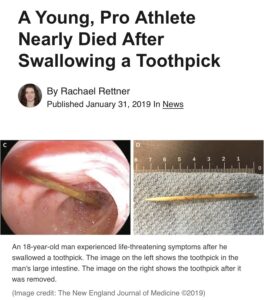
Toothpick side effects: What are the disadvantages of toothpicks?
I can technically think of potential risks regarding nearly every medical specialty, including ophthalmology, ENT and urology.

They may look harmless but can be surprisingly dangerous. Accidental ingestion (often unnoticed) lets the sharp ends perforate the GI tract—most commonly the ileum, duodenum, or sigmoid colon. This can cause peritonitis, abscesses, sepsis, or even injury to nearby organs like the liver. Wooden ones are hard to spot on plain X-rays, so CT is often needed, and endoscopic or surgical removal may be required.
Be extra careful with finger foods, club sandwiches, and appetizers.
Why doctors dont find the use of toothpicks amusing
Toothpicks are more dangerous than they look.
1. Accidental toothpick ingestion is uncommon but can be life-threatening because the sharp ends can pierce the gastrointestinal tract.
2. The most frequent sites of perforation are the ileum, duodenum, and sigmoid colon, leading to peritonitis, abscess formation, or sepsis.
3. Many patients don’t remember swallowing the toothpick, making the diagnosis easy to miss.
4. Wooden toothpicks are poorly visible on plain X-rays, so CT scan is often required if ingestion is suspected.
5. A migrating toothpick can injure nearby organs, causing liver abscess, pancreatitis, fistulas, or even vascular injury in rare cases.
6. Endoscopic removal is preferred if the toothpick is still within reach. Once perforation occurs, surgical intervention may be necessary.
7. An unexplained acute abdomen after eating finger foods, club sandwiches, or appetizers should always raise suspicion for an ingested toothpick, even if the patient denies swallowing one.
You’ll be surprised how many toothpicks are accidentally swallowed, with potentially catastrophic consequences.

Why do Male footballers wear “sports bras” during matches?
The “sports bras” male soccer players wearing are usually not bras at all. They are GPS performance tracking vests. They are electronic, for GPS tracking their positions in the pitch

The black elastic vest fits tightly around the chest, which is why it resembles a sports bra. It contains a small device between the shoulder blades that collects performance data.
It helps coaches measure things like:
Distance covered during a match or training.
Top speed and sprint frequency.
Acceleration and deceleration.
Heart rate (when paired with a heart-rate sensor).
Player workload and fatigue, helping reduce the risk of injury.
Teams analyze this data to:
Decide when a player should be rested.
Monitor recovery after injuries.
Improve fitness and training plans.
Compare performance over time.
players wear these vests in:
Under their jerseys during training.
In some matches, if the competition allows GPS tracking devices.
During warm-ups before games.
So, despite the appearance, they’re high-tech monitoring equipment, not sports bras.
Other names:
People usually colloquially call it sports bra, but it ain’t a bra
It has plenty names, yo’ can call it
* GPS Tracking Vest
* Performance Tracking Vest
* Athlete Monitoring Vest
* Player Tracking Vest
Summary:
These garments are not bras, but specialized electronic performance tracking vests worn by athletes. The tight crop-top design holds a lightweight GPS tracking pod securely between the shoulder blades.The pod tracks precise physical metrics like total distance, top speeds, acceleration, and heart rate.

*CONSULTANT PAEDIATRIC SURGEON, DR. ILUOBE INEGBENOSUN, DISTINGUISHES HIMSELF AT NIGERIAN SURGICAL RESEARCH SOCIETY CONFERENCE*
Excellence, innovation, and academic distinction once again took center stage as Dr. Iluobe Inegbenosun, MBBS, MHPM, FWACS, Consultant Paediatric Surgeon at the University of Benin Teaching Hospital (UBTH) and State Secretary of the Edo State Branch of the Nigerian Medical Association (NMA), made a remarkable impact at the just-concluded Scientific Conference of the Nigerian Surgical Research Society (NSRS), held in Benin City.

Dr. Inegbenosun was among the distinguished surgeons whose insightful research presentation enriched deliberations on emerging trends, groundbreaking innovations, and the future of surgical practice and research in Nigeria. His scholarly contribution drew commendation from colleagues and experts, reinforcing his reputation as one of the nation’s leading voices in paediatric surgery and clinical research.

The conference, which brought together eminent surgeons, researchers, and healthcare professionals from across the country, provided a vibrant platform for the exchange of cutting-edge ideas, professional collaboration, and the advancement of evidence-based surgical care aimed at improving patient outcomes nationwide.
In recognition of his commitment to surgical scholarship and research excellence, Dr. Inegbenosun was formally inducted into the prestigious Nigerian Surgical Research Society (NSRS) alongside other accomplished surgeons. The induction marks another significant milestone in his distinguished career and underscores his unwavering dedication to advancing surgical science, mentoring future generations of surgeons, and strengthening healthcare delivery in Nigeria.
Dr. Inegbenosun’s achievements continue to bring pride to the University of Benin Teaching Hospital, the Edo State medical community, and the Nigerian Medical Association, serving as an inspiration to young medical professionals committed to excellence in patient care, research, and innovation.
He is Married to his lovely beautiful wife Dr. Ann Inegbenosun and blessed with 3 lovely children and currently undergoing a PhD program in Healthcare Administration UNIBEN.


Ondo APC: How Aiyedatiwa’s consensus gamble on NASS candidates backfired

Neymar Denies Clashing With Young Santos Teammates

Liverpool Make Enquiry to Sign PSG Forward Ibrahim Mbaye

Meaning Behind Egypt Manager’s ‘X’ Gesture vs Argentina

Premier League Set-Piece Goals (2025/2026)

Simi Sanya and Femi Dapson Are Now Legally Married and It Is Beautiful to See
-
 Sports19 hours ago
Fabrizio Romano Issues ‘Here We Go’ for Arsenal’s Axel Donczew Transfer
-

 Politics2 days ago
Osun PDP senatorial ticket dispute deepens over factional candidacy
-
 Entertainment2 days ago
EscapeMag Issue 15 Spotlights Mercy Eke’s Growth Through a Fashion Story Worth Watching
-
 Sports1 day ago
Simon Jordan Claims Anthony Joshua vs Kristian Prenga was ‘Fixed’
-
Metro2 days ago
Lagos Taskforce arrests 46 suspected offenders in Island, Lekki raids
-
 Sports2 days ago
Argentine TV Names 10 People Responsible for ‘Argentinophobia’
-
 Metro2 days ago
Troops intensify hunt for abducted Zamfara council chairman
-
 Politics2 days ago
Delta LG 2nd Anniversary: Citizens demand greater transparency