
Sports
EURO 2028 Stadium Guide

Summary
- The 2028 UEFA European Championship will take place across nine stadiums in England, Scotland, Wales, and Ireland.
- Each co-host will aim to finally win the championship, with Wales and England having strong previous performances.
- All hosting stadiums have historical significance; one is yet to be completed, and Belfast’s Casement Park was withdrawn.
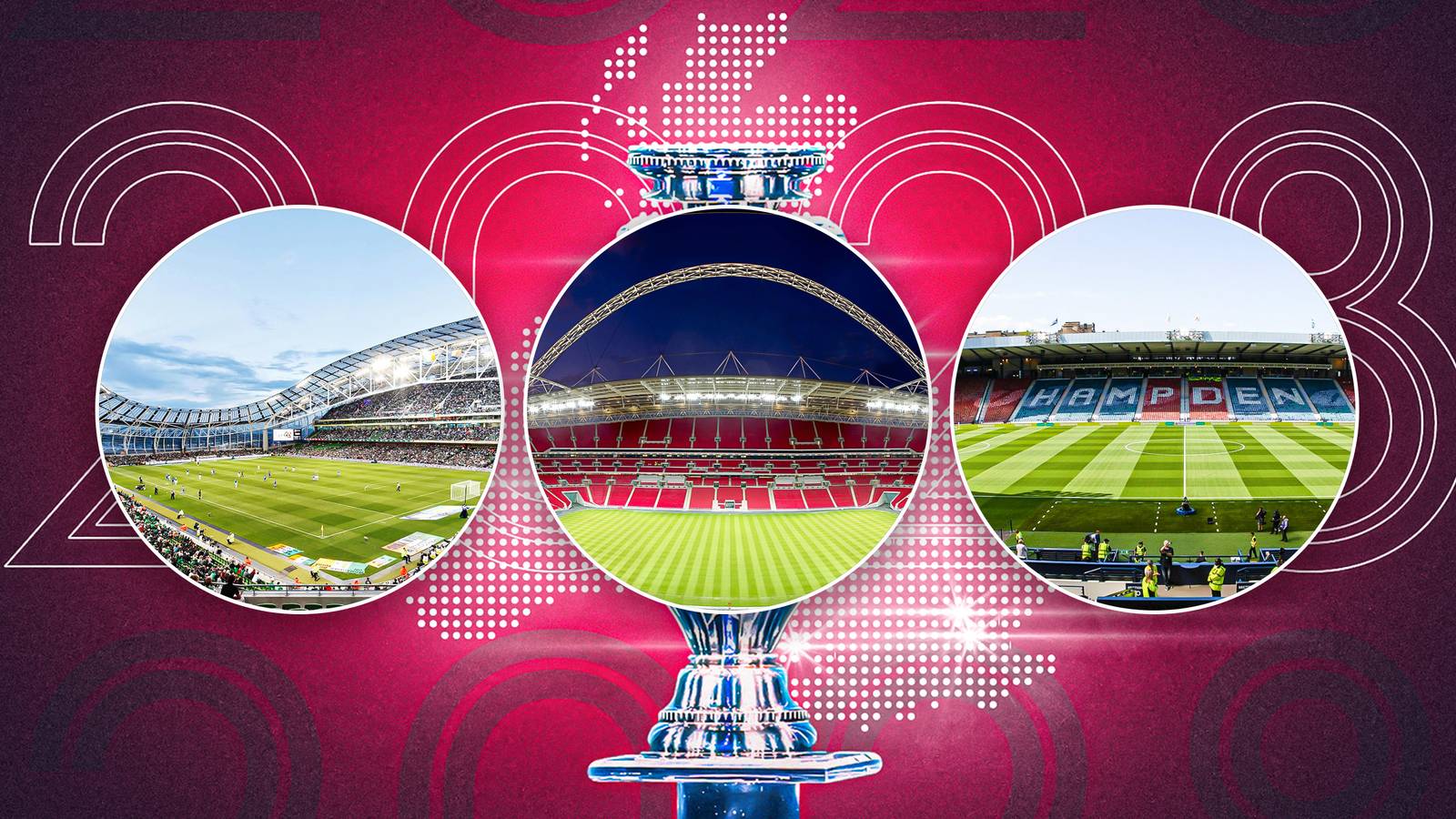
The full schedule for the 2028 UEFA European Championship has now been revealed, with the tournament to take place across nine football stadiums in England, Scotland, Wales and Ireland. Six of the venues are located in England, while the other three countries offer one stadium each.
The tournament officially kicks off on Friday, June 9, with the opening match to be played at the Principality Stadium in Cardiff, Wales. The tournament will come to an end on Sunday, July 9 with the final to be played at Wembley Stadium – the 51st match of the competition.
The last – and the only time – England staged a European Championship was back in 1996, while each of the co-hosts will be hosting the competition for the first time – Euro 2020 excluded. It’s the perfect opportunity for each of them to try and finally win the competition, while the Three Lions have four podium finishes to their name (two finals, two semi-finals) and Wales won bronze in 2016 on their second participation.
Here, GIVEMESPORT takes a look at all the stadiums that will be used during the tournament.
Belfast’s Casement Park was originally earmarked as the tenth host stadium for the tournament. But, as the time and cost involved in renovating the stadium were deemed too significant, its status was eventually withdrawn. However, the stadium was not replaced.
|
Full List of EURO 2028 Stadiums |
||
|---|---|---|
|
Stadium Name |
Location |
Capacity |
|
Wembley Stadium |
London, England |
90,000 |
|
Principality Stadium |
Cardiff, Wales |
74,500 |
|
Tottenham Hotspur Stadium |
London, England |
62,850 |
|
Etihad Stadium |
Manchester, England |
53,400 |
|
Hill Dickinson Stadium |
Liverpool, England |
53,000 |
|
Hampden Park |
Glasgow, Scotland |
52,000 |
|
St. James’ Park |
Newcastle, England |
52,000 |
|
Aviva Stadium |
Dublin, Ireland |
51,700 |
|
Villa Park |
Birmingham, England |
42,640 |
England
Wembley Stadium
- Location: London, England
- Capacity: 90,000
- Opening date: 9th March 2007
- Construction cost: £789m
Few stadiums in the world can boast a richer history than Wembley. Although its modern version was only inaugurated in 2007, its ancestor, which took place on the same site, will celebrate its 105th anniversary in 2028. A legendary arena in which the greatest teams have fought the most epic battles for decades.
From the 1966 World Cup Final to the 1996 and 2020 Euros and the legendary White Horse Final, the London venue has seen its turf trodden by some of the greatest players of all time. And there’s no end in sight, as the stadium is set to host a third European Championship final.
Tottenham Hotspur Stadium

- Location: London, England
- Capacity: 62,850
- Opening date: 3rd April 2019
- Construction cost: £1b
The ultra-modern home of Tottenham Hotspur, whose name it bears, Tottenham Hotspur Stadium will host the first European Championship matches in its history. With a capacity of 62,850, it is currently the second-largest stadium in the Premier League, just behind Old Trafford.
Its South Stand, inspired by the famous yellow wall at Dortmund’s Westfalenstadion, is the largest stand ever built in an English stadium. It can accommodate up to 17,500 fans. While details of the matches to be staged at each stadium are not yet known, it’s safe to assume that a number of final-round matches will be staged there.

10 Most Expensive Stadiums in Football History [Ranked]
From London Stadium to Wembley Stadium, here are the 10 most expensive stadiums in football history.
Etihad Stadium

- Location: Manchester, England
- Capacity: 53,400
- Opening date: 25th July 2002
- Construction cost: £154m
Unlike its neighbor Old Trafford, whose state of renovation could not be guaranteed in time, the Etihad Stadium will indeed host Euro 2028 matches. Home to Manchester City, the Etihad Stadium opened its doors to soccer in 2003 (it was originally built to host the 2002 Commonwealth Games) and underwent its first extension during the 2014/15 season.
By 2026, the stadium will be further extended to accommodate over 61,000 fans, making it the fourth largest club stadium in the Kingdom. Renowned as a real fortress from which the Citizens benefit, the Etihad Stadium has also brought good luck to the Three Lions, who have never been beaten there in three matches.

Man City’s New North Stand Expansion: Opening Date, Latest Developments and More
Manchester City are currently undergoing renovation works at the Etihad Stadium, which will increase the capacity to nearly 62,000.
Hill Dickinson Stadium

- Location: Liverpool, England
- Capacity: 52,769
- Opening date: 24th August, 2025
- Construction cost: £750m
The Hill Dickinson Stadium was chosen as a host venue for the tournament even before construction had finished on Everton’s new home. The home of the Toffees, who left Goodison Park at the end of the 2024/25 season after playing there for more than 130 years, the stadium, located on the banks of the River Mersey, will hold just under 53,000 fans.
A massive investment of around £750m, the first stone of which was laid in 2021 and the last of which will make the stadium the eighth largest in the UK. Like Tottenham Hotspur Stadium, it will also feature a grandstand inspired by Signal Iduna Park’s Sudtribune, which can accommodate 13,000 people.
St. James’ Park

- Location: Newcastle, England
- Capacity: 52.350
- Opening date: 16th October 1880
- Construction cost: Unknown
The second-oldest stadium in the Premier League – behind Stamford Bridge – St. James’ Park will also be taking part. Home to Newcastle United since 1892, its history with the game goes back to 1880, when it was first played in the “Cathedral on the Hill”.
With a capacity of over 52,000 spectators, it is also known for producing one of the finest atmospheres in English soccer’s elite thanks to its dedicated Toon Army. A regular host of major tournaments, in 2028 it will host its second Euro, following on from 1996, when three group-stage matches were staged there.
Villa Park

- Location: Birmingham, England
- Capacity: 42.640
- Opening date: 1897
- Construction cost: £20m
Located on Trinity Road in the city of Birmingham, Villa Park is a landmark in the English soccer landscape. Opened in 1897, it has since been occupied by Aston Villa and has hosted three 1966 World Cup matches, four Euro 1996 matches and 55 FA Cup semi-finals – more than any other stadium.
With a capacity of just under 43,000, the original plan was for the century-old stadium to be able to accommodate some 50,065 people in its stands by 2028. The redevelopment plans have now been put on hold, and the date of delivery is still unknown. It is therefore highly unlikely that the stadium will be ready for the competition.
Wales
Principality Stadium

- Location: Cardiff, Wales
- Capacity: 74.500
- Opening date: 26th June 1999
- Construction cost: £121m
Also known under the name of Millennium Stadium, the Principality Stadium, located in Cardiff, is the largest Welsh stadium and the fourth largest arena in the United Kingdom. With a capacity of 74,500 in its football configuration, it is regularly used by the national team for international matches.
Opened in 1999, its construction cost £121m, 46 of which came from public funds provided by the Millennium Commission. Classified as a category 4 stadium by UEFA, it was the venue for the 2017 Champions League final between Juventus and Real Madrid, as well as several FA Cup finals between 2001 and 2006.
Scotland
Hampden Park

- Location: Glasgow, Scotland
- Capacity: 52.000
- Opening date: 31st October 1903
- Construction cost: Unknown
Although it has undergone a number of renovations over the years, Hampden Park is the oldest stadium designated to host Euro 2028 matches. Mainly known as the home of the Scottish national team since it opened in 1903, it has also been the venue for numerous sporting events (Champions League finals, Euro 2020, Scottish Cup) over the course of its rich history.
A legendary stadium which, until 1950 and the construction of the Maracana in Rio de Janeiro, was the largest stadium in the world – seating 149,415. And although its capacity has since been reduced by two-thirds, its atmosphere and the noise coming from its stands make it one of the hottest stadiums in the UK.
Ireland
Aviva Stadium

- Location: Dublin, Ireland
- Capacity: 51.700
- Opening date: 14th May 2010
- Construction cost: £340m
Also rated category 4 by UEFA (the first and only in the country), Dublin’s Aviva Stadium will be the Irish representative of the Euro 2028 hosts. Opened in 2010, the 50,000-seater stadium – a capacity deemed too low even before its inauguration – was the venue for the 2024 Europa League final between Atalanta Bergamo and Bayer Leverkusen.
This is a stadium where international matches are commonplace, hosting matches for national football and rugby teams. The Irish capital will be looking to avenge the fact that, in 2021, it had to forego three Euro 2020 matches because of the coronavirus pandemic.
Correct as of 17/04/2025

Departing England Test captain Ben Stokes has revealed why he decided to walk away from international cricket.
In a highly unorthodox move, the 35-year-old opted to make his decision public while he was out in the middle, bowling for his side during the third Test match with New Zealand at Trent Bridge.
A statement confirming the news was released at 3.25pm on Sunday’s fourth day, timed to coincide with Stokes beginning an over during a marathon spell of bowling.
As word of Stokes’ resignation made its way around the ground in Nottingham, the 17,000-strong crowd rose to their feet to acknowledge the Durham man.
With every fan in attendance willing him to get a wicket, Stokes rose to the occasion, finding the edge of Zak Foulkes’ bat before Harry Brook took a fine catch at second slip. It was absolute cinema and encapsulated everything that Stokes has become known for his 15 years in an England shirt, with four of those coming as captain.
Stokes celebrated with a beaming smile. His storybook delivery came just days after he returned to the England side, having missed the 253-run defeat at The Oval in the second test while an investigation was carried out into a late-night incident at a London nightclub following the first Test match of the series.
Together with teammate Gus Atkinson, Stokes was issued with a written warning over his behaviour by the Cricket Regulator, before both men returned to the side at Trent Bridge.
However, barely four days into his comeback appearance, Stokes informed his side in the dressing room before the start of play, that the ongoing test would be his last match as an international player.

England have already lost The Ashes to Australia, and after going 3-0 down in the series, Stokes faced some tough questions.
Ben Stokes’ Retirement Decision Explored
While it is natural to assume that the disciplinary issues of the past few weeks may have prompted his decision to quit the international scene, the two-time World Cup winner insisted that other factors had convinced him to walk away.
Speaking to Sky Sports following the end of the day’s play, Stokes told Ian Ward and Stuart Broad that he had been considering his future for some time.
The New Zealand series marks England’s first test match action since Stokes presided over a dismal 4-1 Ashes defeat to Australia during the winter. The departing captain insisted that it was during that series that he really began to have doubts over his future.
Why Ben Stokes Is Waking Away From International Cricket

“It’s the emotional side of this since Australia,” he began. “The way I said it to my wife was: ‘I don’t actually think I have any fight left in me to get over this, to be honest.’
“What we do is brutal, physically and mentally. Even the stuff away from it [the field] is getting tiring these days. I’m 35, I feel like I’ve got to do so much physical work to keep myself doing what I do out there.”
Stokes concluded: “Do I have that fight in me to keep doing that? I know what it takes to walk out there and keep playing for this country. There are so many things that have leaned me towards knowing that this is the right decision. There’s the emotional side, the physical side, the mental side.”
Prior to the Crowe-Thorpe Trophy series with New Zealand, Stokes went on record to call the months following England’s Ashes embarrassment “the hardest period” of his time as captain.
Stokes, along with head coach Brendon McCullum and managing director Rob Key, survived an internal review of England’s performance down under just three months ago, with all three keeping their jobs.
However, with Stokes’ departure, England must now look to rebuild without their enigmatic skipper. No decision has yet been made on who will take up the role. Former captain Joe Root has been widely tipped as the logical choice to take charge for the side’s next Test action, which comes with the visit of Pakistan in August.
AI Names & Ranks 20 Greatest English Athletes of All Time
Legends from the sport of football, boxing, cricket, and Formula 1 all make the top 20, according to ChatGPT.

Tottenham are now said to have slapped an asking price on one of their starters as they look to top up their transfer kitty. Spurs are expected to spend big this summer as they look to give Roberto De Zerbi every chance of turning a relegation-fighting team into one capable of qualifying for Europe.
De Zerbi managed to keep Spurs in the Premier League, but it’s likely he made sure he was promised a significant summer budget before even taking the job. To their credit, the Spurs chiefs are backing up those promises, with four signings already wrapped up between Martin Dubravka, Andy Robertson, Marcos Senesi and Jan Paul van Hecke.
More are likely to arrive, but Spurs are going to need to balance the budget at least a little.
Vicario on his way out of Tottenham this summer

Spurs are expected to sell Guglielmo Vicario this summer, with the Italian said to be keen on returning to Italy. Vicario has been a central part of Tottenham’s efforts over the last few years, and you could see how much the club’s survival meant to him at the end of last season as he celebrated with De Zerbi from the bench.
But he is now looking for a new opportunity, and Spurs are willing to play ball to welcome in some cash this summer. Juventus are said to be the primary interested party, while Inter Milan have also been linked in the past.
And according to Football Insider, Spurs are ‘fully expecting’ to sell Vicario this summer, asking for £20million. That would represent a £3million profit on the Italian for Spurs.
De Zerbi has already signed Dubravka this summer, and he also has Antonin Kinsky, who impressed him towards the end of last season. Kinsky played a key role in Tottenham’s survival, pulling off a number of top saves in Vicario’s absence through injury, and he will likely have the opportunity to fight for a number one with Dubravka next season.
Vicario cash injection could help Spurs

Tottenham have already spent big to land Van Hecke this summer, and they are going to continue to spend big for the rest of the summer. Spurs are looking at spending at least £80million to sign Mateus Fernandes from West Ham, while Newcastle United’s Sandro Tonali is also said to be a possible alternative target.
The North London club need a striker this summer, and they are likely to add depth to another position or two beyond that. Sales will be important to fund that mission to overhaul the squad, and £20million for Vicario will certainly help top up the coffers.
Tottenham Star ‘Agrees Personal Terms’ to Leave After De Zerbi Appointment
He could be the first major departure of the Roberto De Zerbi era

Canada are the first team through to the 2026 World Cup Round of 16 after a narrow victory against South Africa. The host nation were forced to play their first knockout game in the United States of America, but still managed to come away with a 1-0 win.
Jesse Marsch, born in the States, has guided Les Rouges to the last 16 despite being met with extreme doubt ever since his failed spell at Leeds United. Always wearing his heart on his sleeve, the 52-year-old even had to be held back from the referee after a controversial penalty decision in the game.

Furious USMNT Legend Clint Dempsey Slams 2026 World Cup Manager on Live TV
United States Men’s National Team legend Clint Dempsey furious hits out at 2026 World Cup manager on live TV
Nonetheless, a goal from Stephen Eustaquio in stoppage time was enough to eliminate Bafana Bafana and progress to the next round, where Canada will face the winner of the Netherlands vs Morocco.
Jesse Marsch’s Full-Time Speech vs South Africa

Following the full-time whistle, Marsch and his players showed the extreme emotion they were feeling. The manager got into the middle of a huddle and gave an inspirational speech to his players.
ITV’s cameras and microphones captured the entire monologue. “Guys, think about the two years we’ve been together. Think about how we talked about the plan, sticking to who we want to be, playing aggressive and accessing your qualities,” the animated American said.
He went on to label the playing staff ‘Canadian heroes’ for the influence they’d have on younger generations getting involved in football. He continued:
“You guys showing your character. You guys are Canadian heroes. Canadian heroes for the future children of this country who play the sport. The sport has a big future because of you guys.
“You should be so proud of who you are. You should be so proud of this game. You never lost belief; you went after it. Point after point, moment after moment. You are Canadian heroes.”
Watch Jesse Marsch’s full speech below

While everyone involved with Canada, including players and fans, will have loved what they were hearing from the man who just took them to World Cup history, not everyone felt the same.
Marsch often got comparisons with fictional American college football coach Ted Lasso during his time in the Premier League. Supporters of other nations were quick to accuse the Canadian boss of ‘copying’ the TV character.
World Cup Pundit Slams Jesse Marsch’s ‘Ridiculous’ Antics After Canada 6-0 Qatar
Marsch’s behaviour has caused a huge stir.
One X user said: “Jesse Marsch is literally Ted Lasso, isn’t he? Such a strange man, and an American kissing the Canadian badge, wow!”
Another claimed: “The Ted Lasso vibes from Jesse Marsch are overwhelming,” while a fan stated Marsch was ‘leaning into’ the character: “Jesse Marsch really leans into the Ted Lasso thing.”
Others were even harsher on the World Cup boss, with one claiming the real man is more ‘cartoonish’: “Jesse Marsch famously didn’t like being likened to Ted Lasso. It was an unfair comparison. Ted Lasso is much less cartoonish.”
One asked for the ‘performative’ stuff to be kept to a minimum. “Less of this performative Ted Lasso bulls*** please. This team is winning and doing well despite Jesse. Not because of.”


Stock market sustains profit taking, as investors lose N2.4trn

NDC: People looking for excuses to scatter opposition – Dickson

Malaysia seeks local partnership to fill Nigeria’s palm oil supply gap

Simi Sanya and Femi Dapson Are Now Legally Married and It Is Beautiful to See

FCT Area Council Election: Live results from polling units

Premier League Set-Piece Goals (2025/2026)
-
 Sports14 hours ago
Statement Released as Lucas Trejo’s Wife and Children Die in Earthquake
-
 Sports2 days ago
Cody Gakpo’s Son Passes Away During Pregnancy, Girlfriend Confirms
-
 Sports2 days ago
Footage Shows True Crowd Reaction to Iran’s National Anthem vs Egypt
-
 Sports1 day ago
2026 World Cup Nation Punish Players By Cancelling Their Flight Home
-
 Sports23 hours ago
Spain’s Nico Williams Calls Out Uruguay Ace After He Suffers Injury
-
 Sports2 days ago
Turkey Become ‘Unofficial World Champions’ With Win Over USA at the World Cup
-
 Sports2 days ago
US Reporter Slammed For ‘Pathetic’ Comments About Bosnia Ahead of World Cup Game
-
 Sports1 day ago
Supercomputer Predicts Entire F1 Race After Qualifying