
Sports
Oliver Glasner Keen to Join Man Utd

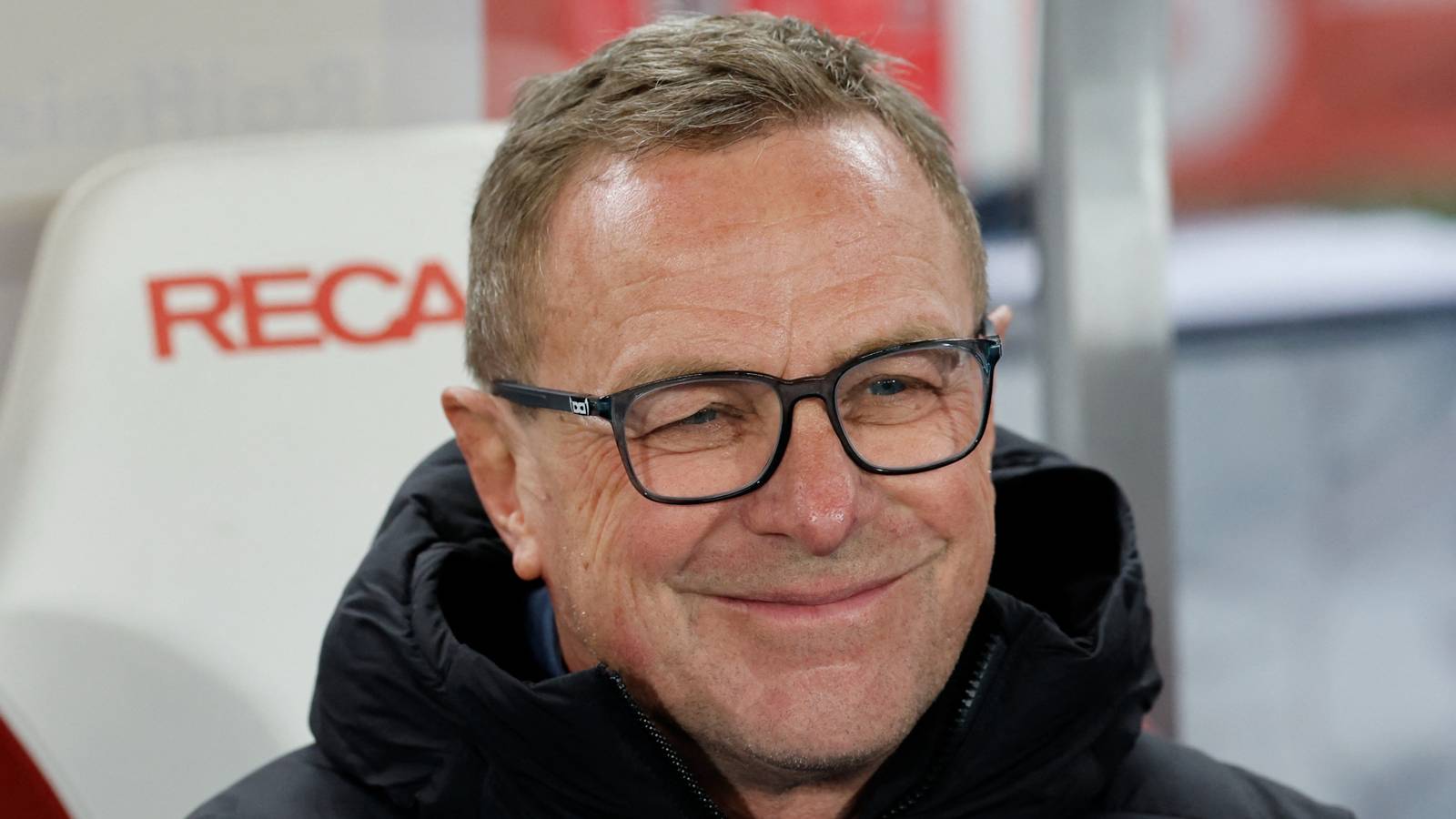
Austria national team manager Ralf Rangnick will appreciate better than most what Ruben Amorim has gone through this week. After all, both men arrived at Manchester United with big expectations but left having failed to live up to them.
As more time has gone on since his exit in 2022, public opinion has somewhat shifted on Rangnick’s time at Old Trafford. While he certainly didn’t deliver results on the pitch, the German was able to accurately point out what was going so wrong for the sleeping Premier League giants.
He spoke about a number of issues at Man Utd, most notably claiming that quick fixes would not be enough, and that ‘open heart surgery’ was needed on the English club. He also tried to persuade the club to sign a number of young players, such as Erling Haaland, Josko Gvardiol, Enzo Fernandez, and Julian Alvarez, who have all gone on to prove their quality at rival teams.
With all that in mind, it’s interesting to now look at which managers have also caught Rangnick’s eye in recent years. Funnily enough, there is one man whom the German has heavily praised. Not only that, but he’s also been linked with the newly vacant manager’s role at Man Utd.
Rangnick is a Big Fan of Oliver Glasner

Rangnick has spoken in the most positive terms about Oliver Glasner in the past. Judging from his comments, it seems as though he thinks the current Crystal Palace man would be the perfect candidate to replace Ruben Amorim at Man Utd. In March 2023, speaking to LAOLA1, Rangnick said:
“For me, Oliver Glasner is currently one of the most exciting coaches – not only in Germany, but in all of Europe. An absolute top coach.”
Glasner built his reputation in his native Austria, where he was actually first given an opportunity in coaching by his mentor Rangnick at Red Bull Salzburg. Rangnick explained how he has been impressed by the path Glasner has taken, adding:
“He developed step by step to where he is now, also because he made the right decisions. From his perspective, it was right to go to Ried, from Ried to Linz, from Linz to Wolfsburg.
“When you see what’s happening with him and Markus Krosche at Eintracht Frankfurt, you can only take your hat off to him. This is a prime example of how a coach’s career should develop. It couldn’t have been written down better beforehand.”
It’s interesting that Rangnick talks about Glasner taking a logical approach to each new step of his career, as he has since left Germany – after winning the Europa League with Eintracht Frankfurt – and moved to England. At Palace, he has established himself as one of the top Premier League coaches, leading the Eagles to their first-ever major piece of silverware by winning the FA Cup in 2025.
Having steadily moved up the coaching ladder across Europe, it may well be logical for Glasner to take the next step and join a bigger Premier League club. With Manchester United available and reportedly interested, it could be the perfect time for Glasner to arrive.
Ben Jacobs: Glasner Open to Joining Man Utd

The positive news is that GIVEMESPORT correspondent Ben Jacobs believes that Glasner would be open to joining Man Utd if an approach is made. He’s even spoken in the past about how his tactics are similar to Amorim’s, noting earlier this season:
“We’re playing the same system. So it looks like it’s a good attacking system. Also, as we show it, you can have a good defensive structure with it. It’s all about what you do with the system and how fluid you are in attack and how creative you are.”
The Red Devils should certainly have taken Rangnick’s advice in the past more seriously. Perhaps they should pay close attention to his comments on Glasner, and push to land the Palace boss before he’s surely snapped up elsewhere.

England’s next World Cup opponents will be the DR Congo as Thomas Tuchel’s squad look to advance from the Round of 32. England and the DR Congo will face off for the very first time, with the encounter taking place in Atlanta, Georgia.
England remain one of the tournament favourites after qualifying from the group stage unbeaten. But does the African nation pose a threat to the Three Lions’ World Cup crusade?
Who are DR Congo?

|
Country: |
Democratic Republic of Congo |
|---|---|
|
Continent: |
Africa |
|
Population: |
124 million |
|
Capital City: |
Kinshasha |
Formerly named Zaire, the Democratic Republic of Congo is the second-largest country in Africa, with a population of approximately 124 million. The country was renamed the DR Congo in 1997 after President Mobutu Sese Seko was overthrown by rebel forces.
The country’s relatively new name is in reference to the great Congo River that flows through the country. The river’s name is derived from the historic African Kingdom of Kongo and the indigenous Bakongo people who lived in the region.
⚽
England World Cup Quiz
You scored
out of 20
DR Congo Record at World Cup 2026
|
DR Congo 2026 World Cup Record |
||
|---|---|---|
|
Date |
Result |
DR Congo Scorer(s) |
|
17/6/2026 |
Portugal 1-1 DR Congo |
Yoane Wissa |
|
24/6/2026 |
Colombia 1-0 DR Congo |
None |
|
28/6/2026 |
DR Congo 3-1 Uzbekistan |
Yoane Wissa (2), Fiston Mayele |
Who are the Best DR Congo Players?

Northern-based England fans will be all too familiar with two of the DR Congo’s biggest threats. Newcastle striker Yoane Wissa is rediscovering his form after an injury-plagued start to life on Tyneside. He has netted three times in the World Cup already, making him the top scoring African player in the group stage.
Noah Sadiki was a pivotal part of Sunderland’s excellent 7th-place finish in the Premier League, earning them Europa League qualification. An energetic and forward-thinking midfielder, expect him to link well with Wissa.
DR Congo’s rearguard offers significant top-level pedigree too. Team captain and all-time leading appearance maker Chancel Mbemba is incredibly experienced at club and international level. The 31-year-old previously played for Newcastle as part of the squad that won the Championship in 2017. He is supported ably by West Ham’s Aaron Wan-Bissaka and Burnley’s Axel Tuanzebe in defence.
But the wildcard for the DR Congo is their veteran striker Cedric Bakambu. The 35-year-old is well travelled and has previously won the Golden Boot in both the Chinese and Greek Super Leagues. Bakambu contributed four goals in World Cup qualifying and is now just one goal behind the country’s all-time leading goalscorer, Dieumerci Mbokani.
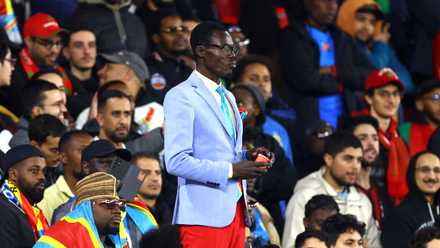
The Reason Why DR Congo Fan Stood Stood Completely Still During AFCON Matches
The viral supporter stood motionless in each of DR Congo’s five matches throughout this year’s AFCON.
DR Congo Manager and Style of Play

- Manager: Sebastien Desabre
- Style of Play/Tactics: 5-3-2 or 4-4-2
Manager Sebastien Desabre is well-versed in international football, having coached both Uganda and the DR Congo during a 20-year managerial career. The Frenchman guided the DR Congo to the semi-finals of the 2023 Africa Cup of Nations. He also led them to impressive victories over Cameroon and Nigeria in World Cup qualification.
Desabre has shown tactical fluidity during the World Cup. The DR Congo adopted a five-man backline against Portugal and Colombia, earning a well-deserved point against Roberto Martinez’s side. But for their 3-1 win over Uzbekistan, Desabre was more offensive, opting for a 4-4-2.
With 29 clean sheets in their previous 57 games under Desabre, the African nation can soak up the pressure when required. This has paired well with a strong counter-attacking style boosted by the pace of Wissa and Sadiki.
World Cup on GIVEMESPORT

Lionel Messi and Cristiano Ronaldo have just become the first two men in history to play at six World Cups. The natural next question writes itself: could there be a seventh?
Their chances are low, but it isn’t impossible, and both men have left enough daylight for the question to be asked and to keep the hopes alive. The two careers have run in parallel for two decades, and now share this milestone in the same tournament.
Four years is a long time at the best of times, let alone in your forties, and will both players be able to hold on and feature on the world’s biggest stage again in four years?
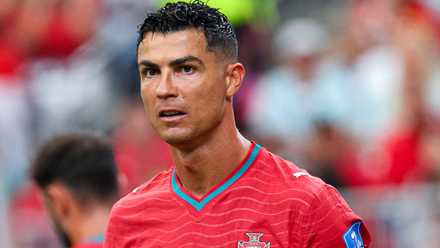
Cristiano Ronaldo Issues 9-Word Response About Lionel Messi as He Storms Out of Interview
Ronaldo issued a nine-word response as he’s asked about Messi – while storming out of the interview
Will Lionel Messi Play at the Next World Cup?

Messi has been typically professional and guarded on the subject. Asked directly about 2030 after his Algeria hat-trick, he laughed off the idea before more considered answers followed later in the tournament.
Pressed again after his Austria performance, in which he became the World Cup’s all-time leading scorer, he settled into a familiar noncommittal stance, claiming he isn’t thinking that far ahead.
He told reporters: “I don’t know. The truth is, I’m not thinking about that right now.”
“It seems a bit far off, but as I said, I’m living one day at a time and focused on the present. I will continue for some time, as long as I can contribute, feel good physically, and help my teammates, then I will keep playing.”
It’s the kind of answer you expect from a professional, media-trained footballer. The kind of answer that commits to nothing whilst also ruling out nothing either.
How Old Will Messi Be at the Next World Cup?
Messi is 39 during this tournament, not that it has had an effect on his performances. By the 2030 finals, he will be 43. There is a genuine pull factor for the 2030 World Cup: it is the centenary edition, and as part of celebrations Argentina will host a one-off match in Buenos Aires, a country that hasn’t staged a World Cup game since 1978. So for a player who has never been able to play in a World Cup on home soil, that could be a real incentive for him to keep going.
However, his Inter Miami contract does expire in 2028, and it remains to be seen whether he will extend, move clubs, or call time altogether on his stellar career. And surviving and playing in the MLS is a lot different to playing in a World Cup campaign at the age of 43.
Will Cristiano Ronaldo Play at the Next World Cup?

Ronaldo has been more open and pessimistic about his own timeline. Speaking at a Tourism Summit in Riyadh, when asked whether this would be his last World Cup, he said: “Definitely yes. I will be 41 years old, and I think this will be the moment in the big competition. It’s probably one or two more years. I’ll still be at the game.”
His contract at Al Nassr runs out in 2027, with reports circulating about an executive role at the Saudi Club upon its expiration.
⚽
World Cup History Quiz
You scored
out of 20
What Age Will Ronaldo Be at the Next World Cup?
The case against Ronaldo at 2030 is steeper than Messi’s. He’d be 45 by then, Portugal’s attack has begun to lean less on him for goals than it once did, and he has repeatedly framed this tournament as a farewell. However, you couldn’t put it past Ronaldo to keep playing until 2030.
The ex-Real Madrid forward has confirmed he wants to keep playing until he reaches 1,000 career goals. Whilst he isn’t far away from that milestone, he might need an extended contract to reach the target, and he may well keep going until 2030 to play in one last tournament, especially considering Portugal are one of the hosts.
Who Are the Oldest Players to Play at a World Cup?

The record book offers some perspective on just how rare this would be. Egyptian goalkeeper Essam El Hadary holds the record, turning out for Egypt against Saudi Arabia in 2018 at 45 years and 161 days, marking the occasion with a penalty save.
Colombia’s Faryd Mondragon is next, coming on as a substitute in 2014 at 43 years and 3 days, in what was also his farewell appearance. Cameroon’s Roger Milla remains the record-holder among outfield players, being 42 years and 39 days when he scored against Russia in 1994.
The Verdict

Most names on the list are goalkeepers, bar one. Milla’s record still sits three years younger than Ronaldo would be if he was to make it. History suggests longevity at this level belongs almost exclusively to those in the posts, which is precisely why one more World Cup campaign remains a long shot for two of the world’s greatest ever players.
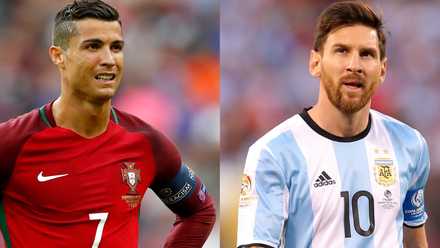
Cristiano Ronaldo’s Eye-Opening Reaction to Lionel Messi’s Argentina Retirement in 2016
Messi announced his international retirement in 2016, sparking a response from his long-term rival Ronaldo.

It begins with a handful of people. Someone jumps to their feet, arms in the air, and then the person next to them follows, then the next, then the next, until a ripple of human hands is sweeping around an entire stadium like a tide rolling in from the sea.
The Mexican wave is one of sport’s most universally recognised rituals, a piece of collective theatre that can turn 50,000 strangers into a single, synchronised unit. It needs no instruction, no referee and no training; it just happens.
But where did it come from, why does it work the way it does, and what does Mexico have to do with any of it? The answers are more surprising than you might expect.
What is a Mexican Wave?

In technical terms, a Mexican wave is what’s called a transverse wave: the spectators themselves move only vertically, standing up and sitting back down, but the wave they create travels horizontally around the stadium. The result, when viewed from above or from a camera on the far side, is a ripple of people moving in near-perfect unison, like a slow-motion breaker rolling along a coastline.
The mechanics are simple. A small cluster of fans in one section stands up with their arms raised, then immediately sits back down. The section beside them, seeing this, follows. Then the next section. Then the next. The wave is self-sustaining; each group of fans is simultaneously reacting to those just before them and triggering those just ahead.
It can take as few as 30 fans standing simultaneously to trigger a wave, with most going in a clockwise direction. The wave is, in short, a beautifully simple piece of crowd physics.
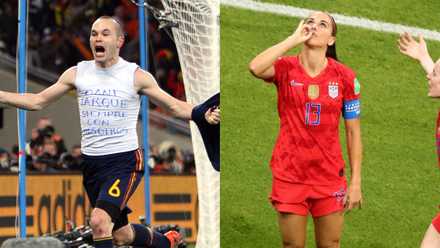
The 12 Best World Cup Celebrations All Time [Ranked]
From Brandi Chastain making the cover of Time magazine to Roger Milla’s corner flag shimmy — here are the 12 greatest World Cup celebrations.
Where and When Did it Originate?

For many people around the world, it may seem like an obvious question. But the truth is considerably more complicated, and the real origin of the wave lies several thousand miles to the north, in the stadiums of the United States.
The strongest claim to inventing the wave belongs to a professional cheerleader known as Krazy George Henderson. Armed with a drum, a pair of cut-off jeans and an almost supernatural ability to animate a crowd, Henderson had spent years refining his craft at sporting events across North America.
⚽
World Cup History Quiz
You scored
out of 20
On October 15 1981, at the Oakland Coliseum during a Major League Baseball playoff game between the Oakland Athletics and the New York Yankees, he finally unleashed it on a major stage. After a couple of failed attempts, it clicked. The wave circled all three decks of the stadium multiple times. It was nationally televised, and Henderson claims that this was the day the wave was born.
From those American beginnings in the early 1980s, the wave spread rapidly through US sports culture, appearing at NFL games, College Football, Baseball and beyond. By 1984, Henderson had even led one at a football match at the Los Angeles Olympics. Mexican crowds picked it up too, took to it enthusiastically, and made it a fixture of their football culture.
Why is it Called the Mexican Wave?

The name comes down to one tournament: the 1986 FIFA World Cup, held in Mexico. While the wave had been circulating through North America stadiums for several years by that point, it was the global broadcast of the 1986 competition that introduced the spectacle to the television audiences across Europe, Asia, Africa and beyond, most of whom had never seen anything like it.
To those watching from outside the Americas, the wave appeared to be a Mexican invention. The packed, passionate crowds at The Azteca and other venues performed it so often, and so joyfully, that it became inseparably associated with that summer. Broadcasters and commentators from English-speaking countries began calling it the Mexican wave, and the name stuck.
In North America, where people had been doing it for five years before 1986, it is still known simply as the wave. But for the rest of the world, Mexico got the credit, and Mexico got the name. It is perhaps one of the most ironic pieces of sporting branding in history: an American invention that became a Mexican icon.
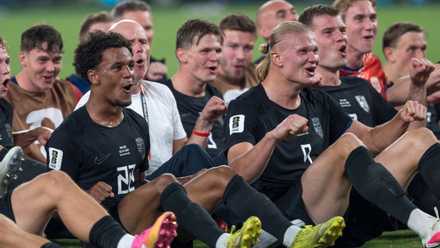
Norway fans’ ‘Viking Row’: Viral World Cup Trend Explained
The Norwegian supporters’ catchy choreography is as simple as it is viral.


Let’s bury our differences to defeat APC — PDP senatorial candidate appeals

Court remands three over alleged diversion of govt mosquito nets

Obi demands transparency, wants INEC to publish candidates’ academic certificates

Simi Sanya and Femi Dapson Are Now Legally Married and It Is Beautiful to See

FCT Area Council Election: Live results from polling units

Premier League Set-Piece Goals (2025/2026)
-
 Sports8 hours ago
Virgil van Dijk Slammed For Comments After Netherlands’ World Cup Exit v Morocco
-
 Sports10 hours ago
Zlatan Ibrahimovic Blames Netherlands’ Shock World Cup Exit on Ronald Koeman
-
 Sports2 days ago
Jesse Marsch’s Full Speech After Canada vs South Africa
-
 Sports7 hours ago
Carlo Ancelotti Explains Why He Didn’t Celebrate Brazil’s Winner v Japan
-
 Sports7 hours ago
Kevin Pietersen Causes Stir With Tweet About His International Cricket Retirement
-
 Sports1 day ago
How Much Emma Raducanu Will Earn Despite Withdrawing Through Injury
-
 Sports1 day ago
Roger Federer Names His Top 5 Tennis Players of All Time
-
 Sports20 hours ago
FIFA Make Decision on Investigating 2026 World Cup ‘Match-Fixing’