
Business
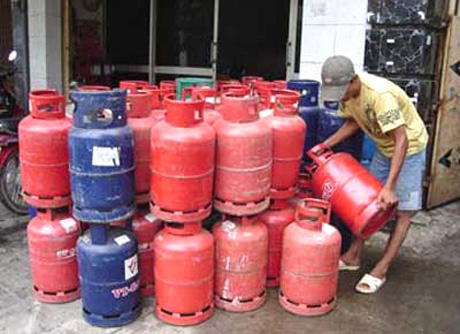
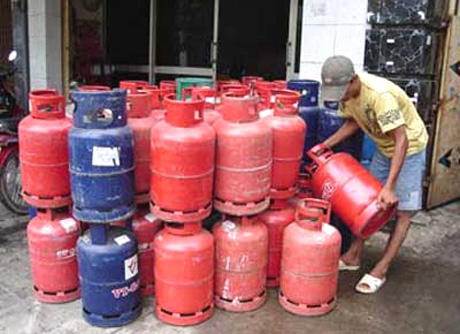
Cooking gas price rises 13% to N1,500 per kg

…As dealers lament poor sales
By Mariam Adebukola
The price of Liquefied Petroleum Gas, LPG, also known as cooking gas has increased by 14.3 percent on a month-on-month, MoM, basis, to N1,500 per kilogram, from N1,300 recorded last month.
However, the ex-depot price of the product increased by 16.7 percent on a MoM basis to N21 million per 20 metric tonnes (MT), up from N18 million recorded last month.
Checks by Vanguard indicated that cooking gas now sells up to N1,500 per kilogramme in many locations.
Speaking with Vanguard, the National President of the Nigerian Association of Liquefied Petroleum Gas Marketers, Mr. Inyang Edu, confirmed that the depot price rose to N21 million adding that the purchasing power of Nigerians dropped drastically due to the hike in price.
According to him, the dealers now record poor sales at their various gas plants as consumers resort to other sources of energy.
“The depots sell N1,065,000 per one metric ton which gives a total of over N21 million for 20 metric tonnes. The depots include, Rainoil, Nipco, Mobil, Ardova. Before now, Nipco sold for N19.5 million per 20 metric tonnes but it has now been increased to N21 million”.
Commenting on the cause of the sharp increase, Inyang said it was related to the Middle East crisis as it has affected not only cooking gas but other petroleum products.
On supply from Dangote refinery, Inyang noted, “the refinery sell at a cheaper rate of about N16 million for 20 metric tonnes to their off-takers who then includes their profits, making the products high for marketers to buy.
He added, “The supply from Dangote is limited, he recently announced that he only gets five out of 13 crude oil allocations it required, as he imports crude oil to refine here in Nigeria”.
“This will continue to hamper the price of petroleum products coupled with the Middle East crises that have disrupted oil production”.
The post Cooking gas price rises 13% to N1,500 per kg appeared first on Vanguard News.

By Obas Esiedesa & Mariam Eko
The Federal Government (FG) has commissioned the upgraded transmission facilities in four major substations in Lagos, adding about 360 megawatts (MW) of transmission capacity to boost electricity supply across the state.
The projects at Ijora, Apapa Road, Alausa and Lekki substations are expected to strengthen bulk power delivery to residential, commercial and industrial consumers within the networks of Eko and Ikeja Electricity Distribution Companies.
Speaking during the commissioning of the projects, Minister of Power, Joseph Tegbe, said the investments were aimed at removing transmission bottlenecks and improving electricity reliability.
“These infrastructures have been here for over 25 years. What we are doing is commissioning new power transformers in Apapa, Ijora, Alausa and Lekki transmission substations. This is important as it will increase our wheeling capacity and also improve our delivery to end-users,” he said.
At Ijora, two new 100MVA transformers raised installed capacity from 90MVA to 230MVA, adding about 112MW, while the Apapa Road substation received two 60MVA transformers and modern gas-insulated switchgear, increasing capacity from 60MVA to 180MVA and adding about 96MW.
At Alausa, an existing 30MVA transformer was replaced with a 100MVA unit, raising total capacity from 135MVA to 205MVA and adding about 56MW. The additional capacity has increased power allocation to Ikeja Electricity Distribution Company to 80MW.
At Lekki, TCN commissioned two by 60MVA transformers, one by 300MVA transformer and nine additional 33kV feeders. The intervention doubled transformation capacity at the 132/33kV level from 120MVA to 240MVA.
Tegbe said the Alausa intervention alone could serve about 70,000 households, representing approximately 180,000 people, while the Lekki project would benefit about 100,000 customers, representing an estimated 400,000 people.
TCN Managing Director, Sule Ahmed Abdulaziz, said the projects were supported by the World Bank and JICA, with Shanghai Electric involved in execution.

By Kafayat kokumo
Experts have called for reforms, increased investment, innovation and stronger collaboration among stakeholders to unlock the full potential of Nigeria’s poultry industry, to enhance food security, job creation and economic growth.
Speaking recently at the Poultry Association of Nigeria (PAN), Lagos State Chapter summit themed, “Flocking to Growth: Transforming Nigerian Poultry Industry through Innovation and Investment,” Prof. Olutayo Adeyemi said Nigeria’s poultry industry remains one of the country’s most strategic agricultural sectors, with the South-West serving as the hub of poultry production in West Africa.
Adeyemi said advances in poultry genetics have significantly improved productivity, stressing that researchers, farmers, regulators, investors and government must work together to drive the industry’s growth.
He identified precision feed milling, genetics and breeding, broiler production, processing, cold-chain logistics, standard abattoirs and value addition as critical areas requiring investment, lamenting Nigeria’s limited processing capacity.
In his paper presentation titled,”Sustainable Poultry Production: Best Practices, Climate Change and Waste Management,” Dr. Mobolaji Alabi said agriculture contributed 23.1 per cent to Nigeria’s Gross Domestic Product (GDP) in the first quarter of the year, while Nigeria’s estimated poultry population of 300 million birds remains insufficient to meet future demand.
He urged poultry farmers to adopt precision management by accurately measuring feed, medication and bird weight to improve productivity and reduce antimicrobial resistance.

By Peter Egwuatu
The Nigerian Economic Summit Group (NESG) has projected Nigeria’s inflation to remain elevated during the remainder of 2026, averaging 15.5 percent in the second half 2026, H2’26, and for the entire year.
This projection is premised on persistent challenges including widespread insecurity in major farming communities, climate-related disruptions particularly flooding and high transportation costs arising from logistics challenges.
In its outlook for 2026, the NESG added that election-related spending, seasonal demand associated with the festive period, and relatively high energy costs could generate temporary cost-push inflationary pressures during H2-2026.
“Howevaer, these pressures could be partly offset by continued exchange rate stability, the lagged effects of tight monetary policy, and favourable base effects” it noted.
While reviewing the Nigeria’s economy in the first half 2026, H1’26, the NESG in its report titled “ Turning Potential into Progress,’ stated that the economy is expected to grow by 4.2 percent in 2026, citing improved performance in the oil, manufacturing, agricultural and services sectors.
The report stated: “Economic growth is expected to strengthen to 4.5 percent in the second half of 2026, bringing full-year gross domestic product (GDP) growth to approximately 4.2 percent’’.
NESG said the oil sector is expected to sustain its growth, supported by improved domestic crude oil production, reflecting better security conditions and the gradual implementation of upstream reforms.
The group said increased domestic refining activity would also strengthen industrial output, reduce dependence on imported refined petroleum products and improve Nigeria’s external position.
“Moreover, manufacturing activity is expected to sustain growth momentum as lower inflation, continued exchange rate stability, and improved foreign exchange liquidity ease production constraints and strengthen business confidence,” the NESG said.


Adeleke visits Tinubu in Aso Villa, presents Certificate of Return

Anambra community title holder shot dead, indigenes suspect Igweship tussle as reason

2027: Step aside, back Peter Obi to remove Tinubu – NDC charges Atiku

Meaning Behind Egypt Manager’s ‘X’ Gesture vs Argentina

Premier League Set-Piece Goals (2025/2026)

Simi Sanya and Femi Dapson Are Now Legally Married and It Is Beautiful to See
-
 Sports2 days ago
Tottenham Plotting Move for Illia Zabarnyi
-
 Sports1 day ago
Ex-Fantasy Premier League Champion Reveals Starting Squad For Gameweek 1
-

 Politics2 days ago
2027: INEC lists challenges ahead of polls
-
 Politics1 day ago
APC releases timetable for Delta, Kogi, others’ primaries
-
 Business2 days ago
NAICOM revokes Universal Insurance’s licence, appoints receiver
-
 Sports1 day ago
F1 Driver Won’t Be Competing at the Dutch Grand Prix
-
 Business2 days ago
Dangote Refinery IPO gets $1bn underwriting backing from Marob, Lilium
-
 Metro2 days ago
Kidnapped Kebbi High Court judge recounts ordeal in bandits’ captivity