
Politics
NDC Primaries: No aspirant will be denied opportunity – Spokesman, Director


The National Publicity Secretary of the Nigeria Democratic Congress, NDC, Osa Director, says no aspirant should be denied the opportunity to participate in the party’s primaries in any part of the country.
Director, who said this in a statement, today, noted that all aspirants who successfully completed the screening process have been duly cleared and are therefore eligible to participate in the primaries.
According to him, any action by any state chapter or party official aimed at preventing a duly cleared aspirant from participating in the exercise is null, void, and of no effect whatsoever.
He added that the NDC remains a progressive and people-oriented political party firmly committed to the principles of accountability, transparency, fairness, and inclusivity.
The spokesman warned that it is unacceptable for any arm of the party’s administrative structure to act contrary to the core values and guiding principles.
“The attention of the Screening and Selection Committees of the NDC has been drawn to reports that some aspirants are allegedly being prevented from participating in the ongoing party primaries across the country.
“We wish to state categorically that all aspirants who successfully completed the screening process have been duly cleared and are therefore eligible to participate in the primaries.
“Accordingly, party members and officials at all levels are directed to ensure that the primaries are conducted peacefully, transparently, and strictly in accordance with the constitution, guidelines, and regulations of the party.
“The primaries for the presidential, governorship, National Assembly, and State Assembly elections will hold nationwide on May 29, 2026.
“Aspirants are further advised to note that, aside from the State Assembly primaries, which will hold within the respective constituency areas, all other primaries shall take place at the local government level as earlier communicated by the party,” the statement read.
dailypost.ng
The New Nigeria People’s Party (NNPP) has called on its members across the country to remain focused and committed ahead of the 2027 general elections despite the challenges facing the party.
The call was made by the party’s National Secretary, Dipo Olayoku, during the 11th National Executive Committee (NEC) meeting held in Abuja on Saturday.
Olayoku said the party had gone through a difficult period since the 2023 elections, particularly with the defection of several elected officials and appointees who emerged under its platform.
“The past three years have not been easy for this party. All our elected members and appointees in government, whom we laboured to bring into office, have left in the name of political realignment,” he said.
Despite the setbacks, he urged party members not to lose hope but to remain united and work towards achieving better results in the next election cycle.
“We must remain focused and work towards a stronger outing in 2027,” he added.
According to him, the NEC meeting marked the end of a series of internal political activities carried out from the ward level to the state level, aimed at preparing the party for the upcoming elections.
dailypost.ng

•The election that could kill Nigeria’s old political formula
By Luminous Janamike
As zoning, ethnicity and religious balancing come under pressure, presidential hopefuls increasingly search for competence over vote-delivering power brokers
For months, Nigeria’s opposition politicians have spoken the language of coalition, unity and rescue.
They gathered in Ibadan and issued declarations. They warned against the emergence of a dominant-party system. They promised cooperation against the ruling All Progressives Congress, APC.
Yet as the January 16, 2027 presidential election draws closer, a different reality is emerging. Instead of convergence, the opposition is fragmenting.
Instead of one challenger, multiple contenders are positioning for the same office. Instead of a united anti-incumbency platform, several parties are preparing separate presidential campaigns.
At the centre of this contradiction lies an even bigger political shift. For decades, Nigerian presidential politics operated on a familiar formula built around zoning, ethnicity, religion and regional balancing.
Winning tickets were carefully assembled to satisfy geographical and demographic expectations.
Political calculations often revolved around who could ‘deliver’ votes rather than who could help govern.
But worsening economic hardship, rising insecurity, youth frustration and growing disillusionment with political elites are beginning to challenge those assumptions.
Inside several political camps, strategists are quietly asking whether the old formula still works.
The question is no longer simply which region should produce a running mate.
Increasingly, the debate is whether competence may now matter more than geography. And that debate could define the battle for Aso Rock in 2027.
The Old Formula is Failing.
When opposition leaders gathered in Ibadan last month and unveiled what became known as the ‘Ibadan Declaration,’ the mood was almost historic.
The gathering brought together an uneasy coalition of politicians united by one common fear, that the APC’s expanding dominance could gradually suffocate competitive politics in Nigeria.
The language was dramatic. Participants warned about an emerging ‘one-party state.’ They promised cooperation. They spoke about rescuing democracy.
Former Vice President Atiku Abubakar later amplified those concerns, warning that Nigeria risked sliding into dangerous political dominance if opposition forces failed to resist APC expansion.
But beneath the public choreography, familiar tensions were already brewing. Peter Obi retained his independent national appeal and youthful support base. Rabiu Musa Kwankwaso still controlled a fiercely loyal northern political structure.
Rotimi Amaechi remained ambitious. Atiku himself was unwilling to abandon his long-standing presidential quest.
An opposition insider familiar with coalition discussions told Sunday Vanguard: “Everybody agreed APC is vulnerable because of hardship. The problem is that everybody also believes he should be the one to benefit from APC’s weakness.”
That contradiction soon exploded into the open. The coalition talks began fraying. Obi and Kwankwaso drifted away from aspects of the evolving arrangement. Inside ADC, Amaechi openly rejected the outcome of the party’s presidential primary after Atiku secured the ticket.
Suddenly, the opposition’s central dilemma became painfully obvious. Unity was emotionally attractive. But ambition remained politically stronger.
The Ghost of 2015
Every serious opposition conversation eventually returns to 2015, the year disparate opposition forces buried personal ambition long enough to defeat an incumbent president for the first time in Nigeria’s democratic history.
But many analysts now believe the atmosphere is fundamentally different. In 2015, there was a single dominant opposition vehicle. Today, there are multiple ambitious centres of power.
Cheta Nwanze, lead partner at SBM Intelligence, has repeatedly argued that fragmentation remains the opposition’s biggest weakness because APC continues to benefit whenever anti-incumbent votes scatter across several parties. That fear now hangs over virtually every coalition discussion.
A New Formula is Emerging Beyond Tribe, Religion and Geography
Quietly, almost reluctantly, a new argument is beginning to reshape elite political calculations: competence, governance, economic management, and policy capacity.
For decades, Nigerian vice-presidential selections largely functioned as political compensation arrangements.
Running mates were chosen primarily because they could ‘deliver’ regions, religious blocs or political structures.
Now, sections of the political class are beginning to ask a more uncomfortable question: What if Nigerians no longer care as much about symbolic balancing as politicians assume?
The country’s worsening economic realities are driving that shift. Food prices have become unbearable for many households. Unemployment remains stubbornly high. The naira crisis has battered businesses. Insecurity continues to haunt large parts of the country.
Increasingly, survival economics is overtaking identity politics.
Peter Obi has repeatedly framed leadership as a competence issue rather than an ethnic calculation.
“We cannot hire people who will give us excuses again. The time for excuses has passed. If you cannot work now, go home,” Obi declared recently while criticising the Tinubu administration.
On Workers’ Day earlier this month, Obi again urged Nigerians to demand “leadership built on competence, character, capacity, credibility and compassion rather than reward ethnic division and bad governance.”
Even former President Olusegun Obasanjo has repeatedly returned to the issue of leadership quality.
“Appointment at the leadership level should be based on competence, knowledge and experience; any other consideration will be sub-optimal,” the former president once argued while discussing governance and leadership standards.
Inside Atiku’s camp, this argument is reportedly influencing vice-presidential discussions.
A source involved in consultations around possible ticket configurations told Sunday Vanguard: “The thinking now is different. Some people are asking whether Nigeria needs another political deal or an actual governing team. Hunger is changing political psychology.”
That calculation partly explains growing interest in technocrats and governance-oriented figures rather than traditional political heavyweights.
Why South May No Longer Guarantee Votes
One of the least discussed but most consequential calculations shaping the 2027 race concerns the changing political value of the South.
For years, vice-presidential selections were heavily influenced by assumptions about regional vote delivery. The logic appeared straightforward: pick a prominent figure from a strategic zone and electoral support would follow.
That assumption is increasingly under scrutiny. Several political strategists now privately believe that parts of the South-East have become politically consolidated around Peter Obi’s movement in ways that make traditional elite endorsements less influential than before.
The South-South presents a different challenge. Once viewed as a relatively predictable bloc, the region has become more fragmented, with competing loyalties, shifting alliances and multiple centres of influence.
A strategist involved in opposition calculations told Sunday Vanguard that one of the questions increasingly shaping internal discussions is whether a running mate from a particular region still adds significant electoral value if that region already appears firmly aligned with another candidate.
That line of thinking is quietly reshaping vice-presidential conversations.
Rather than searching exclusively for regional vote merchants, some camps are increasingly discussing competence, governance experience and economic credibility.
The implication is profound. If regions are becoming harder to deliver through elite bargains, then the old political marketplace built around geographical compensation may be losing value.
For many veteran politicians, that is an uncomfortable possibility.
The Calculation inside
the Opposition
Perhaps nowhere is this changing thinking more visible than in conversations surrounding possible vice-presidential choices.
Traditionally, opposition strategists would focus primarily on electoral geography. Which state can he deliver? Which region can she unlock? Which bloc can they mobilise?
But some political insiders say those questions are increasingly competing with a different set of considerations. Can this person help manage the economy? Can this person drive reforms? Can this person reassure investors? Can this person function as a genuine governing partner?
One source familiar with ongoing consultations put it this way: “People assume every vice-presidential discussion is about votes. That’s no longer entirely true. There is a growing recognition that whoever wins in 2027 will inherit a very difficult country. Some camps are thinking beyond election day.”
Nigeria now stands awkwardly between two competing political realities. One is still governed by the old assumptions of zoning, religion, ethnicity and elite bargaining.
The other is being shaped by hardship, youth frustration and growing demands for competent governance. Neither side has fully won. Not yet.
The old formula remains powerful. But for the first time in decades, its supremacy is being openly questioned inside the same political class that once depended on it. That alone makes 2027 different.
The deeper irony is that politicians are beginning to discuss competence precisely because the old certainties no longer appear certain.
Yet as campaigns intensify and power negotiations deepen, will those same politicians truly abandon the ethnic and regional arithmetic that has shaped Nigerian elections for decades?
Or are they merely speaking the language of competence until the real battle for power begins? That question now hangs over every coalition meeting, every vice-presidential calculation and every presidential ambition.
And perhaps it is the question that will ultimately determine whether 2027 becomes the election that killed Nigeria’s old political formula, or merely the election that briefly frightened it.
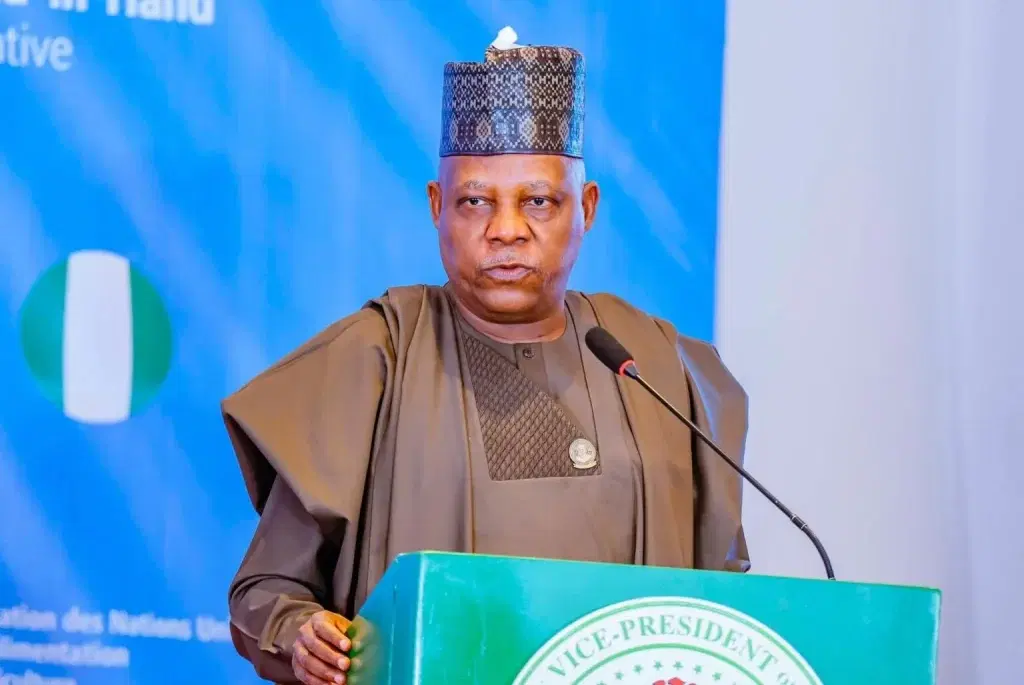
The post Intrigue as Shettima, Kwankwaso, Amaechi, Lamido emerge as potential VP appeared first on Vanguard News.
www.vanguardngr.com

Osun State chapter of the New Nigeria Peoples Party, NNPP, has announced that 50 per cent of its National and State Assembly tickets for the 2027 general elections will be allocated to women, as part of efforts to promote greater female participation in governance.
The declaration was made during the party’s primary elections held at its secretariat in Osogbo on Saturday, where candidates for National Assembly and State Assembly positions were unveiled and affirmed by delegates.
Speaking at the event, the Osun NNPP Chairman, Tosin Odeyemi, said women should be encouraged to play more prominent roles in public service, describing them as courageous, capable and strong enough to deliver when entrusted with leadership responsibilities.
Odeyemi stated that the party recognised the vital role women play in mobilising political support and contributing to national development, adding that this informed the decision to reserve half of its legislative tickets for female candidates.
“Osun NNPP is fully prepared for the general elections. Nigerians are tired of ‘promise and fail’ parties that have ruled in the past. We recognise the strength of our women,” he said.
He added, “That is why the party is giving them 50 per cent of our National Assembly and State Assembly tickets in the 2027 polls.”
The party chairman also said the NNPP was intensifying preparations for the August 15 governorship election in Osun State and promised greater inclusion of women in governance if the party emerged victorious.
“We are also working hard to further improve our chances in the 2026 governorship poll. If Osun voters support us to victory, women will serve in critical offices in our administration,” Odeyemi said.
He pledged support for women engaged in private enterprise, noting that they would receive attention from the government under an NNPP-led administration.
“Those in private businesses will also receive due attention from the government. We believe strongly in the capacity of our women,” he added.
Odeyemi urged the party’s candidates to conduct their campaigns responsibly, advising them to avoid personal attacks and focus on issues affecting the electorate.
He said aspirants should engage in issue-based campaigns and make only promises that they could fulfil if elected into office.
Speaking on behalf of the candidates, the NNPP candidate for Osun West Senatorial District, Folasayo Makinde, called on women across the state to participate actively in politics and pursue leadership positions with determination.
Makinde said women often played significant roles during election campaigns but were frequently overlooked after political victories had been secured.
“Men make use of us more during campaigns; they believe in our ability and capacity to gather votes for them, but when they get into power, they neglect us,” she said.
She commended the party leadership for creating opportunities for women to contest elective offices and expressed confidence in the ability of women to contribute meaningfully to governance.
She appealed to voters, particularly women in Osun West Senatorial District, to support her candidacy, assuring them that she would not disappoint if elected.
Representatives of the Independent National Electoral Commission, INEC, were present at the primary election, where the party’s candidates were formally affirmed as its flag bearers for the forthcoming polls.
dailypost.ng


Arsenal v PSG Ref Blasted For ‘Nonsense’ Decision During Champions League Final

Past three years have not been easy for us – NNPP

Steven Gerrard Slams Eberechi Eze After Champions League Final

Simi Sanya and Femi Dapson Are Now Legally Married and It Is Beautiful to See

FCT Area Council Election: Live results from polling units

Premier League Set-Piece Goals (2025/2026)
-
 Sports16 hours ago
Benjamin Mendy Now Lives Very Different Life
-
 Sports21 hours ago
‘I’m the Helicopter Pilot Who Saved Michael Schumacher
-
 Sports9 hours ago
Erling Haaland’s Post After Arsenal Lose Champions League Final Goes Viral
-
 Sports1 day ago
What Anthony Gordon Said in Spanish During Barcelona Unveiling
-
 Sports1 day ago
Where to Watch Toluca vs Tigres 2026 CONCACAF Champions Cup Final
-
 Metro15 hours ago
Police arrest two for attempted theft of two-week-old baby in Abia
-
 Sports22 hours ago
Rafael Jodar Speaks Out After Clip Goes Viral of Him ‘Shoving’ Ball Girl
-
 Entertainment2 days ago
Everything You Need to Know About Ojude Oba, Nigeria’s Biggest Cultural Fashion Celebration.