
Business
Nigeria‘ll witness monumental devt with correct tax system — Oyedele


By Emma Ujah, Abuja Bureau Chief
The Minister of Finance and Coordinating Minister of the Economy, Mr. Taiwo Oyedele, yesterday said that Nigeria will witness monumental development, if the nation gets her tax system right.
Read Also: Our worries on state police, by parties, other stakeholders
He spoke when he received a delegation of the Chartered Institute of Taxation of Nigeria (CITN) in his office in Abuja.
The minister commended the leadership of CITN for the initiative of a National Tax Awareness Day and for supporting the tax reform of the federal government.
He charged the institute to do more because according to him, “many Nigerians still believe that when the government speaks about tax it is just to take money from the people.”
Oyedele said that the government was not yet receiving enough tax revenue but that its focus was to expand the tax net, not increase the rate of taxes.
“We are still not getting enough revenue from tax, it is not about increasing tax, but making sure that those who are supposed to pay tax pay. We want to promote fairness in tax administration,” he stated.
In his remarks, President and Chairman of Council, CITN, Mr. Innocent Ohagwa, who led the delegation, said: “Over the past year, we have observed numerous misconceptions surrounding the reforms. Some people believe the reforms introduced entirely new taxes on every aspect of economic activity.
“Others have assumed that the reforms were designed solely to increase government revenue without considering the welfare of taxpayers.
“Some business owners have expressed concerns about compliance obligations without fully understanding the reliefs and protections available to them, leading to confusion and unnecessary anxiety, due to conflicting information from social media.”
The CITN president also said that tax compliance was not a burden but a civic duty and a collective contribution to nation-building.
“And taxation works best when there is trust – taxpayers must fulfill their obligations, while the government must uphold accountability, transparency and the effective use of public resources” he said.
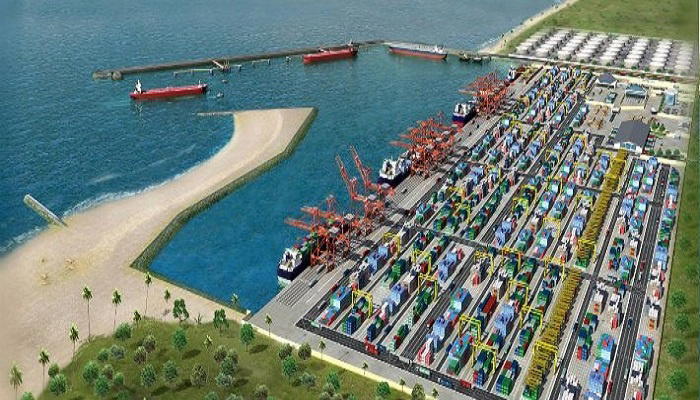
Lekki Deep Seaport.
By Providence Ayanfeoluwa
The Managing Director of Port and Terminal Multiservices Limited (PTML), Mr. Ascanio Russo, has unveiled plans to invest an additional $50 million in the terminal to strengthen port infrastructure, improve operational efficiency and support Nigeria’s ambition of becoming the leading maritime hub in West and Central Africa.
Russo disclosed the proposed investment during a visit to the Minister of Marine and Blue Economy, Dr. Adegboyega Oyetola, in Abuja.
According to a statement by the Minister’s Special Adviser, Dr. Bolaji Akinola, the investment by PTML, a member of the Grimaldi Group, will expand the terminal’s berthing capacity and provide additional state-of-the-art port equipment at the Tin Can Island Port Complex in Lagos.
Russo said: “The Grimaldi Group remains deeply committed to Nigeria and firmly believes in the country’s potential as the leading maritime and logistics gateway in West and Central Africa.
“This proposed investment of $50 million is designed to position PTML for the future by expanding our berthing capacity and deploying additional modern equipment that will significantly enhance operational efficiency, cargo handling capacity and service delivery.”
Responding, Oyetola welcomed the proposal, describing it as a strong vote of confidence in the Federal Government’s ongoing reforms in the maritime sector.
He reaffirmed the government’s commitment to creating an enabling environment for private investment and positioning Nigerian ports as the preferred hub for shipping, logistics and maritime services in West and Central Africa.

By Obas Esiedesa & Ediri Ejoh
Oil marketers across Nigeria have continued to sell Premium Motor Spirit (PMS), popularly known as petrol, at elevated prices despite a sharp decline in global crude oil prices to levels recorded before the outbreak of the US-Iran conflict.
Brent crude, the international benchmark against which Nigeria’s oil is priced, fell to about $72.48 per barrel on Thursday, down from nearly $120 per barrel at the height of the conflict, raising expectations of further reductions in petrol prices.
However, checks by Vanguard in Abuja showed that filling stations largely retained pump prices introduced during the period of soaring crude prices, leaving consumers burdened with high transportation and energy costs.
Before the conflict began on February 28, petrol sold for between N740 and N930 per litre in Lagos and Abuja. As crude oil prices surged amid fears of supply disruptions through the Strait of Hormuz, pump prices rose sharply, reaching as high as N1,403 per litre in parts of the Federal Capital Territory.
A survey of filling stations around Abuja’s Central Area on Thursday showed that the Nigerian National Petroleum Company Limited (NNPC Ltd.) sold petrol at N1,260 per litre, while TotalEnergies dispensed at N1,305 per litre. Conoil sold at N1,320 per litre, while AA Rano and AYM Shafa sold at N1,280 per litre. MRS outlets offered the lowest price among the stations surveyed at N1,240 per litre.
In Lagos, retailers also continued to maintain pump prices at elevated levels with petrol stations retaining old rates. Market survey showed that Peridot sold at N1,205 per litre with MRS dispensing at N1,205 per, Fatgbems at N1,206 per litre and Technoil at N1,200 per litre.
The development comes despite a recent reduction in ex-depot prices by Dangote Petroleum Refinery, which supplies a significant portion of the country’s petrol requirements.
Two weeks ago, the refinery cut its ex-gantry price by N75 per litre, or six per cent, reducing the price from N1,250 per litre to N1,175 per litre following a decline in crude oil prices to about $82.78 per barrel. However, the refinery has yet to announce another reduction despite crude prices falling by an additional $10 per barrel since then.
Industry analyst Henry Adigun of AHA Consultancy said that the sustained decline in crude oil prices should ordinarily translate into lower ex-depot and retail petrol prices, especially as supply concerns that drove the earlier increases have eased.
“It is not always straightforward with marketers who seek to maximise profits at every situation’’, Adigun stated.
Brent crude futures for August delivery fell by $1.06, or 1.44 per cent, to $72.68 per barrel on Thursday, while U.S. West Texas Intermediate crude declined by 76 cents, or 1.08 per cent, to $69.58 per barrel.
The latest decline reflects growing confidence among traders that oil shipments through the Strait of Hormuz will continue uninterrupted following the ceasefire agreement between the United States, Israel and Iran.
According to market reports, crude prices fell from $76.75 per barrel on Tuesday to $73.50 per barrel on Wednesday as concerns over disruptions to global oil supplies eased.
The decline has also been supported by expectations of increased Middle Eastern oil supplies and the prospect of higher Iranian exports following the easing of some U.S. sanctions.
Shipping activity through the Strait of Hormuz, through which about one-fifth of global oil supplies pass, has also improved following measures by Omani authorities and international maritime agencies to facilitate tanker movements.
Meanwhile, Dangote Petroleum Refinery yesterday announced a further reduction in the gantry price of Premium Motor Spirit (PMS), commonly known as petrol, from N1,175 to N1,125 per litre.
This latest adjustment reflects the refinery’s ongoing commitment to ensuring price stability, improving affordability, and supporting Nigeria’s energy security objectives. The price review underscores Dangote Refinery’s responsiveness to prevailing market conditions and its efforts to pass on cost efficiencies to downstream partners and consumers.
Dangote Refinery remains focused on its broader mission of contributing to economic growth, enhancing fuel availability, and fostering a more competitive and sustainable petroleum sector in Nigeria.

By Obas Esiedesa
The Federal Government has expressed confidence that Nigeria will achieve a perfect score in the 2026 validation of the global Extractive Industries Transparency Initiative (EITI), with the Executive Secretary of the Nigeria Extractive Industries Transparency Initiative (NEITI), Musa Sarkin Adar, declaring the country fully prepared for the exercise.
“We are ready for them. Nigerians are very resilient people and very brilliant people. We are not afraid of their coming, and I assure you this time around, we must get that 100 per cent, and we will get it,” Adar said during an engagement with civil society organisations and the media, organised by NEITI and Rule of Law and Anti-Corruption in Nigeria (RoLAC) in Abuja
He said the administration of President Bola Tinubu remained committed to implementing EITI standards and sustaining Nigeria’s membership of the global transparency initiative.
According to him, NEITI has intensified engagements with key institutions to address outstanding corrective actions, holding bilateral meetings with the Nigerian Midstream and Downstream Petroleum Regulatory Authority (NMDPRA), Nigerian National Petroleum Company Limited (NNPC Ltd), Nigerian Upstream Petroleum Regulatory Commission (NUPRC), Federal Inland Revenue Service, Petroleum Technology Development Fund (PTDF) and other agencies.
Adar added that NEITI had also met with the EITI International Secretariat and Nigeria’s validation team to review timelines and assess readiness, while urging civil society organisations and the media to actively participate because their contributions would form part of the assessment.
“If Nigeria loses this process, the investors, especially foreign investors in the oil and gas and mining sectors, may not wish to come and invest in Nigeria,” he warned, stressing that EITI compliance has become a critical benchmark for investors seeking transparency and accountability in resource-rich countries.
Also speaking, CSO representative on the NEITI board, Dr. Erisa Danladi, said the validation process “enables civic actors to take stock of collective achievements, identify existing gaps, and explore practical ways of strengthening transparency, accountability and good governance within Nigeria’s extractive sector.”


Ilobu killing: Family petitions IGP, seeks arrest of eight suspects

Michael Owen Names His England 11 v Panama

Port expansion: PTML plans fresh $50m investment

Simi Sanya and Femi Dapson Are Now Legally Married and It Is Beautiful to See

FCT Area Council Election: Live results from polling units

Premier League Set-Piece Goals (2025/2026)
-
 Sports1 day ago
Bastian Schweinsteiger Sparks Outrage With Comments Ahead of Germany v Ivory Coast
-
 Sports1 day ago
Why Austria and Algeria May Both Want to Lose Their Final Group Game
-
 Sports16 hours ago
Thomas Partey Could Be Blocked From Knockout Tie
-
 Sports1 day ago
Steve Clarke Slammed For Interview After Scotland 0-3 Brazil
-
 Sports9 hours ago
Rory McIlroy Risks Breaking PGA Tour Rule That Led to One-Year Ban
-
 Sports2 days ago
Jude Bellingham Avoids Red Card For Banned Gesture vs Ghana
-
 Sports2 days ago
What Scotland Need To Qualify For World Cup Knockout Stage
-
 Sports2 days ago
World Cup Nation Submit Complaint to FIFA After Controversy in England vs Ghana