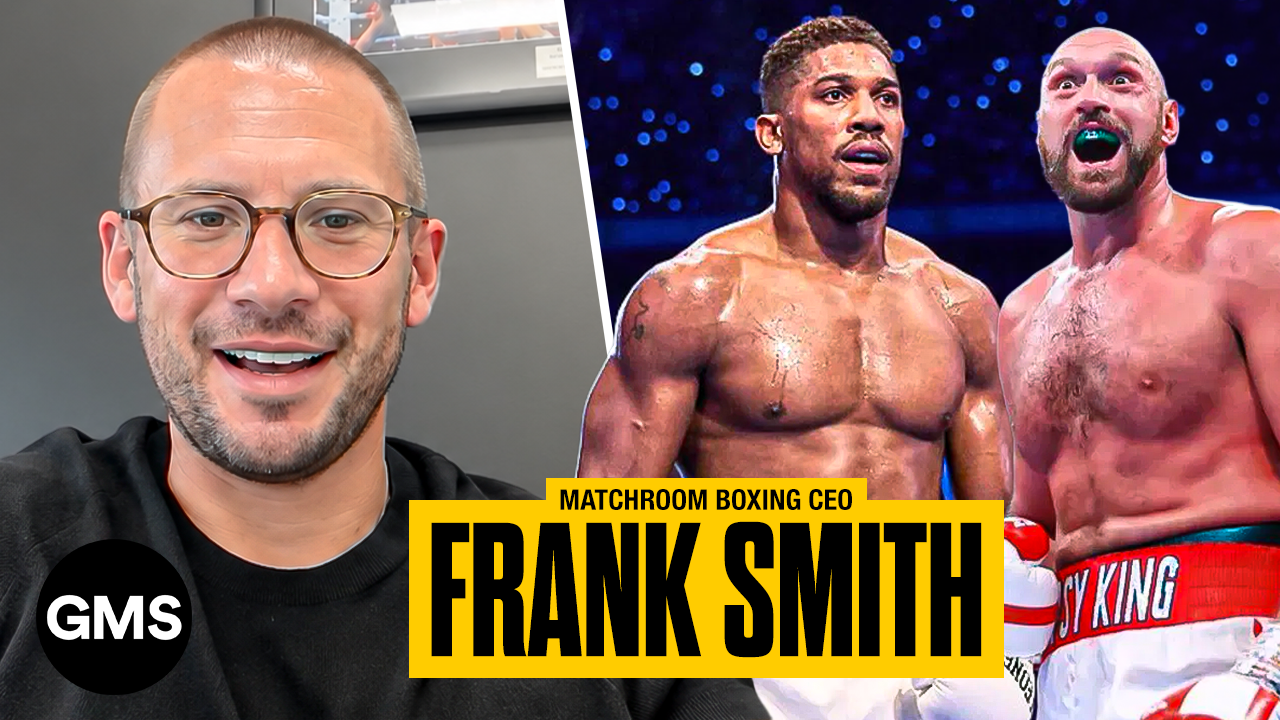
Matchroom Boxing CEO Frank Smith delivers the latest on Anthony Joshua vs Tyson Fury, revealing where negotiations stand and why the blockbuster fight still hasn’t been officially finalized.
Smith discusses the ongoing debate over whether AJ vs Fury will take place in the UK or United States, reacts to Netflix promoting the fight before the final details are complete, and gives his view on a potential Chris Eubank Jr vs Kell Brook clash.
He also looks ahead to Katie Taylor’s historic Croke Park fight, explains why he believes it could be the final bout of her legendary career, and reflects on Matchroom Boxing’s position in the sport and his own journey with the company.
Liverpool have submitted a bid in the region of £60 million to sign Brighton winger Yankuba Minteh, with David Ornstein providing the details.
The Merseyside club are in the market to sign a new winger in the summer transfer window, as they aim to find a replacement for Mohamed Salah on the right-hand side of attack.
The Merseyside club have already secured the signature of Victor Munoz from Osasuna, but they appear to be ready to sign another.
It’s been a relatively slow few months in the market for the Reds, but things are starting to heat up as they search for a new winger.
Bradley Barcola and Ibrahim Mbaye are two others being linked with a move to Anfield, but Liverpool are also assessing alternative options.
Ornstein has confirmed that Liverpool have now made a second offer for Minteh, which has also been rejected by Brighton.
Liverpool originally made a £50 million bid before upping it to £60 million, but the Seagulls are still standing firm.
Ornstein claims that Brighton are demanding a fee of around £70 million to offload the 22-year-old.
Tottenham Hotspur are set to table a bid to sign Liverpool forward Cody Gakpo as they close in on a double deal to sign Savinho and Omar Marmoush from Manchester City.
Tottenham have shown huge ambition during the summer transfer window, having already broken their transfer record twice to bring in Mateus Fernandes and Sandro Tonali, but more big business is expected in the final 10 days of the window.
Spurs have already reached an agreement with City worth £85m in total for Savinho, who the north London outfit have wanted to sign for more than 12 months.
Club chiefs are also in talks with the eight-time Premier League champions over the Brazilian’s attacking teammate Marmoush, as they look to bring in a new centre-forward ahead of September 1, to make a serious assault on the Premier League this term.
According to Italian journalist Alfredo on X, not only are Tottenham on the verge of reaching an agreement to sign the Egypt international, but they are also set to launch an offer to prise Gakpo away from Liverpool.
It is no secret that De Zerbi wants all three players in the door at the Tottenham Hotspur Stadium, although progress with Gakpo could be slower as the Reds work on signing two attacking players for Andoni Iraola in the closing days of the window.
Gakpo is understood to be keen on a move to Tottenham, although an attractive salary offer will need to be on the table given the Dutchman is reported to earn £250,000-a-week at Anfield.
Gakpo Signing Could End Star’s Tottenham Career
Annegret Hilse via Reuters
Richarlison is one Tottenham forward expected to leave if Spurs end up landing all three of Savinho, Gakpo and Marmoush, but there is another player whose future could be in doubt too.
Tottenham Forward Options After Triple Signing
Savinho
Cody Gakpo
Omar Marmoush
Richarlison
Dominic Solanke
Mathys Tel
Mohammed Kudus
Wilson Odobert
Dejan Kulusevski
Xavi Simons
Xavi Simons, Dejan Kulusevski and Wilson Odobert may still be long-term absentees for Spurs, but when they make their returns De Zerbi is going to have a lot of attacking options to choose from, for three positions.
You would expect Savinho, Gakpo and Marmoush to start more often than not if available, with the likes of Solanke, Kudus and Simons providing immediate back-up.
That pecking order would raise doubts over the future of Mathys Tel, who already found first-team starts hard to come by under De Zerbi at the end of last season, when more attacking options were fit.
De Zerbi highlighted his youth as a potential reason why he wasn’t starting in Tottenham’s relegation battle.
He has a great attitude, he has great qualities, he’s very young. Kolo Muani, he has much experience, but we’ll see in the next game. Maybe he can start in the first eleven, but I don’t like to change too many players, one game, one game.
The Frenchman has so far failed to make a consistent impact in a Tottenham shirt, and you do have to wonder how much action he will see in the opening weeks of the season, especially if these three targets join.
Tel needs to perform to a high level when he does get his chance, otherwise it’s hard to see how he has a long-term future at the club.
And Coventry’s badge, which has been reimagined through several different iterations, reflects the trials and tribulations of the club over the past three centuries. But what does the badge’s distinct iconography reveal about the history of the Sky Blues?
Meaning of Coventry City Badge
Action Images / Michael Regan
Central to the badge’s current design are three animals that represent Coventry’s links to symbolic mythology.
Elephant and Castle (on the ball)
Derived from Coventry’s Civic Coat of Arms, the elephant symbolises immense strength and resilience. Carrying a castle on its back, this structure represents the formidable medieval Coventry. Legend suggests that St George, famed for his dragon slaying, was also mythologically tied to the city. In medieval times, the elephant was the nemesis of the dragon.
On the Coventry City badge, the elephant balances precariously on a football, reimagining the emblem to tie in with the city’s sporting heritage.
Eagle of Leofric
Located on the left side of the shield, the eagle represents Leofric, Earl of Mercia. During the 11th century, Leofric ruled the region, with his wife, Lady Godiva, at his side. She remains one of Coventry’s most celebrated historical figures.
Phoenix
Located on the right side of the shield, the phoenix represents Coventry’s knack for rising from the ashes. Added to the civic arms in 1959, it then represented the incredible rebuild of the city following its decimation during the Blitz in World War II.
Coventry City Badge History
Action Images/Ed Sykes
Since the club’s inception in the late 19th century, the badge’s changing identity has reflected Coventry’s evolution over the years and decades.
Initially founded as Singers FC in 1883 by workers at the Singer bicycle factory, the club’s crest was a far cry from the elephant and ball of modern versions. The badge instead reflected the industrial ties to the factory.
Moving into the mid-20th century, and before Coventry adopted the Sky Blues moniker, they were known as the Bantams — a nickname notably used by Bradford City, reflecting the bird on that club’s badge (a bantam is a small chicken). During the interwar and postwar periods, the club simply embraced the traditional civic arms as their badge.
The era of iconic manager Jimmy Hill in the 1960s led to the Sky Blue revolution and two promotions. The change to the sky blue colour scheme also coincided with the decision to include the elephant and ball in match day programmes. Following the elephant’s introduction, the resilient creature eventually forced its way onto the club’s badge, appearing on the team shirts in the 1970s.
The badge remained largely unchanged until the club’s move from Highfield Stadium to the CBS Arena in 2005. The club’s decision to rebrand in preparation for the move resulted in the unveiling of a stripped-back badge design that drew widespread criticism from the supporters. A poll by the Coventry Telegraph at the time showed that 98 per cent of the votes cast were against the new badge. Thankfully for those fans, Coventry’s board listened and abandoned the new design, reverting to the classic badge that the club is well known for.