
Sports
15 Players with the Most Red Cards in Football History [Ranked]

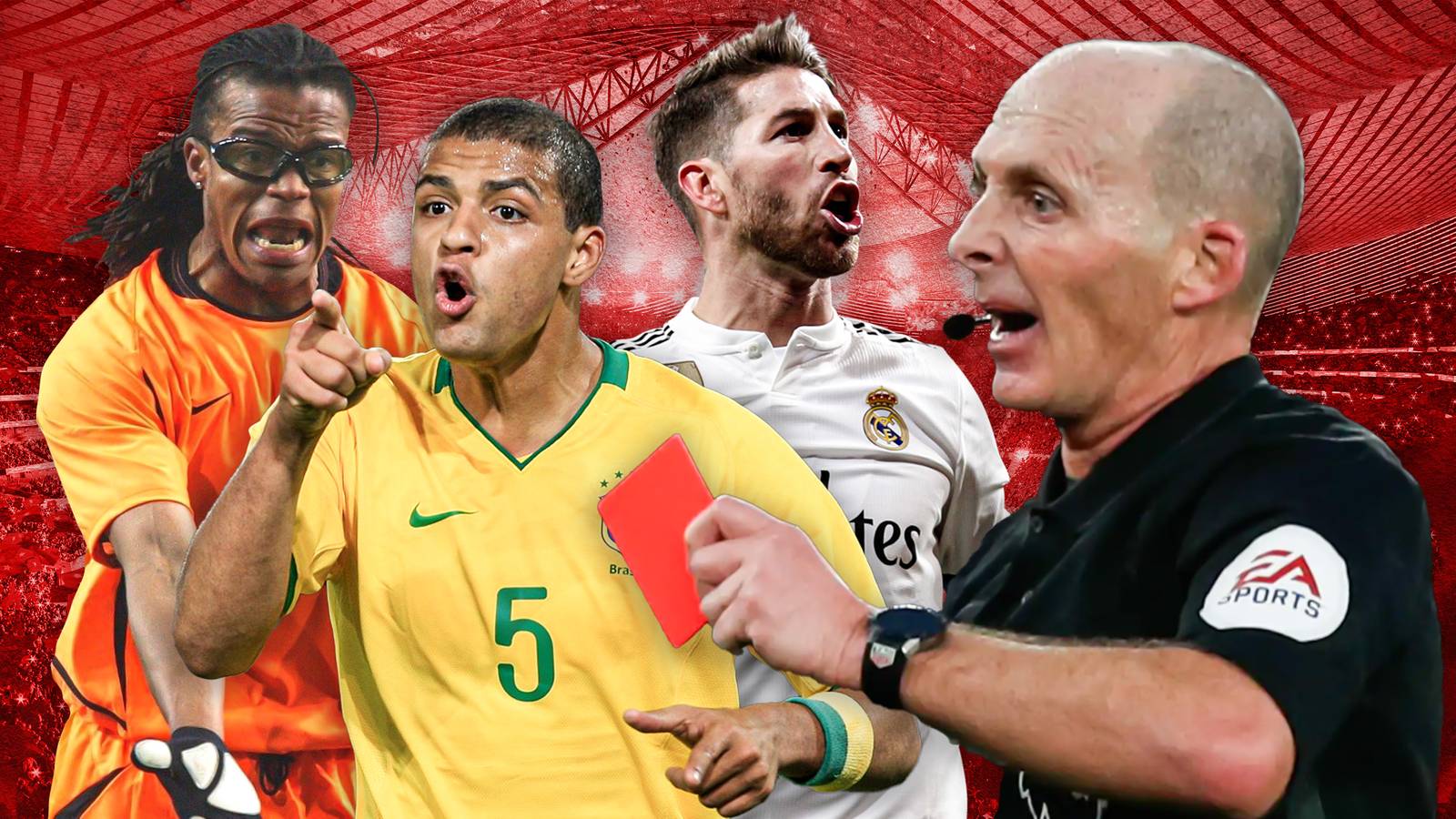
Football remains a physical and passionate game, but if players overstep the mark, then referees will send them off. Some players know this all too well. Sergio Ramos won everything there is to win in the game. He was also sent off an awful lot of times during his career. Ramos would certainly rank as one of the dirtiest players in football history.
When it comes to the players who have had the most red cards, some players may be more familiar than others. Yet all have one thing in common: they’ve seen red far too often. Legendary forward Cristiano Ronaldo edged a step closer to joining this notorious list after receiving the 13th red card of his illustrious career while playing for Portugal against the Republic of Ireland in November 2025, but the five-time Ballon d’Or winner still has some catching up to do before he cracks the top 15.

9 Dirtiest Teams in Football History (Ranked)
Including Real Madrid and Arsenal, football’s dirtiest teams have been ranked.
15
Deividas Semberas
17 red cards

Lithuanian centre-back Deividas Semberas spent 14 years playing in Moscow for CSKA and Dynamo. It was at CSKA where he got 9 of his 17 red cards. Seven of those were for two yellows. In fact, out of his 17 red cards, five were straights reds. All the others were for a second offence.
He won the Russian title three times with CSKA, along with the UEFA Cup, which they won in 2005. In more than 600 career appearances for both club and country, Semberas scored 12 times, meaning he got more dismissals than goals in his 19-year career.
14
Yannick Cahuzac
19 red cards

Yannick Cahuzac made more than 300 appearances for Bastia, but received 19 red cards in his career. During the 2016/17 season he managed to get sent off three times in Ligue One. As Bastia captain, the club may have expected more of him. His first red card came in only his third professional game.
Playing against Dijon, he was given his second yellow with half an hour to go, meaning the 20-year-old had to leave the field. Yet he was still a popular figure in French football, particularly with Bastia, who he gave such committed performances for during 12 years.
13
Gary Medel
19 red cards

Barrel-chested Chilean utility player Gary Medel was no stranger to an early bath. He got five red cards alone while playing for his country. Perhaps his most high-profile sending-off came in 2019 against Argentina in the Copa America third-placed play-off.
Before half time he was involved in a confrontation, which saw him and Lionel Messi getting straight red cards – leading the Argentine to get a three-month ban from international football. Medel had the distinction of getting sent off while playing in the Turkish, Italian and Spanish leagues.
He, of course, was also part of the successful Chile side that won back to Copa America tournaments in 2015 and 2016.
12
Fernando Amorebieta
20 red cards

Venezuelan centre-back Fernando Amorebieta played in Spain, England and Argentina, collecting red cards on the way. He took a lead out of Luis Suarez’s book when he bit an opponent while playing in Paraguay in 2019.
He was at it again in the Copa America, when he was given an early bath for stamping on a Peru player. The defender played 48 times for Fulham between 2013 and 2016, only managing two red cards.
One of those red cards came during a 5-0 drubbing to Manchester City. At the time of his red card, the second half was eight minutes in and Fulham were losing 1-0. It’s unlikely Amorebieta was popular with his teammates afterwards.
11
Matteo Contini
21 red cards

Matteo Contini was a very well-traveled Italian defender, who played in Italy and Spain. He is better known for playing for Parma and Napoli in the 2000s. One of his most high-profile red cards came for violent conduct against Real Madrid, when he elbowed Gonzalo Higuain.
Despite all the suspensions, he still managed to make well over 500 club appearances. In retirement, Contini has gone into management in Serie C in Italy. It will be interesting to see what his attitude is to discipline, especially when it comes to players making rash decisions and missing games as a result.

9 Dirtiest Teams in Premier League History (Ranked)
Football, for all of its upside, has its fair share of moments of ill discipline. So, who are the dirtiest Premier League teams of all time?
10
Gerardo Torrado
22 red cards

Mexican midfielder Gerardo Torrado has the distinction of playing at three World Cup finals between 2002 and 2010. As well as playing for Sevilla early in his career, the midfielder made 388 appearances for Mexican side Cruz Azul.
He had a long international career too, winning 146 caps over the course of 14 years. He played in an eventful Copa America 2001, where Mexico beat Uruguay 2-1 in the semi-final, but lost the final 1-0 to Colombia. Already down to 10 men in that game, Torrado received his second yellow card in injury time to reduce Mexico to nine players.
9
Alexis Ruano Delgado
22 red cards

Alexis Ruano Delgado was a centre-back who played for clubs that included Getafe and Valencia. For the latter he won the Copa del Rey, having not been in the squad for any of the previous rounds, he played alongside David Villa, David Silva and Juan Mata in the final.
Valencia beat Getafe in that final 3-1, with Alexis heading in Valencia’s second goal. Although a tough tackling player, who was rash at times, he suffered at times on the pitch.
While playing for Getafe against Barcelona he collided with an opponent and burst a vein in his testicle. This alarmed his then coach Luis Garcia: “One of Alexis’s testicles was like this” he said, holding up his hands to show a handball-sized ball.
8
Cyril Rool
22 red cards

Cyril Rool was a French journeyman midfielder who played in the nineties and noughties, making over 350 appearances in Ligue One. He may have played a great deal more had he not received so many red cards. In total, he got his marching orders 27 times.
Fairly versatile, Rool could also play full-back. Committed to the cause, he played more than 100 appearances for Bastia, Lens and Nice. He had good Champions League experience and played in the Lens team that beat Arsenal 1-0 at Wembley in 1998. He was on the receiving end that night, as Ray Parlour was sent off for kicking out at Rool’s head.
7
Rafael Marquez
22 red cards

Rafael Marquez is rated as Mexico’s greatest-ever defender. He played for a great Barcelona side alongside a young Lionel Messi, who he clashed with on one occasion.
There is no doubt the Mexican had a fiery side. He was sent off in the 2002 World Cup for a headbutt on the USA’s Cobi Jones.
Talking 16 years after the event, Marquez showed no remorse for his actions: “My act of frustration would’ve never changed the score if it hadn’t have happened and I don’t regret it. I learned from it. Not controlling [myself] and not being able to lose is part of my character.”

10 Players with the Most Fouls in Premier League History
The 10 players who have committed the most fouls in Premier League history.
6
Paolo Montero
23 red cards

Paolo Montero was part of a very successful Juventus team of the 1990s. One of the great midfielders of that era, Edgar Davids, said it was Montero who got the best out of him.
He made 278 appearances for Juventus when the Italian giants were competing year on year for the national and European title. The Uruguayan played in three Champions League finals, yet sadly for him, he lost all of them, to Borussia Dortmund, Real Madrid and AC Milan.
During his 13 years playing in Italy for Atalanta and Juventus, he received 16 red cards in Serie A, a record that is unmatched in the division.

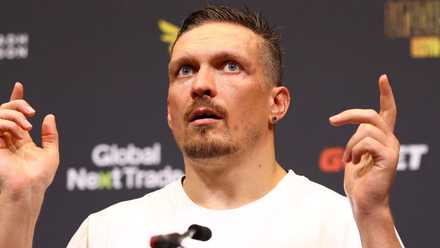
Oleksandr Usyk’s next, and possibly final, opponent has been leaked by Eddie Hearn.
With the Ukrainian now 39 years old, he is approaching the end of his career, and while he has made it clear that he is not yet retiring, his next showdown will be one of his last acts on the boxing main stage.
Usyk has an undefeated professional record of 25 wins and until recently held the WBA ‘super’, WBC, and IBF belts, but on the 26th of June, he announced he would vacate his belts.
“This is a well-considered decision that I am confident will open new opportunities for me. This is not the end of the story. The continuation lies ahead,” he said on X.
In a video message, he added: “I want to vacate all the belts that I currently hold to make them available for the guys next in line to fight for them.
“Friends, I’m leaving the belts but not the sport because I still have my last dance.”
Oleksandr Usyk’s Final Boxing Opponent ‘Revealed’

So who will his last dance come against? While it is unclear whether his next fight will indeed be his last, Eddie Hearn did reveal his next opponent.
Speaking on DAZN, the English promoter stated that Usyk’s next fight will be with Deontay Wilder.
“As I understand it, Usyk will fight Wilder next. He wants to do what he wants to do, I guess, and have one more in the sun, and now the contenders are going to get their shots.”
Usyk’s desire to defeat all the major heavyweights of his era led him to choose the American for his next bout. Usyk has already defeated Tyson Fury, Anthony Joshua, and Daniel Dubois, and will be keen to add Wilder to his conquered list.
The ‘Real Reason’ Oleksandr Usyk Vacated His World Heavyweight Titles Revealed
Usyk no longer holds any gold…
The pair were linked with a fight against each other at the start of the year, but the cards failed to fall into place and the American instead set up a bout with Derek Chisora.
The Bronze Bomber had been scrutinsied following back-to-back defeats versus Joseph Parker and Zhilei Zhang, with many speculating his future in boxing was well into its twilight years. However, a comfortable win against Chisora, in conjunction with a record of 43 knockouts, has proven that he still has what it takes to win at the elite level.

Usyk’s most recent fight came against Rico Verhoeven. It was a tough match for the Ukrainian, who was tested all the way, but he eventually came out victorious late on in the 11th round.
With Usyk and Wilder 39 and 40 respectively, their showdown may act as the grand finale for what has been two legendary careers. When the curtain does fall, they will be remembered as two greats of the game. But for now, the show goes on and a clash between Usyk and Wilder is sure to be an entertaining one.

Bastian Schweinsteiger has been forced to defend himself after comments he made about the Ivory Coast ahead of their World Cup clash with Germany were branded racist by their head coach.
The former Germany, Bayern Munich and Manchester United midfielder described Ivory Coast’s style as unpredictable and unorthodox while working as a pundit, remarks that brought a wave of criticism in the days that followed.
Ivory Coast boss Emerse Fae pulled no punches when addressing the comments, leading Schweinsteiger to release a statement explaining what he had actually meant by the analysis.
Fae Brands Comments Racist as Ivory Coast make History

Fae was quick to give his view on the matter, hitting back after guiding Ivory Coast into the knockout rounds for the first time in their history following a 2-0 win over Curacao.
“We could call it racist, if we were calling a spade a spade.”
Though he added he hoped it was simply a “clumsy statement that’s not necessarily reflective of what’s in his life.”
The issue also drew in Jurgen Klopp, who appeared uncomfortable when pressed on the subject during a broadcast appearance, eventually cutting the interview short.

Schweinsteiger had described Ivory Coast’s approach as “a bit African football, a bit unorthodox, a bit wild, a bit perhaps also not so conditioned by tactics” while appearing on German broadcaster ARD.
World Cup Nation Claim the US ‘Don’t Want to See Our Supporters’ as Visas Denied
The 2026 World Cup has already been pure chaos, and the travel plans of one nation’s supporters torn apart.
The comments quickly drew backlash, with some suggesting he leaned into outdated racial stereotypes. Responding through a statement released by the same broadcaster, Schweinsteiger said:
“I was talking about football, not about people. It’s a football analysis. Nothing more and nothing less. … I certainly didn’t mean to offend anyone.”
10 Greatest Ivory Coast Players in Football History [Ranked]
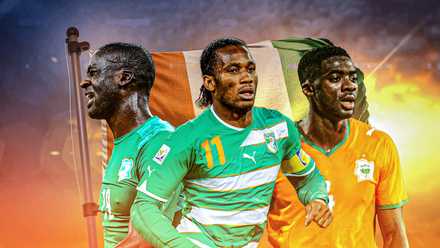
Including the likes of Didier Drogba and Yaya Toure, the best Ivorian players of all time have been ranked.
Axel Balkausky, ARD’s sports coordinator, defended Schweinsteiger’s stance in a very similar manner. “He summarized his experiences and observations from recent games. It wasn’t about individual people but rather a footballing assessment. I can’t detect any form of racism in that or in his choice of words. If the coach of Ivory Coast, Emerse Fae, were to speak directly with Bastian, his suspicions would be quickly revised, I am sure of that. Perhaps an opportunity of that sort will arise in the course of the tournament.”
You scored
out of 20

While there will always be intense debate over where they all rank, Lionel Messi, Pele and Diego Maradona will forever be in the pantheon of all-time football greats.
Pele was football’s first global superstar, his name synonymous with the beautiful game. Winner of the World Cup in 1958 at the age of 17, the Brazilian went on to lift football’s most iconic trophy twice more, first in 1962 and then again in 1970.
And then came Diego Maradona, the first player to seriously threaten Pele’s status as the greatest footballer in history.
The diminutive playmaker inspired Argentina to World Cup glory at the 1986 finals in Mexico, hitting a level of individual brilliance that had never been seen before.
It seemed incomprehensible that we’d see another player as good as Maradona, but the otherworldly Messi burst onto the scene in 2005 and the rest is history.
If Messi wins a second successful World Cup with Argentina in the United States this summer, he will cement his status as football’s GOAT (greatest of all time), in the eyes of many football fans and pundits alike.
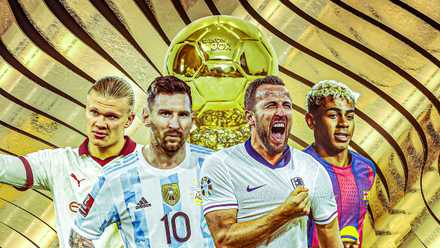
Ballon d’Or 2026 Power Rankings
Tracking the leading contenders to win the prestigious Ballon d’Or award in 2026.
For others, that happened as soon as he won the 2022 World Cup in Qatar, producing a series of performances that rivalled Maradona’s 36 years earlier.
Sadly, Maradona wasn’t around to witness Messi’s crowning moment. He died two years earlier, aged just 60.
Pele, on the other hand, did witness Messi lifting the World Cup, but passed away himself less than two weeks later aged 82.
Pele and Maradona’s Private Chat About Messi in 2016

Years earlier, in June 2016, Maradona and Pele were caught by microphones having a private chat about Messi – and their comments now look very interesting.
Messi was going through a challenging period with Argentina at the time, faced with accusations that he cared more about playing for Barcelona than his national team.
These unfair accusations, combined with a series of near misses at major tournaments, even led to Messi announcing his retirement from international football after the 2016 Copa America.
Several weeks earlier, Maradona and Pele had their private chat. Pele, wanting to learn more about Messi’s personality, asked: “Diego, do you know Messi personally?”
Maradona, who coached Messi at the 2010 World Cup, replied: “Yes, yes, but…”
⚽
World Cup History Quiz
You scored
out of 20
Pele interjected: “Is he a good person? I don’t know him, I know him from…”
Maradona then said: “He is a good person, but he has no personality. He doesn’t have much personality, like how to be a leader.”
Pele responded: “Ah, I understand. Like there were many [players like this] in our time.”
Maradona added: “Exactly, many players, many…”
Pele then said: “In 1970, there was Rivelino. I was speaking about Messi, the Argentina of Messi. He said that Messi is a great player, there is no doubt, but he has no personality.” Watch the clip below:
While Messi has let his gifted feet do most of the talking during his illustrious career, there’s no doubt that his leadership qualities have massively improved since Maradona and Pele’s conversation.
Every player in Argentina’s most-recent squads would run through a brick wall for the eight-time Ballon d’Or winner, who has helped to cultivate an extraordinary team spirit with the help of manager Lionel Scaloni.
Messi, who reversed his decision to retire from international duty after a mass public appeal in August 2016, might be a very different character to Pele and Maradona – but he’s demonstrated over the past 10 years that he also has plenty of personality.

Oleksandr Usyk’s Last-Ever Boxing Match Will Be Against Deontay Wilder, Says Eddie Hearn
Bastian Schweinsteiger Reacts After He’s Accused of Making Racist Comments

Gas explosion razes three shops, vehicles in Jigawa

Simi Sanya and Femi Dapson Are Now Legally Married and It Is Beautiful to See

FCT Area Council Election: Live results from polling units

Premier League Set-Piece Goals (2025/2026)
-
 Sports2 days ago
FIFA Allow Rainbow Flags at World Cup ‘Pride Match’ Featuring Iran vs Egypt
-
 Sports2 days ago
Raphinha’s Wife Debunks ‘Financial Problems’ Claim From World Cup Winner
-
 Sports16 hours ago
Cody Gakpo’s Son Passes Away During Pregnancy, Girlfriend Confirms
-
 Sports2 days ago
Uruguay Players ‘Revolt Against Marcelo Bielsa’ Ahead of Spain Game
-
 Sports23 hours ago
Footage Shows True Crowd Reaction to Iran’s National Anthem vs Egypt
-
 Sports2 days ago
Zlatan Ibrahimovic’s 2026 World Cup Power Rankings
-
 Sports22 hours ago
Turkey Become ‘Unofficial World Champions’ With Win Over USA at the World Cup
-
 Sports21 hours ago
US Reporter Slammed For ‘Pathetic’ Comments About Bosnia Ahead of World Cup Game