
Business
Dangote Refinery lowers petrol price by N75/l as oil falls by 5%



By Obas Esiedesa, Abuja
Dangote Petroleum Refinery has reduced the ex-depot price of Premium Motor Spirit (PMS), popularly known as petrol, by six per cent, or N75 per litre, following a sharp decline in global crude oil prices triggered by easing tensions in the Middle East.
The refinery said in a circular to marketers that the new ex-gantry price has been reduced from N1,250 per litre to N1,175 per litre, effective from midnight on June 16, 2026.
The latest adjustment came as Brent crude, the international benchmark for oil prices, fell by five per cent to $78.87 per barrel yesterday from $82.72 per barrel on Monday, following an agreement between the United States and Iran, and the reopening of the Strait of Hormuz.
Explaining the reason for the price cut, Dangote Refinery said the reduction followed the de-escalation of geopolitical tensions that had pushed up energy prices over the past three months.
“Following the de-escalation of tensions in the Middle East, which has impacted energy prices, we wish to inform you that we have reviewed our premium motor spirit gantry/coastal price,” the refinery stated.
According to the revised pricing template, the coastal price was also reduced by 6.3 per cent to N1.495 million per metric tonne from N1.596 million per metric tonne.
The company further directed that all outstanding unloaded gantry volumes would be repriced at the new rate.
“Kindly note that all outstanding unloaded gantry volumes will be repriced at the new rate effective 12:00 AM, June 16, 2026,” the circular noted.
Dangote Refinery expressed appreciation to its customers for their continued patronage and reaffirmed its commitment to ensuring steady product supply across the country.
“We sincerely appreciate your continued patronage and assure you of our unwavering commitment to reliable product supply and excellent service delivery,” it added.
The post Dangote Refinery lowers petrol price by N75/l as oil falls by 5% appeared first on Vanguard News.
•Flags risks to monetary policy, financial integrity
•As Nigeria ranks 2nd globally, with $59bn crypto inflows
By Emma Ujah & Elizabeth Adegbesan
The International Monetary Fund (IMF) has disclosed that Nigeria accounts for about 60 percent of stablecoin inflows into Sub-Saharan Africa,SSA, while warning that the growing use of dollar-backed digital assets could pose risks to monetary policy and financial stability.
In its latest report, the IMF stated: “Within sub-Saharan Africa, Nigeria accounts for roughly 60 percent of stablecoin inflows since 2019. Stablecoins now form a key bridge between crypto markets and the traditional financial system.”
The Fund added: “The scale is striking, even though measure-ment remains imperfect. Nigeria received about $59 billion in crypto-asset inflows between July 2023 and June 2024.”
According to the IMF, “what began as a niche technology has become a meaningful cross-border payments channel,” with Nigerian households and small businesses increasingly using stablecoins for international transactions and payments to overseas suppliers.
The report noted that adoption accelerated during 2023 and 2024 amid macroeconomic pressures.
“Stablecoins emerged as a hedge against currency risk and a convenient means of paying overseas suppliers,” the Fund said.
It explained that “the sharp depreciation of the naira, high inflation, and constrained access to foreign exchange” contributed to rising demand for dollar-linked digital assets.
The IMF also noted that after the Central Bank of Nigeria (CBN) restricted banks from servicing cryptocurrency exchanges in February 2021, “activity shifted to less regulated channels, notably peer-to-peer platforms.”
While acknowledging the benefits of stablecoins, the Fund warned of potential consequences for the economy.
“As stablecoins are typically denominated in U.S. dollars, widespread use can resemble a digital form of dollarization,” it stated. “By reducing demand for the local currency, it could weaken the transmission of domestic monetary policy.”
The IMF further cautioned that, “transactions traditionally routed through banks are increasingly taking place through digital wallets and crypto exchanges,” adding that “existing monitoring systems designed for conventional financial intermediaries may not adequately capture such transactions.”
According to the report, “the speed and relative anonymity of some platforms heighten the risks of money laundering and other illicit financial activities.”
However, the IMF advised against outright suppression of stablecoins, saying such measures would likely have limited success.
“The most effective defence against digital dollarization is a stable and credible domestic currency,” the Fund stated. “Nigeria’s recent macroeconomic reforms and tighter monetary policy have helped restore confidence in the naira. Sustaining this progress will be critical.”
It also urged stronger oversight, improved monitoring systems and upgraded payment infrastructure, stressing that “these risks are not unique to Nigeria, but the scale of adoption makes them more pronounced.”
The post IMF warns as Nigeria captures 60% of SSA stablecoin inflows appeared first on Vanguard News.

•128,930 smallholder farmers in 25 states, FCT to benefit
By Gabriel Ewepu
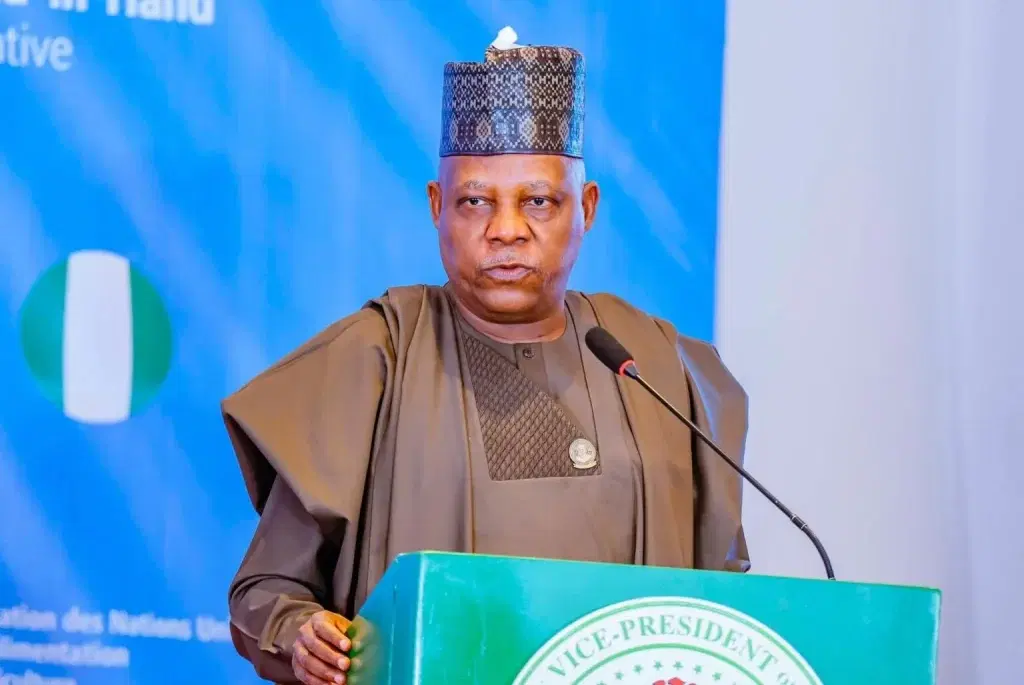
ABUJA — Vice President Kashim Shettima yesterday flagged off the nationwide distribution of 515,720 bags of fertiliser under the National Agricultural Development Fund’s (NADF) Renewed Hope Farm Input Support Programme (FISP).
Represented by the Minister of State for Agriculture and Food Security, Dr Aliyu Abdullahi, at the launch in Abuja, Shettima described the intervention as a major step towards boosting agricultural productivity, strengthening food security and improving farmers’ livelihoods in line with President Bola Tinubu’s Renewed Hope Agenda.
The fertilisers, comprising urea and NPK, will be distributed to 128,930 smallholder farmers across 25 states and the Federal Capital Territory (FCT).
He said: “The provision of 515,720 bags of urea and NPK fertilisers to 128,930 smallholder farmers underscores this administration’s resolve to uplift our farmers and enhance agricultural productivity.”
Shettima disclosed that 11,210 bags of fertiliser would be distributed to 2,930 registered farmers in the FCT.
According to him, “The Farm Input Support Programme focuses on smallholder farmers cultivating less than 0.5 hectares of land, who remain the backbone of Nigeria’s food system.”
He stressed the need for transparency and accountability in the distribution process, saying stakeholders must ensure the inputs reach the intended beneficiaries, particularly women, youths and vulnerable farmers.
Meanwhile, the Executive Secretary and Chief Executive Officer of NADF, Mohammed Ibrahim, said the intervention was coming at a critical stage of the farming season.
He stated: “The programme is being implemented at a critical period to reduce production costs for smallholder farmers, increase yields and strengthen national food supply.”
Describing FISP as a strategic intervention, Ibrahim said: “It is designed to deliver the right inputs to the right farmers at the right time to support food production.”
He added: “All fertilisers distributed under the scheme are locally produced, traceable and clearly marked ‘Not for Sale’ to ensure accountability.”
On the importance of the initiative, Ibrahim said: “Food security is not a side issue. It is a national priority. It is central to economic stability, rural prosperity, job creation and the well-being of Nigerian households.”
Also speaking, Chairman of the House of Representatives Committee on Agricultural Production and Services, Hon. Bello Kaoje, described the programme as a direct anti-hunger measure that would boost food production, stabilise food prices and support inclusive economic growth.
The post Shettima flags off NADF’s 515,720-bag fertiliser intervention appeared first on Vanguard News.


By Yinka Kolawole
The Manufacturers Association of Nigeria (MAN) has faulted the proposed implementation of the National Environmental (Plastic Waste Control) Regulations 2026 by the National Environmental Standards and Regulations Enforcement Agency (NESREA), warning that the measures could have far-reaching consequences for the country’s manufacturing sector and economy.
Under the proposed regulations, NESREA plans to prohibit the production and use of single-use plastic products below 80 microns in thickness, impose taxes on shopping bags with wall thicknesses between 30 and 50 microns, and restrict several other plastic products listed in the Eleventh Schedule.
The association called on the Federal Government to suspend implementation of the proposed regulations pending a comprehensive Regulatory Impact Assessment. It maintained that plastic pollution should be addressed primarily through improved waste collection, sorting, recycling, and disposal systems, while ensuring a balance between environmental sustainability and economic development.
In a statement, Director General of MAN, Segun Ajayi-Kadir, said the proposed measures could disrupt industrial production, undermine investments across the plastics value chain, threaten thousands of direct and indirect jobs, and increase costs for both manufacturers and consumers.
While acknowledging the need to tackle environmental pollution and promote sustainable waste management, Ajayi-Kadir argued that the proposed regulations are premature and lack sufficient empirical justification. According to him, the measures could pose significant risks to industrial growth, employment, and the livelihoods of millions of Nigerians.
He noted that the Federal Government, through the National Plastic Action Partnership (NNPAP), had already developed a Plastic Circularity Roadmap in 2024 in collaboration with the Federal Ministry of Environment.
“The roadmap outlined strategies for reducing plastic waste through improved collection systems, recycling infrastructure, Extended Producer Responsibility (EPR), circular economy initiatives, public awareness campaigns, and investments in waste management. However, many of the roadmap’s key recommendations have yet to be fully implemented.
“There is no evidence demonstrating the effectiveness of previous restrictions on plastic products in reducing environmental pollution, improving recycling rates, or changing consumer behaviour. Public policy should be based on measurable outcomes, evidence, and stakeholder engagement,” he stated.
The post Proposed plastic ban could trigger deindustrialisation, job losses— MAN appeared first on Vanguard News.


Election Violence: Osun community intensifies peace campaign efforts

Rangers Could Lose Nicolas Raskin As European Giants Eye Transfer

IMF warns as Nigeria captures 60% of SSA stablecoin inflows

Simi Sanya and Femi Dapson Are Now Legally Married and It Is Beautiful to See

FCT Area Council Election: Live results from polling units

Premier League Set-Piece Goals (2025/2026)
-
 Sports2 days ago
FIFA Forced Into U-Turn on Spanish Press Conference Rule After Backlash
-
 Sports1 day ago
US Denied World Cup Visa For Mum of Cape Verde Goalkeeper Vozinha
-
 Sports20 hours ago
Saudi Arabia the Only 2026 World Cup Flag That Cannot Touch Ground
-
 Sports1 day ago
Rafael van der Vaart Accused of Making Racist Japan Comments
-
 Sports1 day ago
FIFA Ban Pre-Revolutionary Iran Flags From World Cup Stadiums
-
 Sports2 days ago
Manuel Neuer Breaks World Cup Kit Rules in Germany vs Curacao
-
 Sports1 day ago
Emma Hayes Praised For Using Drinks Break For Tactical Analysis
-
 Sports23 hours ago
Rodri Labelled ‘Salty’ For Cape Verde Comments After Spain Draw